Author Archive

I wasn’t aware of the 1983 Glen Canyon Dam crisis, nor of an effort to achieve the fastest ride through the Grand Canyon until reading The Emerald Mile. Keven Fedarko presents an engrossing, at times lyrical (and occasionally overwhelming) account of the events that led to three men hurtling down the Colorado River in a wooden boat.
Fedarko introduces a cast of characters from John Wesley Powell to park rangers, from boat builders to hydrologists, from river rats to tourists – among others. Historic, meteorological, hydrologic and recreational elements – again, to name a few – are all addressed. Fedarko’s writing is based on thorough research that serves the purpose of illustrating the myriad of components that made the river run possible while addressing aspects that threatened its fulfillment.
The author is a master of the backstory. His writing is much like the river he describes: full of excitement and the unknown, then calm. And, he apparently leaves no stone unturned. Although this is a work of fiction, it has the feel of a mystery: how is Kenton Gura, the man who captained the small, hand-built dory named the Emerald Mile, going to pull off the adventure of a lifetime? This same sense of intrigue is evident in the passages concerning the efforts to thwart a dam failure while dealing with the effects of a massive snow melt: the effect of El Nino.
This work makes me not only want to revisit the Grand Canyon, but also to tour the dams at either end.
The Emerald Mile: The Epic Story of the Fastest Ride in history Through the Heart of the Grand Canyon
Four Bookmarks
Scribner, 2013
415 pages (includes notes and index)

Although 16-year-old Lydia Lee is dead (revealed in the first sentence), her presence is felt on every page of Celeste Ng’s Everything I Never Told You.
The coping mechanisms of each household member are revealed through their past and current experiences. The Lees live in a small, Midwestern college town. Ng’s descriptions of its physical attributes make it sound like Perfect Place, USA. As the reader learns more about the family, the more that’s gleaned about Lydia.
Marilyn, Lydia’s mom, is angry and convinced that Lydia was abducted. Marilyn had aspirations of becoming a doctor not just because she was a brilliant student, but as a way of distancing herself from her mother, a home economics teacher.
James, Lydia’a father, is of Chinese descent. He grew up in the 1950s dealing with prejudices against skin color and eye shape. When he and Marilyn fall in love it’s his realization of the American Dream. Lydia’s older brother, Nath, and younger sister, Hannah, round out the family.
This is a story of a child’s naïve prayer, a mother’s efforts to re-launch a lost ambition, a father who’s spent his life struggling to fit in and two siblings emotionally lost in the shadows of their parents obvious preference for their middle child.
The title is intriguing on its own, but has much more weight at the novel’s conclusion because its meaning is not what was expected. Ng’s narrative is framed by familial and societal expectations. Consequently, there are many victims in her portrait.
Everything I Never Told You
Four Bookmarks
Penguin Books, 2014
298 pages

Hive-Mind by Gabrielle Myers is labeled a memoir, but it’s slightly more than that. Written in diary-like form, Myers describes her summer of 2006 on a farm in Northern California. This is no kiddie account, though. While it’s the focus of her narrative, Myers alternates the chronicle with a look back to her relationship with her mother and growing up in Virginia. As if this isn’t enough, she also includes poetry.
It’s evident that sharing the earlier memories is cathartic; this is true of the latter ones, but is less obvious until the end. Myers’s descriptions of life on the farm, from early spring to late September, are vivid and stunning. I can practically feel dirt stuck in my fingernails as she, Baker (also working on the farm) and Farmer (the woman who owns the land and decides the daily chores) sow and weed and sweat and harvest. The author is also impressive in describing meals prepared from food on the farm.
Farmer is an enigma. This may be Myers’s point: Farmer never reveals enough about herself to know who she is. Myers shares her own thoughts and reactions, but that isn’t enough to make Farmer compelling. Baker is an open book and, consequently, is more interesting.
Myers isn’t writing about coming of age, but of becoming aware. This is evident as she connects the different phases in her life following a 1995 conversation with her mother: “… how I feel can become how someone else feels.”
Hive-Mind
Three and three-quarter Bookmarks
Lisa Hagen books, 2015
299 pages

Disturbing and lyrical are the best words to describe Lida Yuknavitch’s The Small Backs of Children. Graphic and violent could also be added to the list.
Set initially in an unnamed Eastern European village, the narrative involves characters known by single-word descriptions: photographer, writer, playwright, filmmaker, poet, performance artist, widow and girl. Everything centers on the girl.
It is her image as she flees the bombing of her home that is captured by the photographer. The girl has already been victimized by soldiers long before she loses her parents and brother in the explosion. Yuknavitch’s writing is as vivid as the photo that eventually earns the photographer critical acclaim.
The girl runs into the forest and finds her way to the widow’s home where she learns about art and more about survival. Theirs is a quiet, comfortable relationship. Their pasts are always near, but their focus is on the moment.
Meanwhile, on the other side of the world the artists believe they must bring the girl to the United States. The hitch is they don’t know who she is or where to find her. As often happens, money solves most problems and here it comes to the rescue in a round-about way. Even with resources the task isn’t easy.
The realistic descriptions of physical and sexual violence make this a difficult book to read. Fortunately, this is overshadowed by demonstrations of humanity and the author’s powerful writing. At its core, it questions the extremes endured to appease consciences.
The Small Backs of Children
Lidia Yuknavitch
Four Bookmarks
HarperCollins 2015
222 pages

Isabel Allende is among my favorite authors. I am reminded of how I feel about my kids: I love them even though they sometimes do things I don’t always like. Allende’s most recent novel, The Japanese Lover, is like that.
The story involves too many secrets, predictable plot lines and cardboard characters. Alma Belasco, a woman of means in her 80s, moves into Lark House, an unconventional nursing home. There she meets 23-year-old care-giver, Irina Bazili. The two bond, and soon Irina is helping Alma’s grandson, Seth, work on a book about Alma and the Belasco family history.
Of course, Irina has a past about which little is revealed, but Alma has secrets, too. As Seth and Irina learn more about Alma, it’s apparent there’s a lost love. Yawn. The younger couple believes the romance is still going strong, although this is all based on speculation.
There was, in fact, a lover. He started out as the youngest son of the Belasco family’s Japanese gardener and Alma’s childhood best friend. One of the most interesting aspects of the narrative is when Ichimei and his family are uprooted from their San Francisco home and relocated, with thousands of other Japanese-Americans, to an internment camp.
Given his role as title character, Ichimei is one-dimensional. Even Alma could have been so much more – especially in Allende’s hands. Alas, this is one of those books I didn’t like much; nonetheless, I look forward to the author’s next work.
The Japanese Lover
Two-and-a-half Bookmarks
Atria Books, 2015
322 pages

The first sentence in Eka Kurniawan epic, Beauty is a Wound, is a doozy: “One afternoon on a weekend in March, Dewi Ayu rose from her grave after being dead for twenty-one years.” It sets the perfect-wtf-tone for the entire novel.
Set in Indonesia, the narrative combines elements of the island nation’s history with folk lore, superstition, mystery and love. It’s farfetched in scope and captivating in its depiction of a myriad of characters.
Dewi Ayu is of Dutch heritage and her beauty is renowned throughout the island. Her story includes her childhood, survival during the Japanese occupation and eventual career path as a prostitute. She has three daughters whose beauty is also the stuff of legends and a third daughter, whose appearance is so repulsive that out of consideration for others, keeps herself hidden. Also, because of Dewi Ayg’s exquisite looks, she a very popular lady of the night.
Ironically, the ugly daughter is named Beauty.
At times it’s difficult keeping track of who’s who, which political regime is in power and who’s a spirit or not. The effort is worth it. Kurniawan jostles back and fourth among characters and time frames as he tells Dewi Ayu’s story.
Many of the subplots are like fairy tales. They are easy to get caught up in before the author reveals the connections each element has to another. Don’t expect a happily-ever-after outcome, but do be prepared for an engaging, if often exaggerated, explanation of how a woman suddenly is among the living again.
Beauty is a Wound
Four Bookmarks
New Directions Paperback, 2015 (translated edition by Annie Tucker)
470 pages

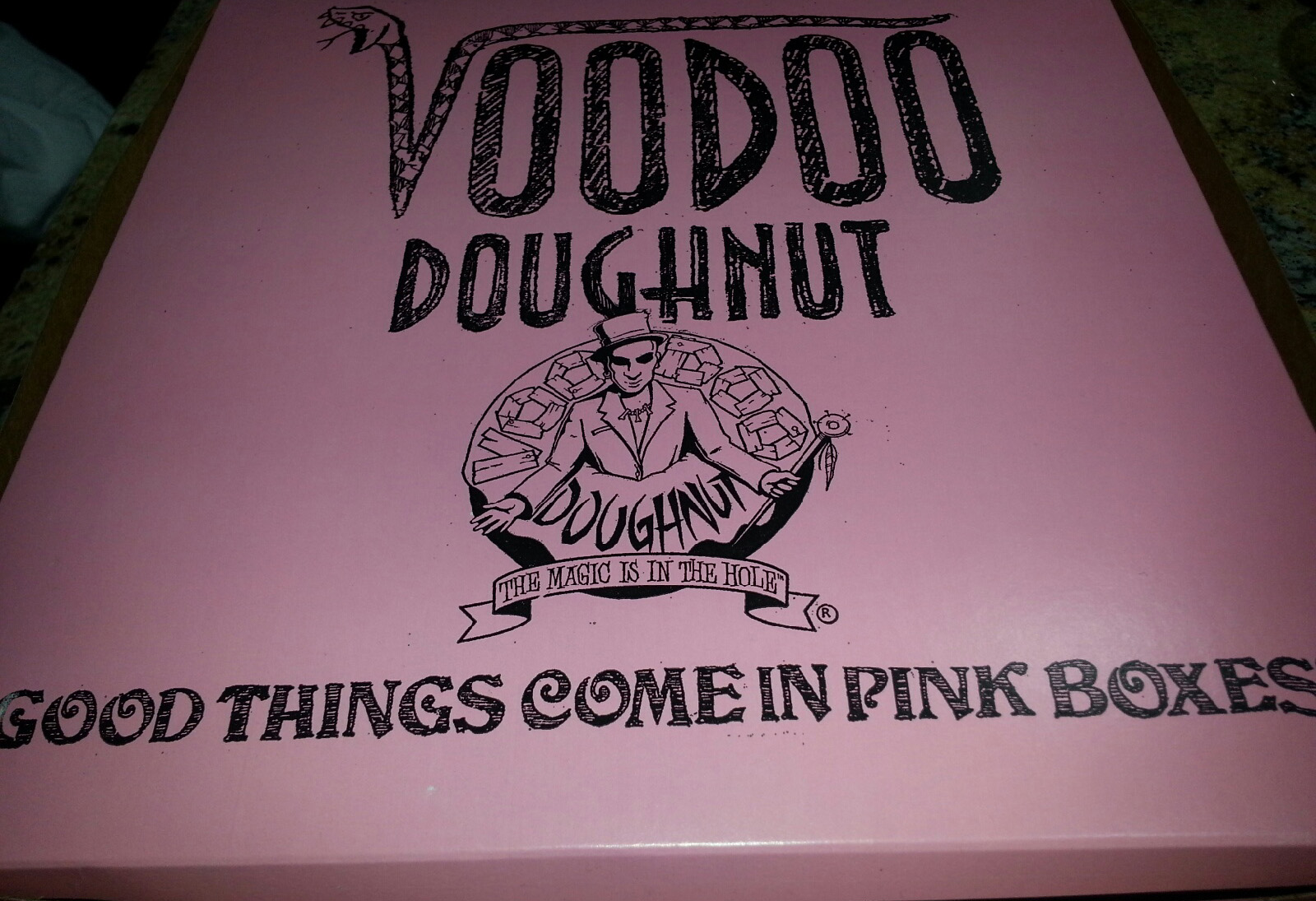
Mariana, our son Tim’s girlfriend, is wonderful for many reasons. Her most recent way into our hearts, and stomachs, was to walk into our house with a box of Voodoo Donuts. We don’t live in Denver, so these are treats I have only read about. Most of what I’ve read includes the lengthy lines involved in snagging a sugary dozen.
She explained that she didn’t have to wait long. In fact, she said, shortly after she got to the counter the line started to build, so she felt lucky. We did, too.

She ordered a Voodoo dozen, which meant that the choices were selected for her. That’s an interesting approach, but we all agreed we were pleased with the variety.
These are eye-catching, sweet-smelling goodies that are surprisingly light and airy. The toppings are uber-creative. Consider the Bubble gum-pink frosted raised donut that not only wafted images of big sticky bubbles, but included a piece of gum. This was too saccharine for me, but I did appreciate the ingenuity. Ditto on the Cocoa Puffs; this was never one of favorite cereals as a kid.
Since there were four of us sharing the donuts we democratically cut most into quarters so we had a couple bites of each one. Chocolate frosted raised donuts have always been one of my favorites and even though there is little to no originality involved, I loved it. Nonetheless, the buttermilk glazed donut was perhaps my favorite; I liked the double-chocolate a lot. I may need another dozen just to make sure.
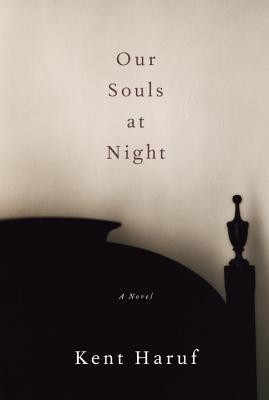
Our Souls at Night by Kent Haruf is best described as sweet. This terse novel was published posthumously, and its content makes me imagine that the author was in his final days when he penned it. This is a story of finding a way out of loneliness while believing that the opinions of others have little value or impact.
Addie Moore and Lewis Waters are widowed and living in the fictional town of Holt on Colorado’s eastern plains. This is Haruf’s preferred setting as many of his previous works have centered around this small communityand its residents. Anyone familiar with his writing will recognize names and places.
One day, Addie calls Lewis. They have known each other for years, but only peripherally. She wonders if he would like to spend the night. This is no brazen, immoral solicitation. It is one lonely heart reaching out to another.
Addie’s son and grandson figure into the narrative as does Lewis’s daughter. The townspeople make sure these adult children are aware of what their parents are doing.
Haruf provides a lot of detail such as teeth brushing and lawn care for someone trading in a scarcity of words (after all, the book is less than 200 pages long).
Unfortunately, the premise, which is touching and somewhat whimsical, overshadows the writing, which is too mundane to be enchanting. Anyone who has experienced a meaningful relationship (be it lover or friend) will appreciate the warmth drawn from conversations that happen just before sleep.
Our Souls at Night
Three bookmarks
Alfred A. Knopf, 2015
179 pages

For a minute forget that Elizabeth Gilbert wrote Eat, Pray, Love. It may take a little longer, but the idea is to not let this dissuade you from reading The Signature of All Things. Gilbert’s novel is as different from her memoir as ice milk is from ice cream. The latter is much richer and nuanced; it’s worth every moment of guilty pleasure spent under its grip.
Gilbert transports the reader from London, across the seas (on multiple occasions), and to Tahiti and Amsterdam. Philadelphia provides the lengthiest setting where the brilliant, unattractive Alma Whitaker is introduced to the world: her birth is literally the first sentence of this epic narrative. In Gilbert’s words, Alma’s childhood “was not yet noble, nor was it particularly interesting …” Thus, the focus turns, albeit temporarily, to Alma’s father, Henry Whitaker.
Henry stole his way out of poverty. He didn’t just acquire wealth, he attained knowledge and became a leading botanist and businessman. Alma’s mother, a stoic and harsh parent intent on fortifying her daughter’s intellect, also possessed a great mind and interest in botany.
Through humor, interesting botanical descriptions and strong, insightful characters, Gilbert creates a story that not only spans continents, but also scientific ideas along with notions regarding love and relationships. The vivid imagery of the various landscapes is a bonus.
Alma is a passionate character rich in curiosity (and foibles). Yet, despite the limits placed on her gender, she explores life in miniscule proportions and unexpectedly reveals its grand scale.
The Signature of All Things
Four-and-a-half Bookmarks
Viking, 2013
499 pages

The title of Kathleen Flinn’s experience at Le Cordon Bleu in Paris is what initially caught my eye: The Shaper Your Knife, The Less You Cry. These words are advice from one of her chef instructors as begins the first of three sections required to earn a diploma from the prestigious cooking school. The subtitle offered more foreshadowing than I would have liked, though: “Love, Laughter and Tears in Paris at the World’s Most Famous Cooking School.”
Flinn’s account combines her background, her romance and her Parisian education, which involved much more than cooking as she learned to navigate a new city with only un petit peu knowledge of French.
The book is divided into the three parts that correspond with the units at the school: Basic, Intermediate and Superior Cuisine. Flinn’s culinary undertaking is humorous, honest and, unfortunately, predictable. Of course she grows through this journey; of course she learned techniques that were as foreign as the language; and of course she is with the man of her dreams. The latter requires no spoiler alert; this is revealed early in the narrative.
Despite its predictability, Flinn gives an insider’s view of how the classes are taught, the types of people who enroll (not surprisingly from all over the world) and the friendliness of the French people. She also includes several recipes and even includes a menu guide for book groups. Fortunately, none require deboning a chicken or dealing with dead rabbit heads.
The Sharper Your Knife, The Less You Cry
Three-and-a-half Bookmarks
Penguin Books, 2007
278 pages


 The Blue Page Special