Archive for the ‘literature’ Tag

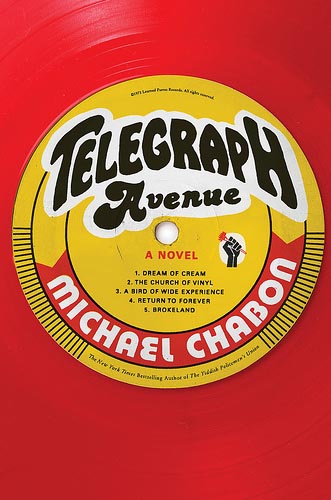
While wondering at the necessity, I marvel at the kind of concentration and craftsmanship it takes to write a single sentence that makes sense and holds interest as it spans 12 pages rife with characters, each distinctly different, who share a common struggle against fate, karma, some elusive and nebulous hand manipulating a game board with varying designs and obstacles; yet this engaging contest in Michael Chabon’s most recent novel, Telegraph Avenue, is played with swagger and fear by men, women and teenage boys fighting to hold onto dreams while desperately needing to relinquish the realities of their colorful lives.
I lack the skill, and inclination, to take a 100+ word sentence any further. Chabon can, but that’s the least of his mastery. Set in Oakland, his story about two men who run a (old school vinyl) record store in danger of being razed to accommodate a mega urban renewal project is a tribute to friendship, music and, oddly, especially family.
The novel is drunk with sensory images. Consider: “At 9:45 a.m. the first batch of chicken parts sank, to the sound of applause, into the pig fat.” Or: “… the loose weather stripping that peeped like a gang banger’s drawers from the seams around the back door.”
The major flaw lies in the glut of characters; initially, it’s difficult keeping track of who’s who. Nonetheless, it’s clear everyone, from actors to midwives, is just trying to get by in life while a poor economy, outdated technology and children get in the way.
Telegraph Avenue
Four Bookmarks
HarperCollins, 2012
465 pages

I was on the library’s waiting list for Gillian Flynn’s Gone Girl for months. When it was finally ready for me to check out, I was impatient to start reading. After mentioning this to a friend, her reaction was less than exuberant, it was baffling. After all, the novel was so popular there’d been hundreds ahead of me waiting for a library copy. It’s been on Publisher Weekly’s list of Best Hardcover Fiction for 15 weeks – and appears pretty comfortable there. I pressed my friend for more, but she held fast: we’d talk when I finished.
Gone Girl is a mystery on several levels, including how I spent time living with such unlikeable characters for the past week? The story follows the disappearance of Amy on her fifth wedding anniversary. By all indications, her husband, Nick, is responsible. Amy and Nick alternate as narrators. The book is divided into three sections. The first focuses on the disappearance, possibly abduction or possibly murder. Nick comes across as shallow and surprised, not upset, at his wife’s unexplained absence. He seems guilty, which is reinforced by Amy-as-victim told through diary entries.
The second and third sections of the book reveal much more about Amy’s ability to weave complicated webs of deceit. It’s not that Nick is suddenly less appalling, but Amy is more so. Flynn is a craftswoman. Her characters are fully developed as repulsive and intriguing. They’re also scary, always a good thing for a mystery, and I couldn’t look away. I need to talk to my friend.
Gone Girl
Four Bookmarks
Crown Publishers, 2012
415 pages
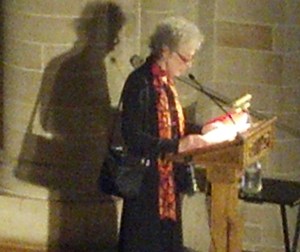
Usually, I’m not a Margaret Atwood fan. She makes it so difficult, through depressing stories and odd characterizations, to appreciate her wit, imagery and intellect. Reluctantly, I read The Year of the Flood. It was the choice for my book group, and the All Pikes Peak Reads 2012 selection. As part of the APPR festivities, Atwood spoke about sustainability and survival: two prevalent themes in her works.
Surprisingly, once I started reading I was anxious to continue. Although Atwood dismisses claims The Year of the Flood is a post-apocalyptic tale, nothing better describes it. The story takes place in a time when mutations, genetic engineering and an order of fear prevail. The flood refers to an unknown deluge caused by man’s errors and destructive predispositions. It is not a natural phenomenon; it’s a “waterless flood.”

God’s Gardeners is a small cult with a foundation in Christianity that celebrates the lives of such people as Rachel Carson and Euell Gibbons, among others, for the contributions they made to saving the environment. The Gardeners strive to protect nature and prepare for (and later survive) the flood. Within the cult, Toby and Ren, represent maturity and youth, respectively. Their narratives move the story forward. Atwood said she purposely incorporates multiple voices in her works because “I don’t like everyone to sound the same.” Toby is represented in third person, while Ren offers a first person perspective. The sermons of Adam One, the Gardeners’ leader, begin each chapter using second person voice.
I’m glad I read this and even more pleased to have heard Atwood speak. It provided insight into her work, but mostly served to demonstrate her keen sense of humor, which fortunately surfaces in this novel. A novel, by the way, which has, as Atwood stated, “A ray of hope.”
The Year of the Flood
Four Bookmarks
Anchor Books, 2009
431 pages

Similar themes, character types and unusual situations find their way to John Irving novels. His latest, In One Person, is no exception. Despite these commonalities, it’s an original look at acceptance and the secrets families hide in plain view, particularly when it comes to sex. The most covert issue is the sexuality of young Billy Abbott, the protagonist/narrator. Billy struggles with this; it’s also something family members have insight into but refuse to reveal – hoping they’re wrong. Yet all around him are mixed messages, from Billy’s loveable cross-dressing grandfather to the cruel teenage wrestling superstar. Billy’s story spans more than 50 years, and it’s clear his family’s hopes were dashed. Billy isn’t gay, he’s bi-sexual, but that’s not what they’re hiding.
Among the characters populating Irving’s novel are angry mothers (several), wrestlers (many), and transgenders (numerous, although Billy’s generation used the term transsexuals). A residential boys school in rural Vermont – another typical Irving element – is among the settings. Perhaps the strongest of the similarities is the power of friendship. Billy’s true friends are an eccentric bunch with shared worries. The complicated town librarian (my favorite character) probably knows Billy best.
The novel is like a one-sided conversation Billy has with the reader. Billy repeats some details, tells some things out of sequence and offers a few teasers. As in his other work, Irving’s irony and descriptive writing prevail.
A Prayer for Owen Meany is not just my favorite book by Irving, it’s one of my favorite books by anyone. In One Person is not on that pedestal, but it’s close.
In One Person
Four-and-a-half Bookmarks
Simon & Schuster, 2012
425 pages

James W. Hall writes crime thrillers and teaches college-level courses about popular
fiction, specifically bestsellers. Although it’s interesting, his recent nonfiction endeav-
or, Hit Lit subtitled Cracking the Code of the Twentieth Century’s Biggest
Bestsellers, reads like a textbook, but one likely to end up on the bargain table in a
bookstore.
The concept is intriguing: analyze 12 novels and identify the characteristics that
make them bestsellers. Included in the list is To Kill a Mockingbird, Gone
with the Wind, The DaVinci Code, The Exorcist, Valley of the Dolls,
The Godfather, The Dead Zone, The Firm, The Hunt for Red October,
The Bridges of Madison County, Peyton Place and, Jaws. I admit I’ve
only read six. Interestingly, the dozen were also made into popular movies – but
that’s another story. Hall, apparently stuck on the number 12, establishes that same
quantity of criteria to examine and actually makes a good case for why, say, Valley
of the Dolls struck a chord with so many readers. What might be even more worth-
while would be to compare these with less popular tomes. to me, the titles selected
by Hall are the equivalent of white bread. It’s easy enough to slap together a sand-
wich between two pieces of nutrition-lacking, tasteless slices, but there are so many
other varieties that go well beyond mere basic sustenance.
I can easily envision using Hall’s work in the classroom, with the caveat that the num-
ber twelve, both in the book selections and the characteristics reviewed, is not neces-
sarily a magic number.
Hit Lit
Two-and-a-Half Bookmarks
Random House, 2012
287 pages (includes index)

It doesn’t happen often, but occasionally after finishing a book I’m uncertain
how I feel about it. The Lifeboat by Charlotte Rogan leaves me ambivalent.
It’s an interesting premise: a group of 40 adrift after their ocean liner explodes
at sea. The year is 1914, so the event is sandwiched between the (unrelated) sink-
ing of the Titanic and the Lusitania.
Grace, newly married, is the narrator whose story is based on journals she is
asked by her attorneys to prepare after the fact. Perhaps some of my hesitance
to rave or rant lies in Grace. It’s clear as she relates how she came to marry her
her husband that she is a manipulator, if not an all-out gold digger. Few of the
characters act admirably in the adverse conditions, but remember Grace is tell-
ing the story. However, even she admits her memory is faulty, at best, from the
extreme conditions of being lost at sea for an extended period of time (at least
two weeks).
Where Rogan shines is descriptive writing: “The boat pitched and rolled as it
alternately climbed the foamy heights of the waves and then descended into hell-
ish troughs so that we were surrounded on four sides by walls of black water.”
It’s enough to keep me away from a boat of any size let alone one meant to save
lives.
Rogan’s boat is a metaphor for choices made and the motivation behind them.
The question I’m struggling to answer is if the idea’s strong enough to hold water?
Lifeboat
Three Bookmarks
Little, Brown and Co., 2012
278 pages
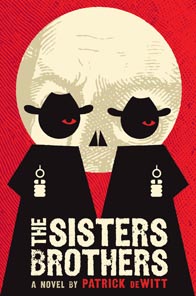
Just to be clear, The Sisters Brothers isn’t missing an apostrophe. The first time I saw
the title by Patrick DeWitt I was certain there was an error. I thought the book was about
the male relatives of sisters. That’s half right: brothers Eli and Charlie Sisters, but no
female siblings.
Set in the Old West, Eli narrates as he and Charlie, both professional gunslingers, embark
on their latest assignment: to find and kill an enigmatic miner. DeWitt’s depictions of time
and place are so strong you can practically smell smoke after the gunfights. Charlie is the
elder and angrier of the two brothers. Eli paints himself as a sensitive man, going so far as
to keep a horse he describes as “portly and low-backed and could not travel more than fifty
miles in a day…” even after he acquires a better, faster one. His reasoning: he felt sorry for
the old one. Strange stuff from a reputed bad guy.
Although his age isn’t mentioned, Eli is going through, if not a midlife crisis, at least a mid-
career one. He’s questioning his line of work. DeWitt injects humor into this western tale
about two men bound by blood and business, but separated by sensitivity and yearning.
Eli realizes he has missed out on many things including, a wife and family, because he has
knowingly ridden alongside Charlie. At one point, this realization even causes Eli to go on
a diet. Yup, mighty strange stuff from a reputed bad guy.
The Sisters Brothers
Four Bookmarks
HarperCollins Books, 2011
325 pages
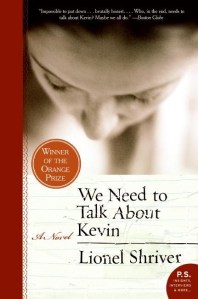
If you read Lionel Shriver’s We Need to Talk About Kevin be sure you have
someone with whom you can talk about it.
This disturbing, yet compelling, story unfolds through a series of letters written by
Eva to her absent husband, Franklin. The purpose of the letters is to try to under-
stand how their 15-year-old son, Kevin, could murder seven classmates, a teacher,
and a school cafeteria worker.
Through a clear almost detached, yet very personal, perspective Eva expresses the
difficulty she has in relinquishing her independence to become a mother. Following
Kevin’s birth, she continues to lack a natural maternal instinct. Still, Eva is not
without heartfelt emotion and empathy; she simply has difficulty showing these traits
to Kevin.
On the other hand, neither is Franklin completely blameless; although his side of the
story is not told. As seen through Eva’s eyes, Franklin maintains a vise-like grip on
the image of a happy, American family. His perception does not include discipline,
respect to others, or a recognition that there are two sides to every story.
Kevin is simply a bad kid, albeit an exceptionally bright one. The concept of uncon-
ditional love falters under Shriver’s pen. Parents are bound to examine their parent-
ing style and question whether it is the right approach. It is easy to be critical of
Eva and Franklin, but it’s hard to know if anyone else could have parented Kevin with
a different outcome.
We Need to Talk About Kevin
Three Bookmarks
HarperCollins, 2006
432 pages
(I wrote this review several years ago, but decided to post it here.)

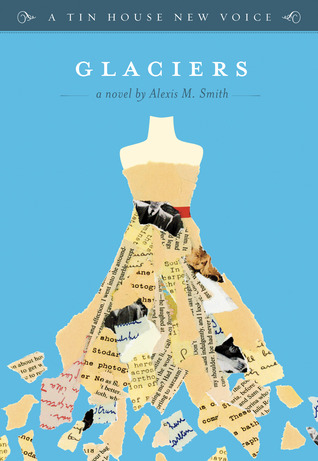
I hope the next book Alexis M. Smith writes will be much, much longer
than her debut novel, Glaciers. At only 174 pages it is obviously terse,
yet remarkably rich in detail with characters I wanted to spend a lot
more time with.
The storyline follows a day in the life of Isabel, a Seattle librarian who re-
pairs damaged books and whose primary interactions are with those who
are also somehow wounded. That may sound either dry or familiar (The Hours
comes to mind since Isabel plans to attend a party later that day), but Smith
writes in a lyrical, understated manner that is immediately enticing.
Isabel’s story takes place in less than 24 hours, but it is not confined to that
time frame. Her dreams, her family, and her childhood in Alaska are all beau-
tifully crafted to create a complex, sensitive woman with a penchant for vin-
tage clothing and old photographs. Isabel recounts her first trip to a thrift
store with her father who explained they were hunting for treasures. Initially,
the young girl is uncertain, even fearful she will miss the prize, until her father
says, “If you love it, you will treasure it, does that make sense?” The four-year-
old Isabel takes this to heart, and, ultimately, subtly applies the explanation
to everything from dresses to relationships.
Without giving anything away, one of Smith’s most impressive writing techniques
is the adroit manner in which she makes Glaciers Isabel’s story in more ways
than one.
Glaciers
Four and a half Bookmarks
Tin House Books, 2012
174 pages

What begins campy and comic book-like soon assumes a more serious tone about
familial dysfunction in Karen Russell’s Swamplandia! This enigmatic coming-of-
age story is set in Florida’s Everglades, where the harsh environment is full of danger-
ous creatures and rich in bittersweet memories for the Bigtree family.
Thirteen-year-old Ava Bigtree is the narrator for most of the novel; when the setting
switches to the nearby coastal town of Loomis, Russell narrates. Swamplandia! is the
name of the Bigtree family’s alligator theme park. When Ava’s mother, the main attract-
ion as an alligator wrestler, dies, the family disintegrates. Ava’s 16-year-old sister is in
love with a ghost; Kiwi, the older brother, leaves to work at the competing theme park
in Loomis; and Chief, the children’s father, leaves Swamplandia to look, he says, for
funding. Through most of the novel, Ava is the most level-headed, so when she shows
her age, it’s a good thing for the reader, but not so much for Ava.
This is one whopper of a tale, but Russell creates complex characters facing difficult
issues in their lives, not the least of which is dealing with the mother’s death. The back-
drop of the theme park and alligators provides some levity on one hand and heavy-duty
allegory on the other. Russell’s beautifully-written descriptions and sentence structure
are captivating. There are some laugh-out-loud moments countered by creepy events.
Several times I considered closing the book to stop what was likely to happen, but
needed to keep reading just in case I was wrong.
Swamplandia!
Four Bookmarks
Alfred A. Knopf, 2011
316 pages






 The Blue Page Special