Archive for the ‘family’ Tag
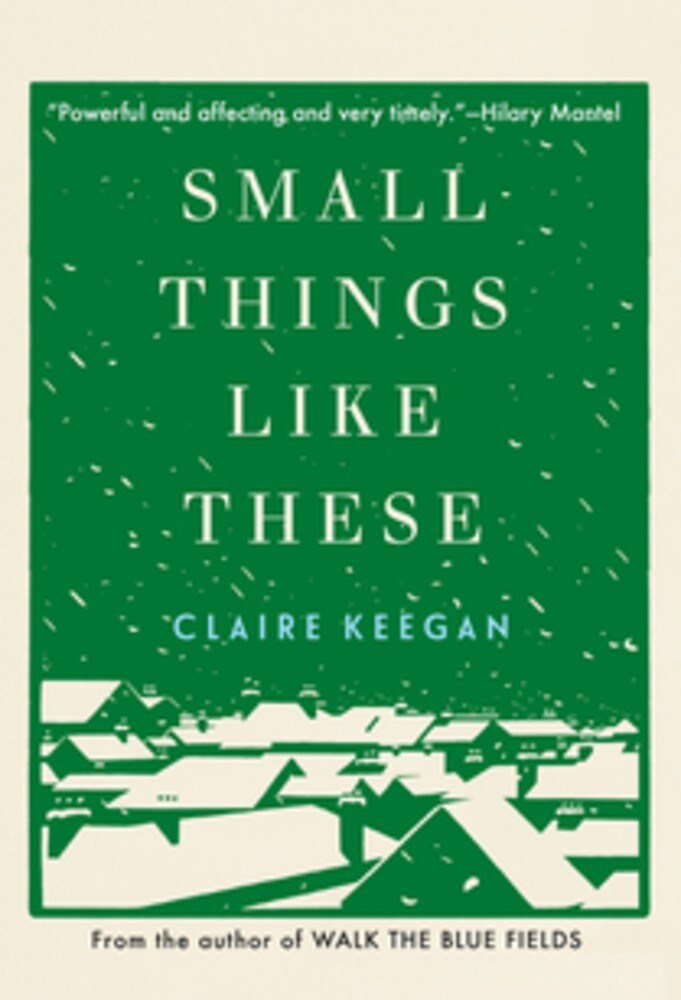
Silence is the same as complicity in Claire Keegan’s short, but impactful novel Small Things like These.
Bill Furlong was lucky; his unwed mother was allowed to stay on as a domestic worker throughout her pregnancy in the prosperous home of Mrs. Wilson, a protestant. The reference to this religion distinction is important.
The young boy grew up, knowing he was different, but also fully aware that he was loved and a beneficiary of the wealthy woman’s kindness. The only consistent male figure in his life was Ned, Mrs. Wilson’s farmhand. Through the years, Bill never learned the identity of his father, but later married and had four daughters.
The setting is a small Irish village during a particularly frigid Christmas season. As a coal merchant Bill is kept busy with deliveries, including one to the nearby convent. There he finds a young, pregnant girl locked in the woodshed. He’s deeply moved and this causes him to think about how often he wondered about his father particularly when he was young.
The terse, yet descriptive narrative is chilling – not just because of cold temperatures, but the unwritten awareness of the Magdalen laundries. Bill is keenly cognizant of all that he has and what life might have otherwise been for him and his mother.
This is a quiet, little, heartfelt work addressing hard life truths.
Small Things Like These
Four Bookmarks
Grove Press, 2021
118 pages, includes acknowledgements
Years ago I gave myself permission to stop reading if I couldn’t get into a book. I should have heeded my own consent with Among Friends by Hal Ebbot. I finished it, although with effort. I felt obligated because it was a book group selection.
The novel focuses on the long-standing friendships between two families: Amos, Claire and daughter Anna; Emerson, Retsy and daughter Sophie. Although from different social backgrounds, the men have been best friends for more than 30 years. Emerson and Claire, both come from privilege, have known each most of their lives. The teen girls have grown up together.
They’re together at Emerson’s country home in upstate New York to celebrate his 52nd birthday. Yet, something’s off; there’s an unstated, and apparently unusual, competition between the men.
Later, when Emerson finds himself alone with teenage Anna, something occurs that has the potential to change all their lives. Anna initially doesn’t tell her parents, but when she does they’re torn as to not only what to believe, but more importantly who.
The narrative then gets bogged down with too much about their pasts and it’s easy to question why they’re even friends.
Although Ebbott creates credible tension both with Anna and her parents, along with the adults’ responses, who care?! Retsy and Amos believe Emerson is capable of Anna’s claims; Claire’s ready to dismiss her daughter’s accusation and Emerson is certain he can manipulate the truth.
The characters aren’t people I’d want to know; reading about them was enough.
Among Friends
Two-and-half bookmarks
Random House, 2025
320 pages
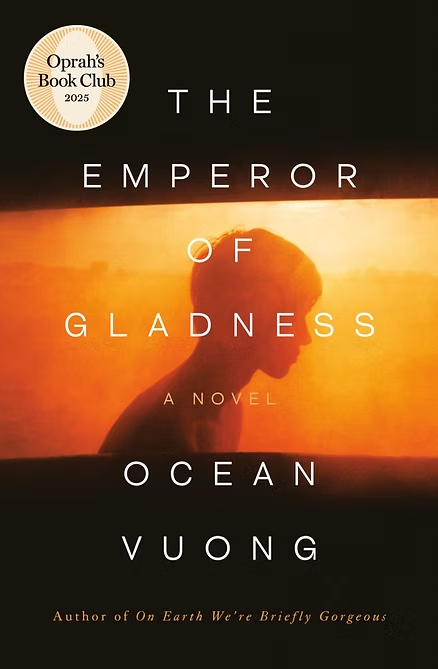
College dropout and drug addict Hai, is about to jump off a bridge in East Gladness, Conn., when he’s talked down by Grazina, an elderly widow, who then invites him into her nearby, rundown home. This is the beginning of Ocean Vuong’s novel The Emperor of Gladness. What ensues is a look at how creating a family can evolve from unlikely relationships.
Hai has lied to his Vietnamese mother about still being in school and, among other things, his sexuality. In fact, he elaborates telling her he’s in medical school. As his friendship with Grazina evolves, he becomes her unofficial caretaker, ensuring she talks her medications and helping her as she relives traumatic flashbacks from when she escaped the war in Lithuania. Nonetheless, she sinks deeper into dementia.
When it becomes clear the pair needs money, he joins his cousin Sony, like the electronics brand, who works in a fast casual restaurant with a group of misfits.
The characters, like the novel itself, are both sad and funny through their distinct personality quirks. Their desperateness is palpable. Sony, who is otherwise not exceptionally bright, is a Civil War savant. Sonny’s mother is in jail and he believes his father is living in Maine.
Vuong’s descriptions are vivid but occasionally longwinded. Despite the author’s colorful details, it’s easy to visualize the desolate town of East Gladness.
Hai’s co-workers at the restaurant are equally adrift, each with their own feelings of loneliness while they unknowingly search for connections.
The Emperor of Gladness
Four Bookmarks
Penguin Press, 2025
402 pages
Kalmann An Icelandic Mystery
by Joachim B. Schmidt
Kalmann Odinsson, 33, is a man with special needs man: mentally he hasn’t progressed beyond that of a six-year-old; he’s uncoordinated and socially awkward. He lives alone in the small town of Raufarhofn, Iceland, nearly 400 miles from the country’s capital.
Fishing is the primary industry and because of the small population, everyone knows everybody. Most are sympathetic to Kalmann who considers himself the town sheriff. He wears a cowboy hat and has a badge to prove it. He also carries an antique Mauser pistol.
For most of Kalmann’s life, his Grandfather was his constant companion, but the elder man was moved to a senior care facility in another town. Kalmann’s mother also moved away, but frequently checks in on her son.
The best times of his life were those times spent with his Grandfather, which helps explains why Kalmann is as self-sufficient as he is. Although he visits his Grandfather weekly, his absence is deeply felt.
The novel is told from Kalmann’s perspective which is both humorous and, at times, heartbreaking. When he discovers blood while hunting for an Arctic fox, a mystery unfolds. First, whose blood and where is the body?
Despite his limitations, Kalmann is often insightful; and perhaps because of them, he is also frustrated. This is similar to my reaction while reading. This is due largely to the novel’s pacing, which is, at times, laborious. In developing Kalmann’s character in such tedious detail, the author, unfortunately, lets the mystery at hand take the back seat.
Kalmann: An Icelandic Mystery
Bitter Lemon Press, 2022
301 pages
Three bookmarks
The Ministry of Special Cases by Nathan Englander is a gripping narrative about family, sacrifice and grief.
Although those elements are far from uplifting, Englander’s characters demonstrate the power of parental love and the ability to find inner strength where it once seemed impossible to exist.
Set in Buenos Aires during the time of Argentina’s Dirty War when people were “disappeared”, Kaddish Poznan is a ne’er do-well Jew, the illegitimate son of a prostitute. The sins of his mother taint all aspects of Poznan’s life. Only his wife, Lillian, tries to see his potential; but his son, Pato, despises him.
Poznan is always one scheme away from success; some are near brilliant and others simply far-fetched. His steady, albeit clandestine, work involves removing names on tombstones in the Jewish section of a cemetery for wealthy families wanting to stay under the regime’s radar.
When Pato disappears, Poznan and Lillian do everything possible to find him. Much involves needing large sums of money which leads to some humorous but agonizing situations for the parents. In their search for Pato, the couple ends up at the Ministry of Special Cases. This proves to be an exercise in futility thanks to the maze of bureaucratic red tape and ineptitude. All of this stumps Poznan, but motivates Lillian, which creates a rift between them.
Englander’s characters are vividly described as is the situation in Argentine at the time when thousands of people were killed or kidnapped by the country’s military leaving families ripped apart.
The Ministry of Special Cases
Four Bookmarks
Vintage International, 2007
339 pages
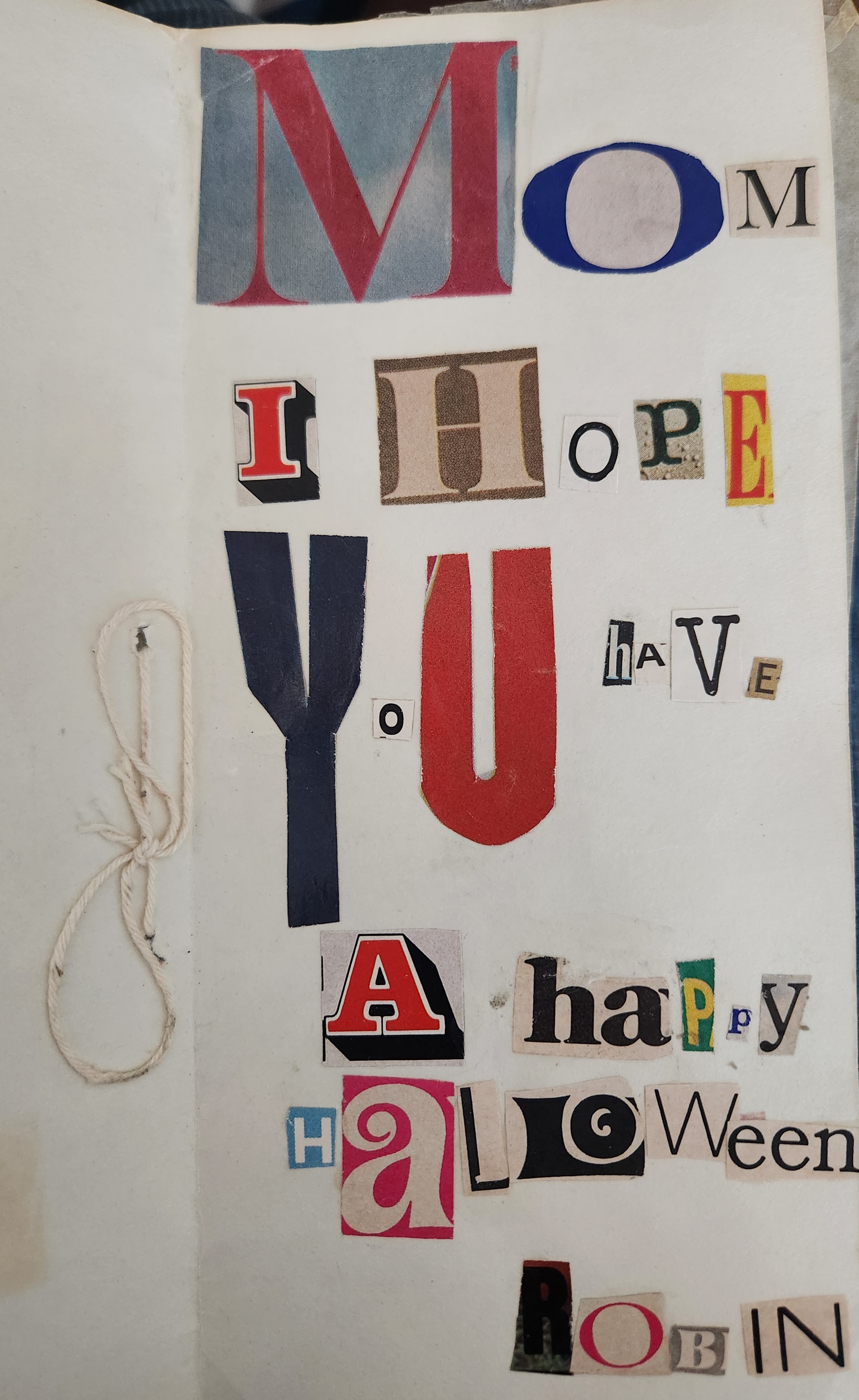
My mother died last week. In going through some of her papers I found letters I’d written her that she’d saved, along with some cards I made. Among the letters, one, in particular stood out, written when I was 25, which was a long time ago.
While reading it, I was struck by how much of the content had not changed. It was a thank you note, but not for anything materialistic. Rather, I thanked her for the wonderful qualities, ones she, wittingly or not, passed onto me. These included, but definitely weren’t limited to, instilling in me the importance of a sense of humor, independence, sensitivity, and the certainty of her love for me.
(In looking at the Halloween card I made, I realize she also imparted an appreciation for mysteries.)
My mom was also my closest friend. The only time I recall that not being the case was when I was 13. That age explains it all. Otherwise, we laughed a lot, shared details of our lives once I moved away from home as a young adult and ever since. We spoke by phone almost daily – until about six weeks before she died. Talking on the phone was difficult for her, so the conversations practically ceased. I think that’s when the grieving process started for me.
I was with her when she died. I’m glad that card wasn’t the only time I expressed my appreciation for all she gave me. I’m saddened I can’t keep letting her know.
It’s 1966 and young men are going off to war in Viet Nam; except they’re not alone. Young women go, too, which is the topic of The Women by Kristin Hannah.
Frankie McGrath volunteers for the Army Nurse Corps soon after learning her brother has been killed in the war. She is part of a field medical unit treating wounded soldiers. Many of whom can’t be saved. As her nursing skills get stronger so does her friendship with fellow nurses, Ethel and Barbara. She also falls in love with a naval pilot.
Dealing with the natural elements, seeking safety from enemy bombardments and never getting used to the carnage wrought by war is almost nothing compared to Frankie’s return to the States following two tours of duty.
Hannah’s descriptions of the attitude toward Viet Nam vets are heart wrenching because of their truth. This is compounded by the mindset held by many, including other vets, that there were no women in Viet Nam. Even Frankie’s father refuses to admit to his country club social circle that his daughter served in the war.
The novel is divided into two parts. The first focuses on Frankie’s naiveté and gradual realization that the situation in Viet Nam is uncompromising for those in its midst. The second section deals with her reintroduction to society vehemently opposed to the war without acknowledging its toll. Thankfully, Frankie’s nursing friends provide unending love and support as she fights her inner battles and struggles to move forward.
The Women
Four Bookmarks
St. Martin’s Press, 2024
470 Pages, includes Author’s note and acknowledgements
A book with few likeable characters such as Paula Hawkins’ A Slow Burning Fire, is difficult to recommend. Granted, the mystery element is strong with several suspects, but it almost doesn’t matter who-dunnit if there isn’t one for whom to root.
When the body of a young man, Daniel, is found brutally stabbed on a London houseboat the immediate suspect is Laura who was seen leaving his place covered in blood shortly before the body is discovered. Yet other suspects include Miriam who lived on the neighboring boat, and Carla, Daniel’s once-estranged aunt.
The back stories for these major characters factor into the present-day mystery. Laura was in a serious bicycle accident as a child and has dealt with anger management issues ever since.
Miriam is without friends or family. As a teenager she was abducted, and these many years later she remains a broken, unkind person.
Carla, the deceased man’s aunt, had a tenuous relationship with him based on guilt for how she treated his mother/her sister. Fifteen years earlier, Carla’s three-year-old son died while in the care of her sister. Her nephew discovered the child’s body.
Hawkins offers plenty of credible twists throughout, including several instances where it seems obvious, beyond a reasonable doubt who killed Daniel.
Laura is befriended by Irene, an elderly woman (who interestingly lives next door to Carla’s late sister’s home). For the younger woman, this is significant: Irene genuinely cares about her. Consequently, Irene is finally a character the reader can actually appreciate.
A Slow Burning Fire
Three Bookmarks
Riverhead Books 2021
306 pages
The Last Animal by Ramona Ausubel could easily be titled The Last Family because it’s about a mother and her teenage daughters trying to keep it together.
Jane is a paleo biologist, whose husband died in a car accident a year ago. Eve and Vera are 15 and 13, but wiser than most kids their age. This is, in part, due to their strong bond with each other and to tagging along with their parents on scientific expeditions around the world.
The novel is rich with humor and pathos as the trio treks to Siberia, Iceland and a private animal refuge in Northern Italy. As Jane becomes increasingly disappointed in her ability to be heard/seen as a legitimate scientist, the girls assume responsibility for her care. Grief fills all three as they move forward with their lives while making scientific and personal discoveries.
Part of which involves Jane’s theft of genetically-created embryos of a woolly mammoth, which are clandestinely inseminated into an elephant at the Italian refuge.
What ensue are questions of ethics, sexism and a family struggling for some semblance of normalcy. The latter is particularly difficult given the possibility of introducing an extinct prehistoric animal to the modern world.
Eve and Vera are remarkable characters even if, at times, difficult to consider realistic because they’re wise beyond their years, self-aware teens. They have enough sense to be skeptical of what the future holds, yet are naïve enough to hope for the best – attitudes worth emulating at any age.
The Last Animal
Four Bookmarks
Riverhead Books, 2023
278 pages
Presented as a coming of age tale, Go as a River by Shelley Read relies on the spirit of place while addressing romantic and maternal love. And, the author incorporates Colorado history.
Victoria Nash is 17 when she meets a drifter in her small town of Iola. This quickly evokes feelings she’s never experienced. Wilson Moon is not much older than Victoria but his wisdom and sensitivity captivate her. They embark on a brief, clandestine affair. He’s suspected of theft, although his only crime is being Native American in a mostly racist community.
When his body is found at the bottom of a gulch, Victoria suspects her brother of murder. However, her attention soon turns to dealing with her pregnancy. When she can no longer hide her swollen stomach, she runs away from the family peach orchard to hide in the nearby mountains.
Read’s descriptions of the land, Victoria’s feelings and determination to survive on her own are vivid Victoria endures harsh conditions alone, including giving birth. This, and coming upon a young family picnicking in the forest with whom she furtively abandons her son, make belief difficult to suspend.
The impending destruction of Iola, a consequence of the creation of Blue Mesa Reservoir is among the losses she carries the rest of her life. Yet, she moves forward. With assistance from a botanist and others, Victoria moves the peach trees to Paonia before Iola is submerged. And thoughts of the son she gave away remain close to the surface.
Go as a River
Spiegel and Grau, 2023
305 pages, includes acknowledgements








 The Blue Page Special