Archive for the ‘books’ Tag
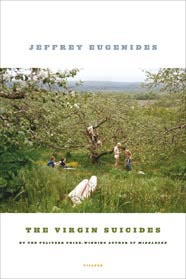
First published twenty years ago, The Virgin Suicides by Jeffrey Eugenides remains poignant and rich with dark humor. The account of the Lisbon sisters, whose mere existence – and ultimate demise – captured the attention of their entire community, is told in a plural form of the third person voice representing the neighborhood’s teenage boys. It’s not quite the “royal we” but is an interesting technique nonetheless.
Eugenides’s narrative takes place in a quiet Detroit suburb. Seasons are noted by references to fish-flies, fallen leaves and holiday lights. For the Lisbons, however, there are complications. The narrator(s) rely on observation and references to interviews conducted with other neighbors, teachers and clergy. Mention is also made of several “exhibits” which include medical reports and photographs.
The five sisters range in age from 13 to 17, and the youngest is the first to kill herself. It’s clear not just from this suicide which takes place early in the novel, but also from the title, that the others will follow suit. The narrators share this sense of the girls’ impending self-destruction. Eugenides masterfully creates tension, and toys with the reader suggesting the possibility that, perhaps, the girls will be unsuccessful.
However, this is not a work simply about teen angst with no way out. It is a coming of age chronicle and a love story. The narrator(s) are forever changed by their connection to the Lisbon family, but the impression is that would have been true even without suicide as part of the tale.
The Virgin Suicides
Four Bookmarks
Picador, 1993
243 pages
I took last week off; I read, I hiked, I ate too much, I slept some, I wrote a bit, but mostly I decided to take a break from the Blue Page Special. In the process, I discovered that I missed it.

I just finished reading Tell the Wolves I’m Home by Carol Rifka Brunt and can’t stop thinking about it. Although the writing doesn’t fall into the take-your-breath-away category, the story certainly does. I still want to spend time with the characters: June, a 14-year-old misfit; Greta, her super-achieving sister; Finn, their deceased uncle; and Toby, Finn’s lover.
June is devastated when Finn, her best friend, dies of AIDS. She struggles, then Toby enters her life, and she continues to flounder. Except now she has someone to help her keep Finn’s memory alive. Toby and Finn lived together and, even though she spent a lot of time in their apartment, June never knew about Toby. This aspect has the potential to be implausible; instead, it enhances June’s character as a naïve teenager. Another potentially hard-to-believe feature is the bond that develops between the young girl and the thirty-something Toby. Remarkably, there is never anything creepy or uncomfortable about it. This is largely due to their love for Finn, and the tentative manner in which their friendship evolves. Equally important is the sisters’ relationship.
Brunt masterfully creates relationships that are rich, painful, and grow before our very eyes. The novel is about friendship, first loves, misplaced jealousy and sibling relationships. Set in the mid 1980s, AIDS has just begun to make itself felt in American culture. Yet, that is simply a background element. This is a coming-of-age story that considers the way people change based on age, interests, opportunities, and circumstances.
Tell the Wolves I’m Home
Four-and-a-half Bookmarks
The Dial Press, 2012
355 pages

When our boys were little, and not so little, we read to them. Often, that wasn’t enough for our middle son, Tim, who insisted on a special story as he was tucked into bed each night. These were the Tim Stories, and each one always began the same way: Once upon a time there was a little boy named Tim whose parents loved him very much…
I don’t remember when the Tim Stories stopped, but the reading aloud continued for many, many years. We read at night. We read in the car on road trips. We read on camping trips, in tents when it rained or by the campfire with the help of a flashlight when it was clear. We read series written by C.S. Lewis, Lemony Snicket and J.K. Rowlands. Heck, we had a book we read during dinner for a while. It was a fun one about manners (Do I have to Say Hello by Delia Ephron). We read a lot out loud.
Reading has always been hard for Tim. Although he struggled with it in school, he developed some great strategies. He is an excellent listener, he discovered books on tape, and he learned to ask questions for clarification, for help. He studied with tutors. He worked more than his brothers, harder than his friends or anyone else around.
This week Tim graduates from college — early. And, he still knows a good story when he hears one: Once upon a time there was a young man named Tim whose parents love him very much…
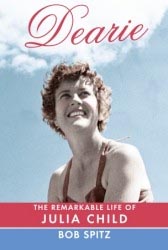
Any foodie worth his or her cookware will want to read Bob Spitz’s Dearie: The Remarkable Life of Julie Child. Even if you’ve already savored your way through other biographies, memoirs or the film Julie and Julia, this is a must-read. At 500+ pages the book may seem daunting, but Spitz’s writing is conversational and personal; his respect for his subject is clear.
And why not? Her contribution to food culture notwithstanding, Julia Child was an intelligent, loving, enthusiastic woman. For much of her early life, food was just sustenance. She didn’t start cooking, or truly enjoying meals, until she was in her late 30s; once she did, she never stopped.
The biography is told chronologically, except for the prologue. Here the author describes the scene at WGBH in Boston just before Child makes her first television appearance where she cooked an omelet using a hot plate. From there, Spitz tracks everything including her privileged childhood in Pasadena, Calif., life in the Office of Strategic Services outposts, her marriage to Paul Child, and her almost-accidental love affair with food. The most interesting aspects are those that show her as a woman filled with a joie de vie and the ability to change with the times.
Spitz did extensive research to tell Child’s story. The result is a portrait of an unlikely leader in the early days of the food awakening in the United States. Her television shows, her cookbooks, even the parodies of her, contributed to the word “foodie” becoming part of our everyday vernacular.
Dearie: The Remarkable Life of Julie Child
Four-and-a-half bookmarks
A.A. Knopf, 2012
534 pages

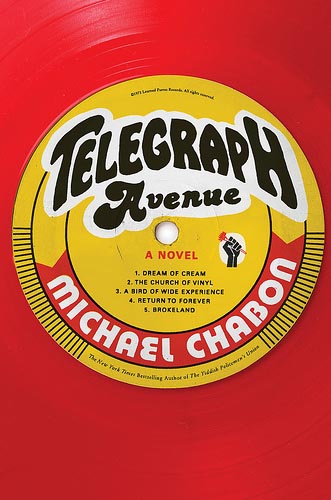
While wondering at the necessity, I marvel at the kind of concentration and craftsmanship it takes to write a single sentence that makes sense and holds interest as it spans 12 pages rife with characters, each distinctly different, who share a common struggle against fate, karma, some elusive and nebulous hand manipulating a game board with varying designs and obstacles; yet this engaging contest in Michael Chabon’s most recent novel, Telegraph Avenue, is played with swagger and fear by men, women and teenage boys fighting to hold onto dreams while desperately needing to relinquish the realities of their colorful lives.
I lack the skill, and inclination, to take a 100+ word sentence any further. Chabon can, but that’s the least of his mastery. Set in Oakland, his story about two men who run a (old school vinyl) record store in danger of being razed to accommodate a mega urban renewal project is a tribute to friendship, music and, oddly, especially family.
The novel is drunk with sensory images. Consider: “At 9:45 a.m. the first batch of chicken parts sank, to the sound of applause, into the pig fat.” Or: “… the loose weather stripping that peeped like a gang banger’s drawers from the seams around the back door.”
The major flaw lies in the glut of characters; initially, it’s difficult keeping track of who’s who. Nonetheless, it’s clear everyone, from actors to midwives, is just trying to get by in life while a poor economy, outdated technology and children get in the way.
Telegraph Avenue
Four Bookmarks
HarperCollins, 2012
465 pages

I was on the library’s waiting list for Gillian Flynn’s Gone Girl for months. When it was finally ready for me to check out, I was impatient to start reading. After mentioning this to a friend, her reaction was less than exuberant, it was baffling. After all, the novel was so popular there’d been hundreds ahead of me waiting for a library copy. It’s been on Publisher Weekly’s list of Best Hardcover Fiction for 15 weeks – and appears pretty comfortable there. I pressed my friend for more, but she held fast: we’d talk when I finished.
Gone Girl is a mystery on several levels, including how I spent time living with such unlikeable characters for the past week? The story follows the disappearance of Amy on her fifth wedding anniversary. By all indications, her husband, Nick, is responsible. Amy and Nick alternate as narrators. The book is divided into three sections. The first focuses on the disappearance, possibly abduction or possibly murder. Nick comes across as shallow and surprised, not upset, at his wife’s unexplained absence. He seems guilty, which is reinforced by Amy-as-victim told through diary entries.
The second and third sections of the book reveal much more about Amy’s ability to weave complicated webs of deceit. It’s not that Nick is suddenly less appalling, but Amy is more so. Flynn is a craftswoman. Her characters are fully developed as repulsive and intriguing. They’re also scary, always a good thing for a mystery, and I couldn’t look away. I need to talk to my friend.
Gone Girl
Four Bookmarks
Crown Publishers, 2012
415 pages

I wasn’t sure if I wanted to wait to acknowledge the first anniversary of The Blue Page Special next month, or do a shout out for this my 100th post. Then I thought, hey I can do both — if I want. It’s a cool milestone: 100 posts. Along the way I’ve experienced some great and not-so-good books and meals, discovered new blogs and learned more about myself.
Mostly, I’m grateful for my readers. Some are family members; many are people I’ve known for years and still others are new-found friends who simply share a common interest in books and/or food. I must admit, though, I was thrilled when the number of followers I’ve never met began to slowly (very slowly) surpass those I know personally. This is not meant to disparage my friends, because I appreciate your support more than I can express. Rather, it’s just an odd sense of validation.
I’d love to be able to make a living writing about books and food, or just books, or just food. Instead, I teach at a community college (something I enjoy a lot), read as much as possible (something essential in my life), dine out more than I should (something I find exceptionally enjoyable), and love my family (something self-explanatory). Although only one of those helps pay any bills, my blog has made me more disciplined in my writing and my readers have made me want to be as creative, honest and as worthy of your time as possible. Thanks for being part of the ride.
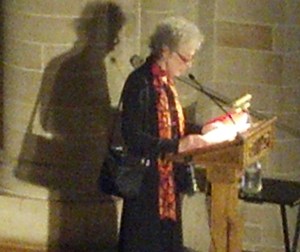
Usually, I’m not a Margaret Atwood fan. She makes it so difficult, through depressing stories and odd characterizations, to appreciate her wit, imagery and intellect. Reluctantly, I read The Year of the Flood. It was the choice for my book group, and the All Pikes Peak Reads 2012 selection. As part of the APPR festivities, Atwood spoke about sustainability and survival: two prevalent themes in her works.
Surprisingly, once I started reading I was anxious to continue. Although Atwood dismisses claims The Year of the Flood is a post-apocalyptic tale, nothing better describes it. The story takes place in a time when mutations, genetic engineering and an order of fear prevail. The flood refers to an unknown deluge caused by man’s errors and destructive predispositions. It is not a natural phenomenon; it’s a “waterless flood.”

God’s Gardeners is a small cult with a foundation in Christianity that celebrates the lives of such people as Rachel Carson and Euell Gibbons, among others, for the contributions they made to saving the environment. The Gardeners strive to protect nature and prepare for (and later survive) the flood. Within the cult, Toby and Ren, represent maturity and youth, respectively. Their narratives move the story forward. Atwood said she purposely incorporates multiple voices in her works because “I don’t like everyone to sound the same.” Toby is represented in third person, while Ren offers a first person perspective. The sermons of Adam One, the Gardeners’ leader, begin each chapter using second person voice.
I’m glad I read this and even more pleased to have heard Atwood speak. It provided insight into her work, but mostly served to demonstrate her keen sense of humor, which fortunately surfaces in this novel. A novel, by the way, which has, as Atwood stated, “A ray of hope.”
The Year of the Flood
Four Bookmarks
Anchor Books, 2009
431 pages

I don’t know what it is that makes me crave Scandinavian crime fiction, but I’m addicted. Sweden’s Hakan Nesser’s Mind’s Eye fed my habit, but I know I’ll need more soon. Nesser is a master storyteller whose pacing is neither rushed nor sluggish. The crime scenes aren’t too gruesome and the clues are well hidden. He even manages to throw humor into the mix.
The story begins with Janek Mitter awakening from a drunken stupor only to find his wife drowned in the bathtub. Mitter’s too easy a suspect, but is, nonetheless, tried and convicted before things take a turn and get exciting: Mitter, too, becomes a victim. That’s where Chief Inspector Van Veeteren, a middle-aged investigator with an attitude, comes in. His success rate at solving crimes is impressive. He had early doubts about Mitter’s guilt, but not soon enough.
I had a fairly good idea about who the actual killer was, but was not prepared for why. Van Veeteren knows who but won’t name names because, as he tells a subordinate, “… there has to be a story,” in other words a reason. Nesser’s characters develop slowly, and in an interesting manner. Many chapters begin with stream of consciousness narration and it is unclear who’s doing the thinking. This only enhances the element of suspense. Eventually, it gives way to very clear identities and perspectives.
This is the first of Nesser’s Van Veeteren mysteries. I can’t wait for my next fix, I mean the next installment. Fortunately, Nesser has several.
Mind’s Eye
Four Bookmarks
Pantheon Books, 2008
278 pages

Even if you aren’t necessarily a fan of Patti Smith or Robert Mapplethorpe, Smith’s memoir, Just Kids, is more than an autobiographical look at the relationship between the two artists. It also examines life and culture in the late 1960s and 1970s.
I’m just young enough that Smith was never on my radar when I was growing up. And, I’m just old enough to be aware of the controversy caused by a retrospective of Mapplethorpe’s work with the National Endowment for the Arts – long after his death. I might have skipped this book if not for a friend’s recommendation. I read it, and I’m glad.
Smith and Mapplethorpe met and lived together in New York City when they were kids (twenty-year-olds) at a time when the underground music and art scenes were beginning to materialize. Their timing was perfect: she became part of the former and he part of the latter. Their paths crossed with the likes of Jimi Hendrix, Janis Joplin, Todd Rundgren, Sam Shepard, Andy Warhol and many others.
Just Kids reflects the impressive strength of friendship Smith and Mapplethorpe created with one another. This is a love story, even though each went on to have different partners; it’s also Smith’s homage to her late friend and the era in which they emerged. Her voice is honest and unrestrained. It’s easy to imagine the romance of their early lives as they lived hand-to-mouth, meeting other up-and-coming artists all while discovering their own artistic personas.
Just Kids
Three-and-a-half Bookmarks
HarperCollins, 2010
283 pages






 The Blue Page Special