
I’m usually not drawn to apocalyptic novels, but Emily St. John Mandel’s Station Eleven is so much more than a foreboding tale about a small group of people who survive a pandemic. It’s also about getting through the trials of what we might consider the normal elements of life: existence before the disaster. She blends the backstory of the half dozen characters she masterfully introduces with their lives following the devastation; and it works!
The story follows the characters whose lives shared parallel paths with Arthur Leander, a famous actor, and which orbit around the fall of society. Unrelated to the flu that kills most of the world’s population, Arthur dies of a heart attack. Nonetheless, he remains a substantial character as viewed by those who knew him: one of his ex-wives, his best friend, a young girl who watches him die and the man who tries to save him. Another ex-wife and Arthur’s son have important, albeit tangential, roles. Each character is connected to Arthur, although they don’t all intersect with one another.
St. John Mandel creates a bleak, but not black and white picture, which is often the case in similarly-themed novels. Cormac McCarthy’s The Road comes to mind as a portrayal of a dismal post-catastrophe world. Sure, there is plenty of anarchy and death in Station Eleven, but somehow they don’t overshadow the power of friendship, love and art.
The author deftly illustrates that fear and loss exist before and after the collapse of civilization – as does hope.
http://www.emilymandel.com/bio.html
Station Eleven
Five Bookmarks
Alfred A. Knopf, 2014
352 pages
 I recently returned to enjoy dinner at Scarpetta in Bevery Hills. It was as good as I remembered, although I think one element was even better: the service.
Our server, Christian, enhanced our meal with his knowledge of the menu and attentiveness. He knew the ingredients, the preparation and offered to make changes if needed.
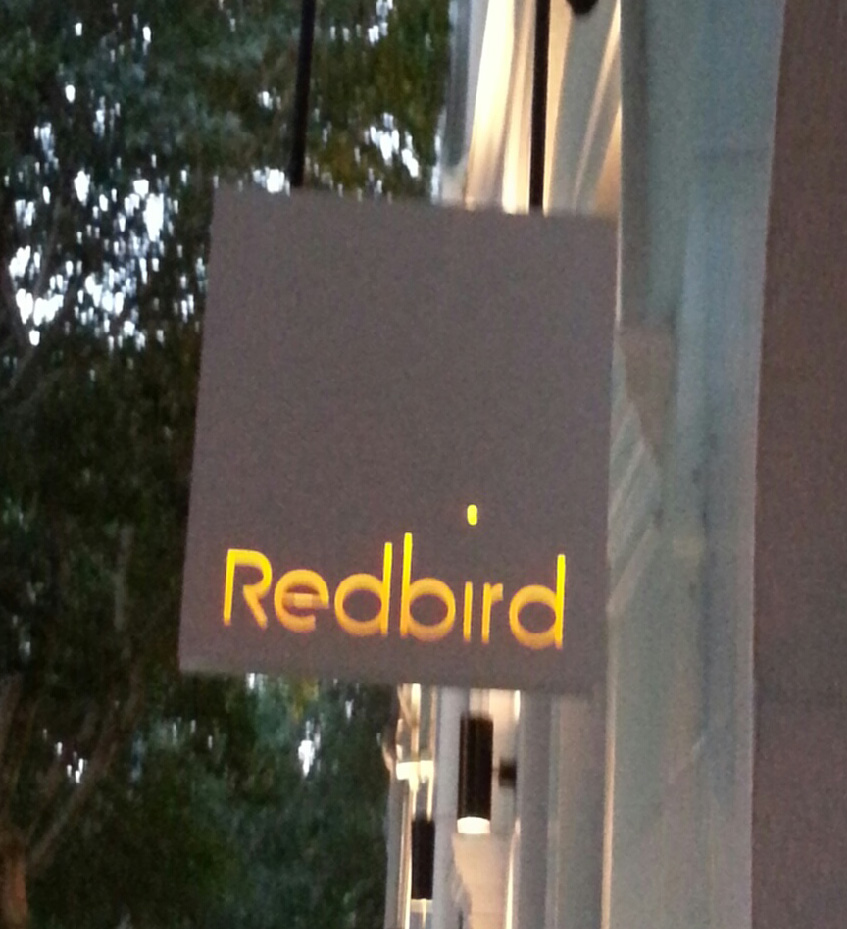
The next evening we dined at Redbird, the new restaurant in what was once the rectory of St. Vibiana’s in downtown Los Angeles. The press about chef/partner Neal Fraser’s new digs has made getting a reservation feel like winning the lottery. However, thanks to the service, we didn’t feel victorious.

Our questions about the menu were answered by our (nameless) server rote-style stating what we could read for ourselves. A few items were unknown and he did fill in those gaps, but without the passion Christian radiated at Scarpetta.
I ordered Ora King Salmon served with roasted beets, farro verde and pomegranate. The fish featured the most beautifully-crisped skin I’ve ever tasted. However, the farro was ripe with the distinct infusion of goat cheese. Had I known, I would have made another choice or at least requested a different side dish. Half the fish and beets were gone by the time our server returned to check on us. It was evident I wasn’t eating the farro.
I inquired about the offending ingredient and the server needed to check with the kitchen. He returned praising my discerning palette — admittedly, it wasn’t much of a stretch. I continued to enjoy the fish, which, again, was cooked to perfection. A manager offered apologies, explaining that staff is trained to ask about dietary restrictions. My dislike of goat cheese is based on personal preference; I can’t, in good conscience, call it a restriction. At that point it appeared it was my fault for not informing the server of my aversion. Even if I had, he hadn’t been aware of its presence. I was offered another side, but at this point my entrée was nearly consumed.

A friend suggested a complimentary dessert. That didn’t happen. Instead, the farro was boxed up for me to take home. I’m confident Christian would have handled things much differently.
Scarpetta Redbird
225 N. Canon Dr. 114 E. 2nd St.
Beverly Hills Los Angeles

In her debut novel, An Untamed State, Roxane Gay serves up a brutal story about cruelty, survival and love. In the process she’s created haunting characters who don’t easily disappear from the mind’s eye — even days after putting down the book.
While vacationing in Haiti to visit her parents, Haitian American Mireille Duval Jamison is kidnapped just outside the gates of their well-heeled estate. Her husband, Michael, and young son are threatened, but it’s Miri the kidnappers want for the ransom she’s likely to bring. What they have no reason to expect is her father’s steadfast and misguided refusal to ante up. Nor can they have any clue regarding Miri’s tenacity to survive.
Gay tells the story in two sections. The first includes the kidnapping and Miri’s past: how her parents came to leave their island home only to return years later having led successful lives in the U.S., as well as how Miri and Michael fell in love. A particularly moving section recounts Miri’s care of her mother-in-law and the evolution of that relationship from tolerance to respect and even friendship. This plays a significant role in the novel’s second section which comes after Miri is released from her 13-day ordeal. There’s no need for a spoiler alert, since the beginning of the story reveals as much.
Gay doesn’t temper her descriptions of Haiti’s poverty or of the brutality inflicted by the captors. Miri’s pain, fatigue and even filth are tangible. So is her despair.
An Untamed State
Four Bookmarks
Black Cat, 2014
367 pages

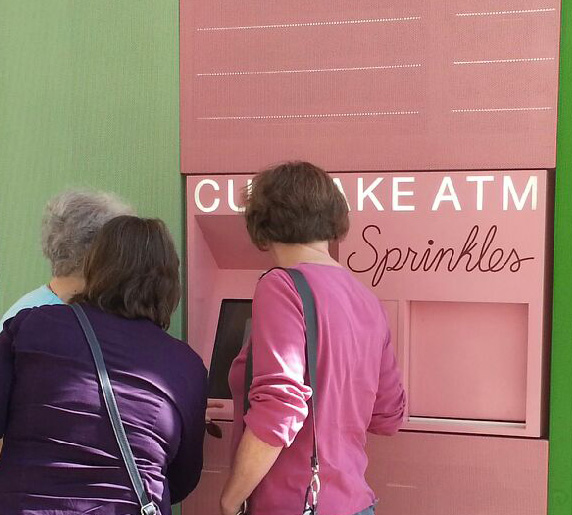
I used an ATM for the first time on a recent visit to California. It’s not because I haven’t seen them before or had a need for cash at an odd time of day or night. I just have an inexplicable aversion. The ATM I recently used was for cupcakes! I’ve wanted to try Sprinkles Cupcakes ATM in Glendale at the Americana shopping area for quite a while. The ATM experience was fun, but the cupcakes were unsatisfying.
Sprinkles has been a mainstay in the cupcake world for a decade with shops around the country. I’ve enjoyed their small frosting-laden cakes in Beverly Hills and New York City. Cupcakes are one of my favorite foods. I like their compactness, the ratio of cake to frosting and the creativity of flavors many bakers incorporate.
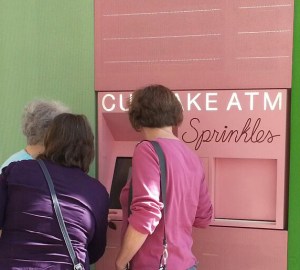
It all begins at the ATM’s touch-screen that reveals a menu with several flavor options, including Red Velvet and a few gluten-free varieties. I know the Red Velvet is rich and moist, but decided to try something new: peanut butter and chocolate. We also ordered Double Chocolate, Marshmallow Chocolate and Black and White. Four is the maximum number per order. With a quick swipe of the credit card, within minutes four separate boxes containing the baked goods are ready for retrieval.
My choice was underwhelming. It was dry and the amount of frosting was disappointing. The other flavors were fine, but I regret not ordering the Red Velvet. Guess I’ll have to give the cupcake ATM another try.

Sprinkles Cupcakes
629 American Way, Glendale, Calif.

Anthony Marra’s A Constellation of Vial Phenomena demonstrates that families are often created by need, proximity and shared experiences – sometimes more than bloodlines.
Marra writes of worn-torn Chechnya. More accurately, his story involves the newly-formed family of Akhmed, Havaa and Sonja, three genetically-unrelated characters whose lives intersect because of friendship, obligation and fate.
Moving back and forth between 1994 and 2004, Marra details the poverty and fear of those living in a small Chechen village. Eight-year-old Havaa is rescued by Akhmed, a long-time family friend, when the girl’s father is “disappeared” by military authorities.
Akhmed, a third-rate physician, takes the child to the city hospital 11 kilometers away. There, he convinces Sonja, a surgeon, in charge of the facility to keep Havaa. In exchange, Akhmed offers his medical services, which prove to be lacking.
The novel’s beauty is Marra’s writing. The people and landscape are bleak, and are vividly portrayed. Yet hope surfaces in spite of the harsh conditions. Havaa is optimistic about her father returning; Akhmed hopes he can keep the child safe; and Sonja needs to believe that her younger sister, Natasha, is still alive. Hope also makes cameo appearances when Marra foretells characters’ futures. At first this is done with incidental players, then minor ones and finally those about whom the reader cares most.
Trying to understand the historical context of Chechnya is confusing. Fortunately, Marra’s emphasis is on a handful of characters, each who do what it takes to survive while trying to remain true to themselves.
A Constellation of Vital Phenomena
Four Bookmarks
Hogarth, 2013
384 pages

Trends are like appetites, which is particularly true in the food industry. Sometimes we binge, sometimes we graze, sometimes we walk away when we’ve had enough. New food treats show up for our palates to enjoy, extol and, eventually, outgrow.
In an engaging and intelligent manner, David Sax examines food trends in his book, The Tastemakers: Why We’re Crazy for Cupcakes but Fed Up with Fondue. There are foods that are hip, inspire copycat versions and subject to whims. In other words, the popularity of some foods depends on more than taste. Sax quotes a trend forecaster who says, “If you can Google a trend, you’ve completely missed the trend.”
Culture, economics, politics and marketing are among the areas Sax addresses. He incorporates humor with extensive research that took him coast to coast interviewing food truck owners, a heritage rice grower, goat farmers and Baconfest organizers, among many others.
Sax often seems as baffled by some food trends as the rest of us, especially when he writes about the Summer Fancy Food Show sponsored by the Specialty Food Association. As if describing the Academy Awards or Golden Globes, Sax puts the reader at this annual event where new foods are introduced and their purveyors cling to the possibility that theirs (anything from iced rice tea to beer-flavored crackers, and more – much, much more) will take the spotlight on America’s plates and napkins.
Sax’s research is thorough, but it’s no surprise that food trends are difficult to anticipate.
The Tastemakers: Why We’re Crazy for Cupcakes but Fed Up With Fondue
Four Bookmarks
PublicAffairs, New York, 2014
318 pages, including index and selected bibliography

I enjoyed Orange is the New Black, the book by Piper Kerman. I haven’t seen the Netflix series of the same name, but after reading Kerman’s account I’m now inclined to watch because Kerman’s account intrigued me.
The author, privileged and intelligent (except for the episode in her life that landed in her prison), writes about her year in a minimum security facility in Danbury, Conn. She is honest about her own fear at being incarcerated and the guilt she has for vicariously putting her family, fiancé and friends through her ordeal. Yet, she does so without self-pity, with humor and insightful respect for most of her fellow inmates.
It’s the latter that particularly garners the reader’s attention and doesn’t let go. Kerman learned to survive thanks in large part to the women around her. It’s no surprise that Kerman would undergo a transformation, but perceptions about prisoners and their crimes do, too. Although it wasn’t an easy 12 months, Kerman shares moments of fun, revelation, pride and friendship – in addition to the aforementioned guilt.
Of course, hers is not a summer camp experience, but neither is it as brutal as initially anticipated. At least that’s the case while in Connecticut. This changes, though, when just before her release she is transferred to Chicago to await testifying in a related trial. There she confronts the woman who years earlier revealed Kerman’s name to authorities. Nonetheless, the author’s honesty and humor make this a worthwhile read.
Orange is the New Black
Four Bookmarks
Spiegel & Grau Trade Paperback, 2013
302 pages
http://piperkerman.com/

The Book of Unknown Americans by Cristina Henriquez is a timely read with the issue of immigration never far beneath the political surface. Yet, the novel isn’t about politics, but people.
Arturo and Alma leave Mexico for Delaware because they want to do more for their teen-aged daughter, Maribel, who suffered a brain injury. They believe she’ll benefit in a better school. They’re not illegals; they have work visas. Each chapter is told from one of the character’s perspectives, some in greater detail than others; only never Maribel’s.
Woven in with the challenges of living in a new land with a new language is the relationship that develops between Maribel and Mayor.
Sixteen-year-old Mayor Toro lives in Maribel’s apartment building; his parents left Panama when he was less than a year old, but he’s never fit in. From Mayor’s perspective, Henriquez writes: “The truth was that I didn’t know which I was. I wasn’t allowed to claim the thing I felt and I didn’t feel the thing I was supposed to claim (Panamanian).”
This sums up the experience of those introduced in the book. Henriquez has created a montage of immigrants: from Mexico, Panama, Puerto Rico, Guatemala, Nicaragua, even Venezuela and Paraguay. These places are all part of the Americas, which is what makes the title so appropriate with its double entendre. In brief, compelling chapters, among those told in Alma and Mayor’s voices, the neighbors share their pasts explaining why they left their native countries for the U.S.A.
The Book of Unknown Americans
Four Bookmarks
Alfred A, Knopf, 2014
286 pages

Although I read a lot, it’s been a while since I held a book I didn’t want to put down. Even at 500-plus pages, I hated to turn the final one of Anthony Doerr’s All the Light We Cannot See. Doerr is garnering a lot of well-deserved attention including being named a finalist for the 2014 National Book Award and #1 New York Times bestseller.
This story is about hope and connections, those that are tangible and those we simply know exist. Marie-Laure, a young girl in Paris, is blind. Her story is told in turns with that of Werner, a German mining town orphan with an aptitude for science and gadgets. The novel jumps around the years just before WWII and during the August 1944 bombing of Saint-Malo on the French coast.
From the onset, there’s a sense the two youths will meet, but how and when leave much to the imagination. Werner builds a small, crude radio from scrap parts. This ability ultimately earns him a spot in Hitler’s army. Marie-Laure relies on her father who builds small models to recreate, first, their Parisian neighborhood and later Saint-Malo where they flee. The hand-crafted items are meant to aid communication with good intentions in a world rife with evil.
Doerr’s work is easy to embrace for its vivid descriptions of the kindness and fear individuals extended or induced during the war. Mostly, though, the characters are so finely fashioned that they come alive in the mind’s eye.
Five Bookmarks
All the Light We Cannot See
Scribner, 2014
530 pages

Once I was able to get beyond the similarities, of which there are many to the 1977 movie The Turning Point, I found myself enjoying Maggie Shipstead’s Astonish Me. Actually, what I appreciated, and what kept me turning pages, were the various characters in this ballet-driven narrative that blends unrequited love, the ideal of loyalty, personal disappointment, deceit and triumph.
The focal point is Joan’s infatuation with Russian ballet star Arslan Rusakov and her inability to convincingly let go of her feelings long after she has gone on to what can only be described as a normal life in the suburbs with her husband and son, Harry. Shipstead deftly portrays Joan’s transformation from an unhappy member of the (ballet) corps to contented, if not exuberant, resident of Southern California where she teaches ballet.
The story moves through different phases of Joan’s life from the mid-1970s to 2002. Arslan remains prominently in the background while the focus is on Joan, Harry, and Chloe, the girl next door. With Joan as their teacher, they ultimately become enamored with ballet so it becomes a force in their lives.
Again, the characters provide the strength of the novel. Chloe is particularly interesting as a young child and later as a young woman. Her parents may be caricatures of unfulfilled lives, especially her father, but their daughter consistently maintains a strong sense of self.
It also helps that Shipstead is an engaging story teller who incorporates humor (in small doses) and irony (in larger servings).
Astonish Me
Four Bookmarks
Alfred A. Knopf, 2014
257 pages




 The Blue Page Special