Archive for the ‘Books’ Category

Even if you aren’t necessarily a fan of Patti Smith or Robert Mapplethorpe, Smith’s memoir, Just Kids, is more than an autobiographical look at the relationship between the two artists. It also examines life and culture in the late 1960s and 1970s.
I’m just young enough that Smith was never on my radar when I was growing up. And, I’m just old enough to be aware of the controversy caused by a retrospective of Mapplethorpe’s work with the National Endowment for the Arts – long after his death. I might have skipped this book if not for a friend’s recommendation. I read it, and I’m glad.
Smith and Mapplethorpe met and lived together in New York City when they were kids (twenty-year-olds) at a time when the underground music and art scenes were beginning to materialize. Their timing was perfect: she became part of the former and he part of the latter. Their paths crossed with the likes of Jimi Hendrix, Janis Joplin, Todd Rundgren, Sam Shepard, Andy Warhol and many others.
Just Kids reflects the impressive strength of friendship Smith and Mapplethorpe created with one another. This is a love story, even though each went on to have different partners; it’s also Smith’s homage to her late friend and the era in which they emerged. Her voice is honest and unrestrained. It’s easy to imagine the romance of their early lives as they lived hand-to-mouth, meeting other up-and-coming artists all while discovering their own artistic personas.
Just Kids
Three-and-a-half Bookmarks
HarperCollins, 2010
283 pages

Mark Haddon’s The Red House is a metaphor for the definition of family; the meaning can be obscured by comfort or serve as boundaries through which no one should cross. Haddon emphasizes the latter. Estranged brother and sister, Richard and Angela, meet for a family vacation shortly after their mother’s death. Richard’s a doctor and newly married to his second wife. Her 16-year-old daughter is part of the package. Angela and her husband have three children, but she mourns the still-born daughter she lost 18 years ago. These eight family members spend a week together in the English countryside as they tentatively reveal themselves to each other – some with better results than others.
Haddon’s approach is interesting. Each chapter represents one day of the vacation, and everyone’s perspective is provided to set the scene. Initially, it’s difficult, even confusing, keeping track of who’s who. However, as the storyline evolves, more about Angela’s grief is explained, not just from her viewpoint but her husband’s, too. Also, Richard is not as professionally secure as he projects, this from his wife.
Haddon blends the familiar (sulky teenagers) with the uncomfortable (sulky parents). Slowly, observations and experiences round out each character. Jumping from one person to another becomes less awkward. Mostly, the time together leads to everyone’s better understanding of him or herself. Haddon writes, “Behind everything there is a house … compared to which every other house is larger or colder or more luxurious.” Sounds a lot like the way all families are perceived.
The Red House
Three-and-a-half Bookmarks
Doubleday, 2012
264 pages

Similar themes, character types and unusual situations find their way to John Irving novels. His latest, In One Person, is no exception. Despite these commonalities, it’s an original look at acceptance and the secrets families hide in plain view, particularly when it comes to sex. The most covert issue is the sexuality of young Billy Abbott, the protagonist/narrator. Billy struggles with this; it’s also something family members have insight into but refuse to reveal – hoping they’re wrong. Yet all around him are mixed messages, from Billy’s loveable cross-dressing grandfather to the cruel teenage wrestling superstar. Billy’s story spans more than 50 years, and it’s clear his family’s hopes were dashed. Billy isn’t gay, he’s bi-sexual, but that’s not what they’re hiding.
Among the characters populating Irving’s novel are angry mothers (several), wrestlers (many), and transgenders (numerous, although Billy’s generation used the term transsexuals). A residential boys school in rural Vermont – another typical Irving element – is among the settings. Perhaps the strongest of the similarities is the power of friendship. Billy’s true friends are an eccentric bunch with shared worries. The complicated town librarian (my favorite character) probably knows Billy best.
The novel is like a one-sided conversation Billy has with the reader. Billy repeats some details, tells some things out of sequence and offers a few teasers. As in his other work, Irving’s irony and descriptive writing prevail.
A Prayer for Owen Meany is not just my favorite book by Irving, it’s one of my favorite books by anyone. In One Person is not on that pedestal, but it’s close.
In One Person
Four-and-a-half Bookmarks
Simon & Schuster, 2012
425 pages

James W. Hall writes crime thrillers and teaches college-level courses about popular
fiction, specifically bestsellers. Although it’s interesting, his recent nonfiction endeav-
or, Hit Lit subtitled Cracking the Code of the Twentieth Century’s Biggest
Bestsellers, reads like a textbook, but one likely to end up on the bargain table in a
bookstore.
The concept is intriguing: analyze 12 novels and identify the characteristics that
make them bestsellers. Included in the list is To Kill a Mockingbird, Gone
with the Wind, The DaVinci Code, The Exorcist, Valley of the Dolls,
The Godfather, The Dead Zone, The Firm, The Hunt for Red October,
The Bridges of Madison County, Peyton Place and, Jaws. I admit I’ve
only read six. Interestingly, the dozen were also made into popular movies – but
that’s another story. Hall, apparently stuck on the number 12, establishes that same
quantity of criteria to examine and actually makes a good case for why, say, Valley
of the Dolls struck a chord with so many readers. What might be even more worth-
while would be to compare these with less popular tomes. to me, the titles selected
by Hall are the equivalent of white bread. It’s easy enough to slap together a sand-
wich between two pieces of nutrition-lacking, tasteless slices, but there are so many
other varieties that go well beyond mere basic sustenance.
I can easily envision using Hall’s work in the classroom, with the caveat that the num-
ber twelve, both in the book selections and the characteristics reviewed, is not neces-
sarily a magic number.
Hit Lit
Two-and-a-Half Bookmarks
Random House, 2012
287 pages (includes index)

A Good American is not only an engaging tale about immigrants, it’s also a captivating
account of the power of family and community. Alex George’s novel begins as a love story,
which ultimately becomes a chronicle spanning four generations. George starts with the un-
likely courtship of Frederick Meisenheimer and Jette Furst in Hanover, Germany. The uncon-
ventional Frederick woos Jette, a robust independent woman, by singing Puccini from behind
a privet wall; thus setting a precedent for the importance of music in the Meisenheimer house-
hold. The pair soon relocates to Beatrice, Missouri.
Narrated by James, Frederick and Jette’s grandson, the novel is an absorbing examination
of domestic life. The story is abundant with an eccentric cast of supporting characters, rang-
ing from a giant to a midget. And, as James notes, “While we were growing up, so was America.”
Rural America is the perfect backdrop for the Meisenheimer portrait. This is not a glowing
portrayal because the members have their share of faults. Yet these only to serve to make
everyone more believable. As with any family, dysfunction does exist in the bloodline. Its
manifestation simply, and oddly, makes everyone even more endearing. The beauty, and
strength, of the novel is that it is filled with not just one good American, but many. It may
be easy to overlook the concept of America as a melting pot today, but George’s narrative,
even while acknowledging the negative elements lurking in the shadows, reflects the best
ingredients that make this country what it is.
A Good American
Five Bookmarks
G.P. Putnam’s Sons, 2012
387 pages

It doesn’t happen often, but occasionally after finishing a book I’m uncertain
how I feel about it. The Lifeboat by Charlotte Rogan leaves me ambivalent.
It’s an interesting premise: a group of 40 adrift after their ocean liner explodes
at sea. The year is 1914, so the event is sandwiched between the (unrelated) sink-
ing of the Titanic and the Lusitania.
Grace, newly married, is the narrator whose story is based on journals she is
asked by her attorneys to prepare after the fact. Perhaps some of my hesitance
to rave or rant lies in Grace. It’s clear as she relates how she came to marry her
her husband that she is a manipulator, if not an all-out gold digger. Few of the
characters act admirably in the adverse conditions, but remember Grace is tell-
ing the story. However, even she admits her memory is faulty, at best, from the
extreme conditions of being lost at sea for an extended period of time (at least
two weeks).
Where Rogan shines is descriptive writing: “The boat pitched and rolled as it
alternately climbed the foamy heights of the waves and then descended into hell-
ish troughs so that we were surrounded on four sides by walls of black water.”
It’s enough to keep me away from a boat of any size let alone one meant to save
lives.
Rogan’s boat is a metaphor for choices made and the motivation behind them.
The question I’m struggling to answer is if the idea’s strong enough to hold water?
Lifeboat
Three Bookmarks
Little, Brown and Co., 2012
278 pages
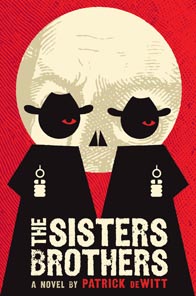
Just to be clear, The Sisters Brothers isn’t missing an apostrophe. The first time I saw
the title by Patrick DeWitt I was certain there was an error. I thought the book was about
the male relatives of sisters. That’s half right: brothers Eli and Charlie Sisters, but no
female siblings.
Set in the Old West, Eli narrates as he and Charlie, both professional gunslingers, embark
on their latest assignment: to find and kill an enigmatic miner. DeWitt’s depictions of time
and place are so strong you can practically smell smoke after the gunfights. Charlie is the
elder and angrier of the two brothers. Eli paints himself as a sensitive man, going so far as
to keep a horse he describes as “portly and low-backed and could not travel more than fifty
miles in a day…” even after he acquires a better, faster one. His reasoning: he felt sorry for
the old one. Strange stuff from a reputed bad guy.
Although his age isn’t mentioned, Eli is going through, if not a midlife crisis, at least a mid-
career one. He’s questioning his line of work. DeWitt injects humor into this western tale
about two men bound by blood and business, but separated by sensitivity and yearning.
Eli realizes he has missed out on many things including, a wife and family, because he has
knowingly ridden alongside Charlie. At one point, this realization even causes Eli to go on
a diet. Yup, mighty strange stuff from a reputed bad guy.
The Sisters Brothers
Four Bookmarks
HarperCollins Books, 2011
325 pages

When my husband and I go to a movie we silently give a thumbs up or down to the trailers
before the main feature. We know that even if it looks promising, it’s entirely possible that
all the good parts are revealed in the preview. The same holds true with book jackets, such
is the case with Coral Glynn by Peter Cameron.
In 1950s rural England, Coral is a home nurse caring for the dying Mrs. Hart, mother of
Clement Hart, a young man disabled in war. Based on Coral’s presence in the family home
and a few shared brandies in front of the fireplace, Clement proposes and she accepts. There
are no sparks; in fact, there is not even any flirtation. There is, however, an unrelated crime.
The couple is getting ready for bed just when a police officer arrives. Minutes after being
interviewed by the constable for a murder Coral did not see, but knew about nonetheless,
Clement suggests she go to London. This is only one of several shrug-your-shoulders and
roll-your-eyes incidents. The marriage is never consummated, and Coral simply flows with
the tides of life in an apparent daze. If this all sounds unusual, it’s because it is.
Cameron has not created characters who elicit emotion, let alone interest. There is neither
humor nor tragedy, or perhaps there is both. With this in mind, I suggest reading the dust
cover. It’s far more interesting than the pages it embraces, and takes a lot less time.
Coral Glynn
Two-and-a-half Bookmarks
Farrar, Straus and Giroux, 2012
210 pages

The Black Minutes by Martin Solares is a two-tiered crime novel held together by in-
teresting characters and captivating murders over a 20-year time span. The writing is
icing. Solares creates easy to envision situations in a fast-paced style. The only problems
occur in the transitions from reality to dreams and the number of personalities filling the
pages.
Thankfully, Solares includes a three-page Cast of Characters to help keep track of who’s
who. Most are corrupt law enforcement, politicians, clergy, and businessmen; but not
everyone is a bad guy. While there may not be any white knights, there are a few gray
ones. The story begins with the murder of a young journalist investigating a serial kill-
ing spree that took place 20 years ago in his town of Paracuan, a Mexican port and home
of a drug cartel. Ramon Cabrera is the honest police investigator who is removed from the
case shortly after he connects a few dots. Cabrera establishes a relationship between the
journalist’s death, the past murders and a scrupulous detective, Vincente Rangel, who
led the investigation two decades ago. This is where it gets fun.
Solares incorporates different narrators, while maintaining his role as storyteller. Certain
chapters are identified as “testimony” wherein the first person voice of one of the characters
tells his version before the writing reverts to third person. The majority of the book tracks
Rangel’s investigation, followed closely by Cabrera’s. Several surprises surface that make
the past more closely linked than one can imagine.
The Black Minutes
Four Bookmarks
Black Cat, 2010
436 pages

The smoke and flames rose into the sky beginning Saturday afternoon. As the
proverbial crow flies, the fire was probably five miles from my home, and many
friends live in areas of imminent danger. They were evacuated immediately. In
the early hours of Sunday morning the entire town of nearby Manitou Springs
was evacuated. Although residents there were allowed home less than 24 hours
later, it was unsettling for everyone. As neighborhoods around our home received
evacuation notifications, my husband and I discussed what we would take: not
surprisingly, photos and family mementos topped the list. When we got word we
were in a pre-evac area, it was time to really consider what to pack. This difficult
task was made even more daunting by the fact that by this point thousands of people
had been displaced and many had lost their homes.
We have shelves and shelves of books. Looking at them I knew I would not be able
to select just a few to carry away. Only one of our sons is home from college this
summer. He packed a box filled with what he called his “theatre and geek books.”
My husband packed his Bible. I looked at my nightstand stacked high; I searched
the shelves near my desk, in the living room, in the study. I even looked at the titles
my absent sons have in their rooms.
Finally, like a scene from Moonrise Kingdom, I packed the library books in a suit-
case. What books would you take?



 The Blue Page Special