Archive for the ‘Books’ Category

Trends are like appetites, which is particularly true in the food industry. Sometimes we binge, sometimes we graze, sometimes we walk away when we’ve had enough. New food treats show up for our palates to enjoy, extol and, eventually, outgrow.
In an engaging and intelligent manner, David Sax examines food trends in his book, The Tastemakers: Why We’re Crazy for Cupcakes but Fed Up with Fondue. There are foods that are hip, inspire copycat versions and subject to whims. In other words, the popularity of some foods depends on more than taste. Sax quotes a trend forecaster who says, “If you can Google a trend, you’ve completely missed the trend.”
Culture, economics, politics and marketing are among the areas Sax addresses. He incorporates humor with extensive research that took him coast to coast interviewing food truck owners, a heritage rice grower, goat farmers and Baconfest organizers, among many others.
Sax often seems as baffled by some food trends as the rest of us, especially when he writes about the Summer Fancy Food Show sponsored by the Specialty Food Association. As if describing the Academy Awards or Golden Globes, Sax puts the reader at this annual event where new foods are introduced and their purveyors cling to the possibility that theirs (anything from iced rice tea to beer-flavored crackers, and more – much, much more) will take the spotlight on America’s plates and napkins.
Sax’s research is thorough, but it’s no surprise that food trends are difficult to anticipate.
The Tastemakers: Why We’re Crazy for Cupcakes but Fed Up With Fondue
Four Bookmarks
PublicAffairs, New York, 2014
318 pages, including index and selected bibliography

I enjoyed Orange is the New Black, the book by Piper Kerman. I haven’t seen the Netflix series of the same name, but after reading Kerman’s account I’m now inclined to watch because Kerman’s account intrigued me.
The author, privileged and intelligent (except for the episode in her life that landed in her prison), writes about her year in a minimum security facility in Danbury, Conn. She is honest about her own fear at being incarcerated and the guilt she has for vicariously putting her family, fiancé and friends through her ordeal. Yet, she does so without self-pity, with humor and insightful respect for most of her fellow inmates.
It’s the latter that particularly garners the reader’s attention and doesn’t let go. Kerman learned to survive thanks in large part to the women around her. It’s no surprise that Kerman would undergo a transformation, but perceptions about prisoners and their crimes do, too. Although it wasn’t an easy 12 months, Kerman shares moments of fun, revelation, pride and friendship – in addition to the aforementioned guilt.
Of course, hers is not a summer camp experience, but neither is it as brutal as initially anticipated. At least that’s the case while in Connecticut. This changes, though, when just before her release she is transferred to Chicago to await testifying in a related trial. There she confronts the woman who years earlier revealed Kerman’s name to authorities. Nonetheless, the author’s honesty and humor make this a worthwhile read.
Orange is the New Black
Four Bookmarks
Spiegel & Grau Trade Paperback, 2013
302 pages
http://piperkerman.com/

The Book of Unknown Americans by Cristina Henriquez is a timely read with the issue of immigration never far beneath the political surface. Yet, the novel isn’t about politics, but people.
Arturo and Alma leave Mexico for Delaware because they want to do more for their teen-aged daughter, Maribel, who suffered a brain injury. They believe she’ll benefit in a better school. They’re not illegals; they have work visas. Each chapter is told from one of the character’s perspectives, some in greater detail than others; only never Maribel’s.
Woven in with the challenges of living in a new land with a new language is the relationship that develops between Maribel and Mayor.
Sixteen-year-old Mayor Toro lives in Maribel’s apartment building; his parents left Panama when he was less than a year old, but he’s never fit in. From Mayor’s perspective, Henriquez writes: “The truth was that I didn’t know which I was. I wasn’t allowed to claim the thing I felt and I didn’t feel the thing I was supposed to claim (Panamanian).”
This sums up the experience of those introduced in the book. Henriquez has created a montage of immigrants: from Mexico, Panama, Puerto Rico, Guatemala, Nicaragua, even Venezuela and Paraguay. These places are all part of the Americas, which is what makes the title so appropriate with its double entendre. In brief, compelling chapters, among those told in Alma and Mayor’s voices, the neighbors share their pasts explaining why they left their native countries for the U.S.A.
The Book of Unknown Americans
Four Bookmarks
Alfred A, Knopf, 2014
286 pages

Although I read a lot, it’s been a while since I held a book I didn’t want to put down. Even at 500-plus pages, I hated to turn the final one of Anthony Doerr’s All the Light We Cannot See. Doerr is garnering a lot of well-deserved attention including being named a finalist for the 2014 National Book Award and #1 New York Times bestseller.
This story is about hope and connections, those that are tangible and those we simply know exist. Marie-Laure, a young girl in Paris, is blind. Her story is told in turns with that of Werner, a German mining town orphan with an aptitude for science and gadgets. The novel jumps around the years just before WWII and during the August 1944 bombing of Saint-Malo on the French coast.
From the onset, there’s a sense the two youths will meet, but how and when leave much to the imagination. Werner builds a small, crude radio from scrap parts. This ability ultimately earns him a spot in Hitler’s army. Marie-Laure relies on her father who builds small models to recreate, first, their Parisian neighborhood and later Saint-Malo where they flee. The hand-crafted items are meant to aid communication with good intentions in a world rife with evil.
Doerr’s work is easy to embrace for its vivid descriptions of the kindness and fear individuals extended or induced during the war. Mostly, though, the characters are so finely fashioned that they come alive in the mind’s eye.
Five Bookmarks
All the Light We Cannot See
Scribner, 2014
530 pages

Once I was able to get beyond the similarities, of which there are many to the 1977 movie The Turning Point, I found myself enjoying Maggie Shipstead’s Astonish Me. Actually, what I appreciated, and what kept me turning pages, were the various characters in this ballet-driven narrative that blends unrequited love, the ideal of loyalty, personal disappointment, deceit and triumph.
The focal point is Joan’s infatuation with Russian ballet star Arslan Rusakov and her inability to convincingly let go of her feelings long after she has gone on to what can only be described as a normal life in the suburbs with her husband and son, Harry. Shipstead deftly portrays Joan’s transformation from an unhappy member of the (ballet) corps to contented, if not exuberant, resident of Southern California where she teaches ballet.
The story moves through different phases of Joan’s life from the mid-1970s to 2002. Arslan remains prominently in the background while the focus is on Joan, Harry, and Chloe, the girl next door. With Joan as their teacher, they ultimately become enamored with ballet so it becomes a force in their lives.
Again, the characters provide the strength of the novel. Chloe is particularly interesting as a young child and later as a young woman. Her parents may be caricatures of unfulfilled lives, especially her father, but their daughter consistently maintains a strong sense of self.
It also helps that Shipstead is an engaging story teller who incorporates humor (in small doses) and irony (in larger servings).
Astonish Me
Four Bookmarks
Alfred A. Knopf, 2014
257 pages

I’m a sucker for a good title and that’s the reason I read Yelena Akhtiorskaya’s Panic in a Suitcase. The book was included on the long list of the Tournament of Books. It didn’t make the cut to the short list, and I can see why.
Akhtiorskaya’s novel begins in 1993 with the Nasmeratovs who have settled in Brooklyn’s Brighton Beach following the Soviet Union’s collapse. They are a continent away from their roots, but the new community is a little Russia where shops, restaurants and neighbors share the same language and customs. Assimilation isn’t necessary.
Pasha Nasmeratov is a poet and the one family member who remains on native soil. He visits his family in New York, but never commits to immigrating. His sister, her husband and their daughter live with Pasha’s parents in a crowded apartment. Pasha is the link to the past in many ways. Jump ahead to 2008 and Frida, his niece, is grown up. She’s intrigued by the mother land, but is rooted in an inability to embrace the future while clinging to the past, even one she doesn’t remember. Frida was young when the family left Odessa.
The problem is there’s too much jumping from one character or location to another. Still, the author’s writing is rich in clever turns of phrase and vivid imagery. Humor is a lively resident among the prose: “Frida stumbled past tidy strips of lawn, her favorite with a PLEASE CARB YOUR DOG sign…”
Panic in a Suitcase
Three-and-a-half Bookmarks
Riverhead Books, 2014
307 pages

All the Living by C. E. Morgan is one of the most beautifully written novels I’ve read; unfortunately, the story doesn’t reach the same level as the words that embrace it. It’s not bad; it just doesn’t rise to the same level as the well-crafted images. I must admit that the opening sentence immediately grabbed me with its element of intrigue: “She had never lived in a house and now, seeing the thing, she was no longer sure she wanted to.”
She is Aloma, a young woman, who spent her early years living with relatives in a trailer before being sent, at age 12, to a “mission school” – essentially an orphanage. There, she discovers a talent (and passion) for the piano. Otherwise, there is little to set her apart.
The house, on a tobacco farm, is Orren’s. When his mother and brother are killed in an accident he asks Aloma, whom he had recently met, to join him as he tries to maintain the homestead. A young preacher who befriends Aloma is added to the mix, which also includes the harsh, isolated landscape.
There’s no time frame but basic amenities are evident; it’s clear this is not a back-in-the-day tale. The house has an old, hopelessly out-of-tune piano. Orren has the farm and a reticence that comes from grief and the responsibilities he’s inherited.
Possessing little, but more than they realize, Aloma and Orren’s story isn’t just about being lonely even when others are present, but about love and self-awareness.
All the Living
Three-and-a-half bookmarks
Farrar, Strauss and Giroux, 2009
199 pages
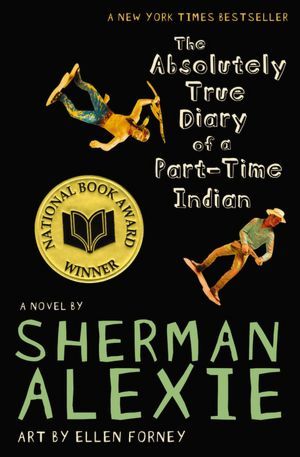
When I worked as a writing tutor at the local community college, I saw enough rhetorical and critical analyses on Sherman Alexis’s “Superman and Me” to fill a classroom – floor to ceiling. I knew his essay inside and out. Until now I was unfamiliar with his other writings. The Absolutely True Diary of a Part-Time Indian is a fictional account (complete with cartoon illustrations by Ellen Forney) of Arnold Spirit Jr., aka Junior, aka Arnold.
Certainly, similarities exist to Alexis’s life growing up on the Spokane Indian reservation in eastern Washington, but the diary entries are fiction. They follow Junior/Arnold in his freshman year of high school. Plenty of back story is provided, beginning with Arnold/Junior’s birth defects that physically, socially and intellectually isolate him from most others on the reservation. He’s suspended on the first day of school and decides to transfer to the “white” school 22 miles away. On the reservation he’s known as Junior; at the new school he’s Arnold.
He changes schools in hopes of opening new doors while learning to accept that old ones are slammed in the process. His life is a dichotomy. He’s always struggled to fit in and expects to endure the same at the new school. It’s clear from the onset that Junior/Arnold is an underdog, so the outcome is predictable. The transformation of other characters is what’s most heartening; it shows that tribes can be of our own creation. This is evident through the diary reflecting its author’s humor, perception and emotion.
Four Bookmarks
The Absolutely True Diary of a Part-Time Indian
Little, Brown & Co., 2007
230 pages

In a way I’d love to frequent a place often enough that I’d be known, if not by name, perhaps by where I liked to sit or what I ordered. Colman Andrews recounts the numerous places around the world where this is the norm for his dining experiences. In My Usual Table: A life in Restaurants, Andrews shares his earliest recollections as a child dining in many of the landmark eating establishments in the Los Angeles area. As a kid he, with his family, was a regular at Chasen’s, the Brown Derby and Musso & Frank Grill (only the latter remains today).
Where does one go from there? Apparently, everywhere. Andrews grew up to be a wine connoisseur, dining critic and co-founder of Saveur magazine. He’s also authored several cookbooks.
My Usual Table is an eat and tell memoir with casual and not-so-casual name dropping: Wolfgang Puck, Ruth Reichl, Alice Waters, among others. Some meals are described vividly, some barely mentioned while he focuses on those associated with the meals. What’s most fun is following Andrews’ time line, which precedes, for example, the farm-to-table concept to the present.
Andrews is a fine story teller, but his voice begins to wear thin about 2/3 through. It’s difficult consuming and digesting such rich, often heavy fare for too long. I enjoy dining out, but there’s nothing like a home cooked meal or an occasional burger for basic sustenance. I’m happy, afterall, to have my usual table be in my own dining room.
My Usual Table: My Life in Restaurants
Three-and-a-half Bookmarks
Ecco, 2014
311 pages

The Boys in the Boat isn’t compelling as a title until considering the subtitle: Nine Americans and Their Epic Quest for Gold at the 1936 Berlin Olympics. That, believe it or not, provides just the amount of spark to pick up the book. Once in hand, Daniel James Brown’s account is riveting. Sure there are a few spots where it catches a crab, in rowing vernacular where an oar doesn’t completely come out of the water and slows the pace of the shell (boat). Fortunately, Brown keeps a mostly steady tempo.
The narrative follows the unlikely evolution of nine young men who find their way to the University of Washington rowing crew. Much of the story follows Joe Rantz, a particularly poor young man with a heartbreaking past: his stepmother convinced his father to essentially abandon Joe. His history, along with that of his crewmates and their coaches, provide the book’s heart, literally and figuratively. Each chapter begins with a quote from George Yeoman Pocock the boat builder who served as a mentor to Joe and others.
Interspersed with descriptions of the men’s pasts, their grueling training and the exciting races — particularly those against California – Brown describes events in Germany before the world fully understood the atrocities occurring there.
Even though the outcome of the race is known from the start, how the American crew made it to Berlin is fascinating. It’s a story of indomitable spirit that demonstrates the power of hard work, friendship and the American dream.
The Boys in the Boat
Four Bookmarks
Viking Adult, 2013
416 pages