Archive for the ‘Books’ Category
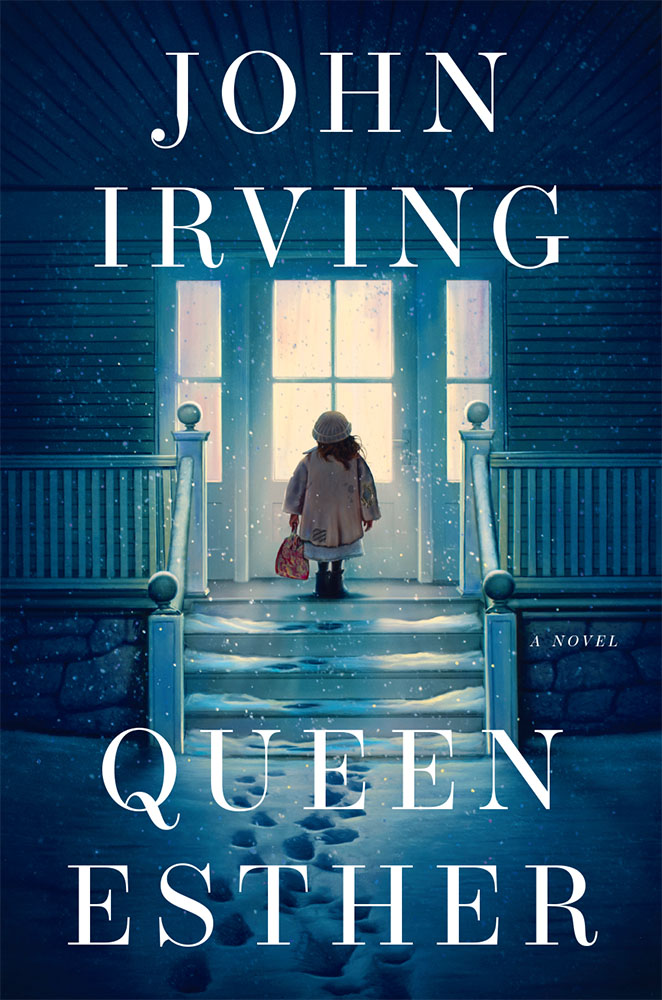
In Queen Esther, John Irving introduces readers to the Winslows of Pennacook, N.H., an intelligent, generous family with five daughters and several adopted caregivers for the girls from St. Cloud’s Orphanage (this may stir memories of an earlier Irving work particularly references to Dr. Larch).
The last adoptee is Esther, a Jewish orphan whose early and continued influence on the family is inexplicable: one of the novel’s shortcomings. When efforts to place her with a Jewish family fail, the Winslows’ aversion to anti-Semitism makes them the most likely candidates.
Through a winding narrative that moves from New Hampshire to Vienna, from Amsterdam to Jerusalem, from the early 1900s to 1981, Jimmy Winslow, the grandson of Thomas and Constance Winslow is the main character more than Esther. Jimmy is reared by the five Winslow sisters; yet, Hope, is the mother of record and Esther gave him birth. She has no direct role in his upbringing but is always a shadow in his life. As a young adult after leaving the Winslows, Esther spends her life searching for her Jewish self; this coincides with Israel’s contemporary political history. She provides Jimmy no tangible attributes – only a lot of questions.
Likeable and earnest, Jimmy grows up to be a writer, eventually a father, but someone whose curiosity about Esther is always a shadow.
As is true with most Irving works, there’s humor and an array of interesting, if not always necessary, characters. The novel is too long with little to redeem its wordiness.
Queen Esther
3.75 Bookmarks
Simon & Schuster, 2025
408 pages + acknowledgements and Reader’s Guide
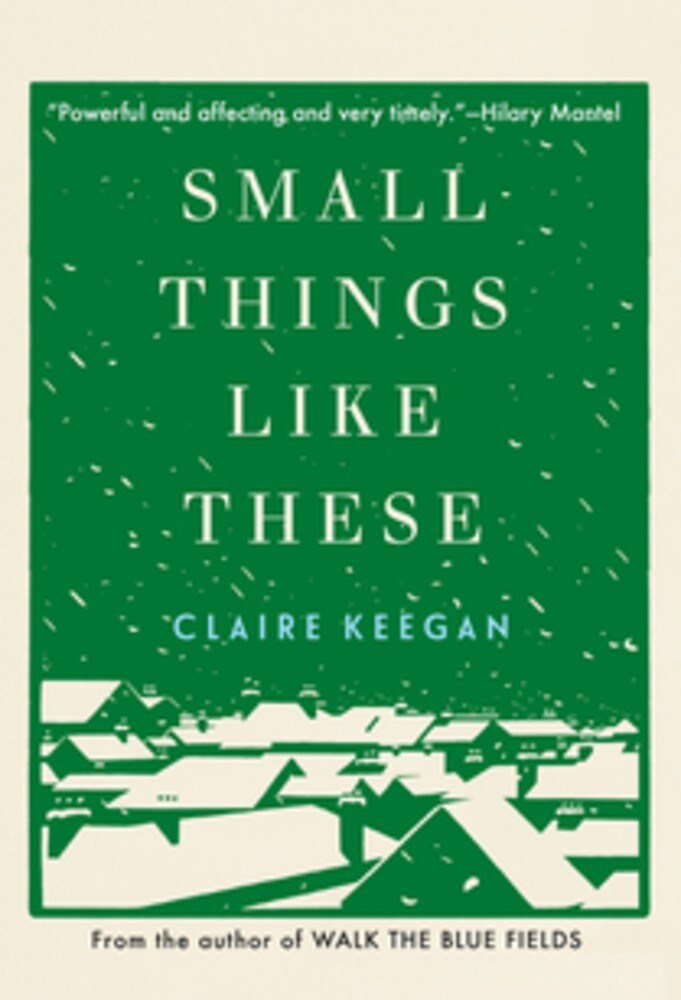
Silence is the same as complicity in Claire Keegan’s short, but impactful novel Small Things like These.
Bill Furlong was lucky; his unwed mother was allowed to stay on as a domestic worker throughout her pregnancy in the prosperous home of Mrs. Wilson, a protestant. The reference to this religion distinction is important.
The young boy grew up, knowing he was different, but also fully aware that he was loved and a beneficiary of the wealthy woman’s kindness. The only consistent male figure in his life was Ned, Mrs. Wilson’s farmhand. Through the years, Bill never learned the identity of his father, but later married and had four daughters.
The setting is a small Irish village during a particularly frigid Christmas season. As a coal merchant Bill is kept busy with deliveries, including one to the nearby convent. There he finds a young, pregnant girl locked in the woodshed. He’s deeply moved and this causes him to think about how often he wondered about his father particularly when he was young.
The terse, yet descriptive narrative is chilling – not just because of cold temperatures, but the unwritten awareness of the Magdalen laundries. Bill is keenly cognizant of all that he has and what life might have otherwise been for him and his mother.
This is a quiet, little, heartfelt work addressing hard life truths.
Small Things Like These
Four Bookmarks
Grove Press, 2021
118 pages, includes acknowledgements
Since 2011, when I started The Blue Page Special, fewer than two dozen books have warranted Five Bookmarks. The list is now available in case you may have missed some of my favorites!
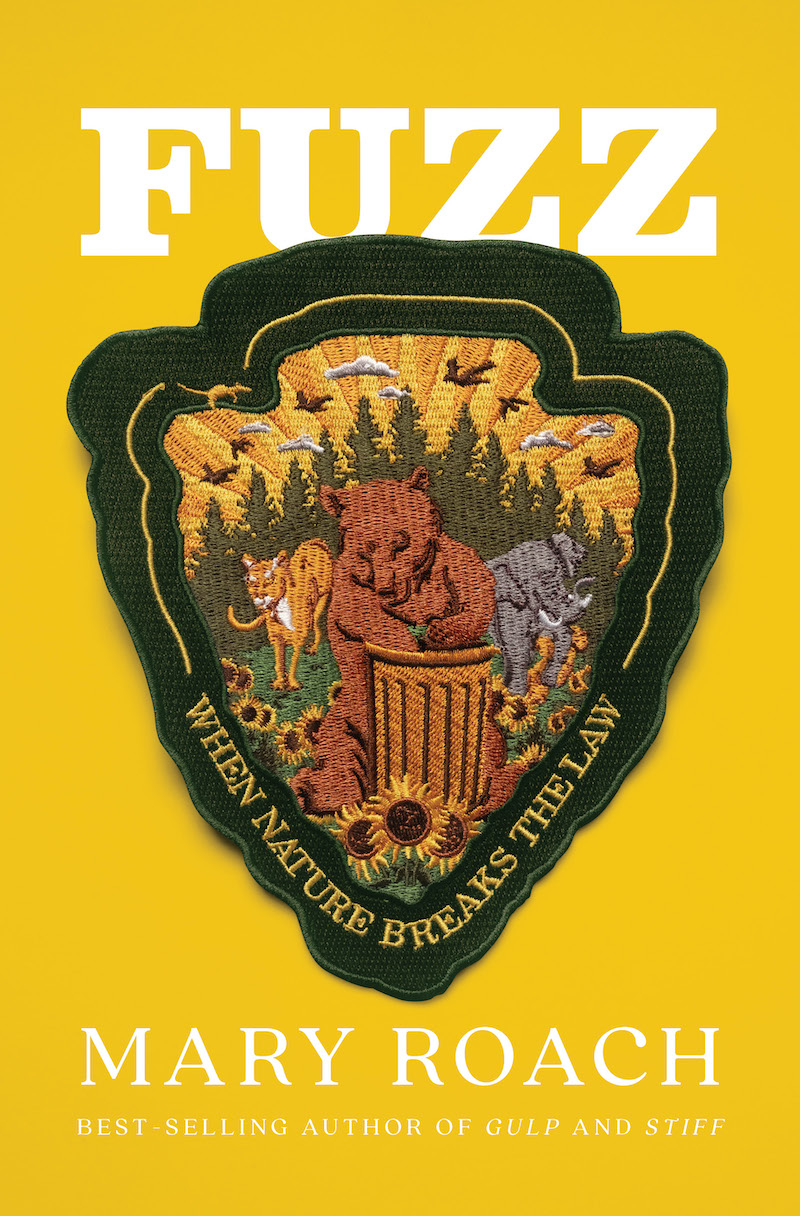
The subtitle of Fuzz by Mary Roach: When Nature Breaks the Law is an early indication of the author’s sense of humor. After all, who thinks about nature’s creatures as potential crooks?
Turns out, not all birds and animals are above suspicion, and many are often repeat offenders.
The work jumps right into it with Roach participating in a Wildlife-Human Attack Response Training in Nevada. There, readers can see the similarities between a murder investigation where people are the suspects. The trainees look for clues to determine whether another human was involved, and if not, what type of animal might be in question. Roach calls this “a wildlife whodunit.”
Bears, elephants, leopards, gulls and even noxious weeds, among others, are fall under Roach’s scrutiny. She’s exhaustive, often to the extreme, in her research. She spends time with wildlife managers, attack-animal forensics investigators, and Vatican employees; also among many others. The work isn’t limited to one country, or even a single continent.
Some of the species are endangered; others have abundant populations.
Interspersed with Roach’s wit are serious statistics and concerns. When animals “jaywalk” whose fault is it? Ditto, for bears who break into cars and homes for food? Sometimes, humans simply make it too easy. Some of the species are endangered; others have abundant populations. As she illustrates the problems, Roach is well aware that human behavior is a contributing factor.
Fuzz When Nature Breaks the Law
Three- and three-quarters Bookmarks
W.W. Norton, 2021
308 pages, includes Acknowledgements and Bibliography; Reading Group Guide not included in page count
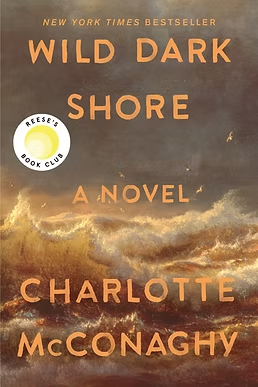
Grief, isolation, broken relationships and climate change are beautifully and tragically addressed in Wild Dark Shore by Charlotte McConaghy.
Dominick Salt and his three children are the caretakers and lone residents of Shearwater Island, near Antarctica. They’re organizing and packing the contents of a seed bank awaiting a ship to return them to the mainland. Rising tides, harsher weather conditions and the island’s isolation make it uninhabitable or a viable environment for continued study. Shearwater is a critical element of the story.
When a barely-alive woman washes ashore during a severe storm there’s an immediate sense of foreboding. Rowan’s reasons for traveling to Shearwater are suspect given Shearwater’s remoteness; when she reveals that she’s looking for her husband who had been in charge of the seed bank, the Salts’ reticence makes her suspicious.
As Rowan’s wounds heal she gets to know each of the children, while remaining mistrustful of Dom. The five characters are richly portrayed, each nearly eclipsed by grief and none able to communicate their feelings.
McConaughy’s writing maintains a palpable sense of tension throughout the narrative. It’s nerve-wracking and impressively captivating with numerous unanswered questions: what happened to the other members of the research team; how will the Salts adjust from their extremely secluded life; can their brokenness be mended; and more.
First person voice tells Rowan and Dom’s side of the story, while third person voice is used for the children. Short chapters further heighten a sense of dread, but also offer occasional glimmers of hope.
Wild Dark Shore
Five Bookmarks
Flatiron Books, 2025
302 pages, includes acknowledgements
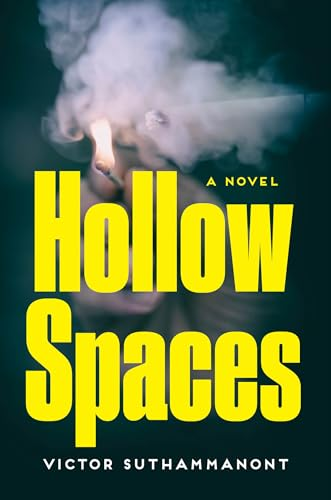
Hollow Spaces, the title of Victor Suthammanont’s debut novel, refers to the emptiness created by emotions such as grief, anger and at times even love.
It’s been 30 years since Brennan and Hunter Lo’s father, John, was acquitted of murdering his lover, they were young children. Yet, for the last 30 years, the unresolved question of whether he was actually guilty or not has divided them.
Brennan only saw the good in her father while Hunter saw only the bad. Their mother, who was betrayed by her husband’s infidelity, did little to help either of her children work through their feelings. Instead, the siblings, who had rarely gotten along, decide to look for the answers to determine whether John was guilty of murder or not. Agreed is the concession that one will acknowledge the other was right all along.
Many witnesses are no longer alive and old police records not easily accessible. Still, they embark on their own private investigation. Brennan’s an attorney; Hunter is a journalist. They’re both adept at research.
Along the way, they receive threats from unknown sources to quit pursuing their search. This makes them suspect they’re on to something.
The narrative is fast paced and characters are well developed, if not always likeable. Brennan comes across as condescending and Hunter is arrogant. Nonetheless, their efforts to know more about the circumstances that tore their family apart all those years ago are intriguing and compelling. In the process they discover they have more in common than once believed.
Hollow Spaces
Three-and-three-quarters Bookmarks
Counterpoint, 2025
374 pages, includes acknowledgements
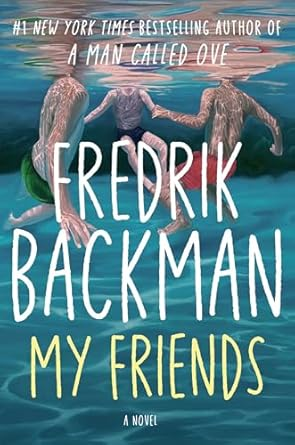
Just as the title, My Friends, implies Fredrik Backman’s novel is about friendships both those in the past and an emerging one.
Louisa has grown up in foster homes and just turned 18. Her best friend, Fish, has recently died leaving her completely on her own.
Through a random, and hard to believe, encounter with a famous Artist in the back alley of an art gallery, they graffiti a wall together. She learns he’s the artist she’s long admired; he sees she’s a talented artist. Before he dies shortly thereafter, he instructs his friend, Ted, to find Louisa to give her the painting that first brought him worldwide attention. It’s one she’s been obsessed with most of her life.
That chance meeting changes her life and thus begins a journey to learn more about the artist and herself. Despite’s Ted’s reluctance and discomfort to have Louisa as his companion, they embark on an adventure that occurs simultaneously as he shares the story of how he, the Artist and two other friends spent the summer they turned 15.
Backman, through Ted, details how the painting came to be, illustrates the close bonds the friends shared and describes their unprivileged backgrounds. Louisa easily relates to having never had much and still carries memories of Fish close to her heart.
Backman injects humor in this often poignant, predictable work. It’s about the strength of friendship, perseverance and the ability to survive through unlikely circumstances.
This is a story about friendship, perseverance and survival.
My Friends
Four Bookmarks
Astoria Books, 2025
436 pages, includes acknowledgements
Four bookmarks
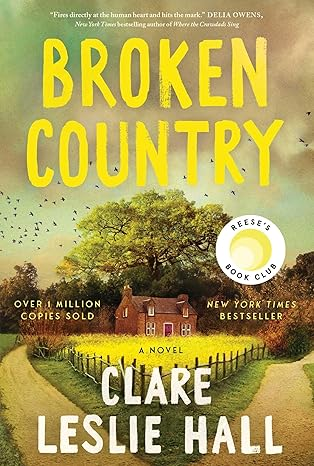
Claire Leslie Hall’s novel, Broken Country, is a study in class differences, miscommunication and reignited emotions, primarily love and guilt.
When Gabriel Wolfe reappears in Beth Johnson’s life years after their brief, but intense love affair ended, not only is her life uprooted, but so is everyone else’s in the small, rural English village (their country) where they live.
Despite the tragedy of losing their young son in an accident, Beth and Frank Johnson have a strong, seemingly healthy marriage. They work the family farm with Jimmy, Frank’s younger brother and they’re well-respected in their community. Gabriel is a well-known author from an affluent background who’s returned to his family’s estate with Leo, his young son in tow. He’s the same age as Beth’s son at the time he died.
Yes, this is a love story, but there is also an element of mystery. The character-driven plot is rich with descriptive images of the rural landscape and the deep-seeded emotions of Beth, in particular. This makes it more her story with the others as supporting actors. Nonetheless, each one is richly nuanced.
The narrative randomly alternates among the past, present and future. This serves not only to inform the reader about previous and existing relationships, but also hints at some of what’s to come. Thus, there’s much that is predictable here, particularly that Gabriel and Beth will once again be drawn to each. Fortunately, there is at least one major surprise that is bound to keep readers engaged.
Broken Country
Four bookmarks
Simon and Schuster, 2025
307 pages
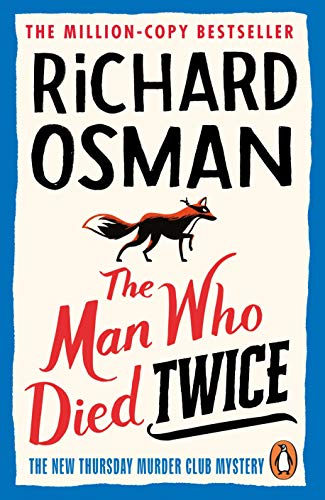
After reading The Thursday Murder Club by Richard Osman, I wanted to read more in the series of the same name. The Man Who Died Twice is the second of five that follow the crime solving escapades of Elizabeth, Joyce, Ron and Ibrahim, septuagenarian residents of an upscale retirement complex in rural England.
The format is the same as the introductory novel. Chapters alternate between those written in third person voice and those told from Joyce’s perspective. Joyce is the character with heart, who sees the good in people. She’s a good foil to the hardened Elizabeth, a former M15 spy. There are also two plot lines.
One involves nabbing the young thug who mugged Ibrahim; the second is more complex because it brings Elizabeth’s past into the limelight. He ex-husband, also a spy, is accused of stealing diamonds from a man with connections to various worldwide crime organizations.
There’s plenty of humor, intrigue and even a little romance. Osman’s characters are intelligent and caring. This includes the two local police officers they befriended, and often irritated, in the first book. The writing is sharp and engaging as the author provides more insight into the characters’ histories. After all, who knew Elizabeth had an ex?! That isn’t all that’s revealed about their pasts.
Of course, there’s a murder to solve, perhaps even two. This, and efforts to bring Ibrahim’s perpetrator to justice, keep the foursome busy, the police wondering and some of the bad guys unaware of what awaits them.
The Man Who Died Twice
Four Bookmarks
Pamela Dorman Books, 2021
368 pages
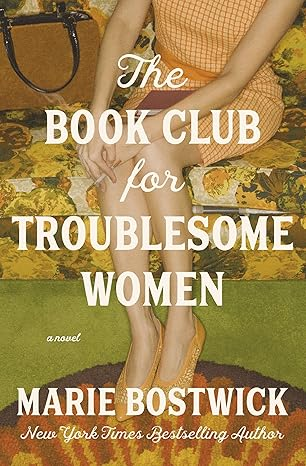
Set in 1960s in a northern Virginia suburb of Washington, D.C., Marie Bostwick’s novel, The Book Club for Troublesome Women is a misnomer– at least by today’s standards.
The housing development where the women live is new, so none of the neighbors know one another well. After visiting the local bookstore, Margaret Ryan decides to form a book club. She invites three other women to discuss Betty Friedan’s The Feminine Mystique, which has just hit the shelves. The group calls itself The Bettys.
Bostwick ascribes interesting attributes to each woman. Marilyn, Viv and Charlotte are all married with children. Charlotte is brash and creative unlike anyone Marilyn has ever met. Bitsy, the youngest and married to a much older man, is desperate to get pregnant.
The novel focuses on the personalities and friendships, which are initially in line with the times in which they live. This is primarily focused on the sexism they face in their marriages and outside their homes. Slowly, and predictably, as the women grow closer they begin to change by challenging the norms of the day.
There’s plenty of humor and nostalgia, even for those who weren’t part of that era. The women’s frustrations at not being taken seriously are palpable, but so is their joy when they are.
The final chapter takes readers to the early 2000s. As for the title, these women aren’t troublesome; rather they’re brave, progressive and evolve to become defiant. There’s little that’s unexpected, but it’s a fun read nonetheless.
The Book Club for Troublesome Women
Almost four bookmarks
2025, Harper Muse
371 pages, including acknowledgements and Discussion Questions

 The Blue Page Special