Archive for the ‘strangers’ Tag
When Phoebe Stone abruptly leaves her Midwest college teaching job at the beginning of the semester, she heads to an upscale hotel on the Rhode Island coast. It’s a place she’d always dreamt of going with her husband, but he’s left her for another woman and Phoebe needed to get away; she’s had enough.
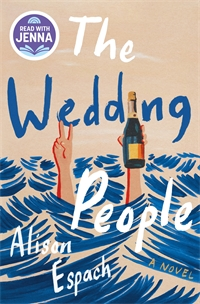
Alison Espach’s humorous and compassionate novel, The Wedding People, is as much about self-discovery as it addresses misplaced emotions, chance encounters and probable bad decisions.
The hotel is booked for a weeklong private affair and Phoebe is easily mistaken as a wedding guest; albeit without any luggage. It’s a large group of family and friends. No one takes particular notice until the bride, Lila, realizes Phoebe’s presence has the potential of ruining the festivities. Lila has planned everything, while sparing no expense, practically down to the minute. The unanticipated presence of a stranger could ruin everything.
Yet, Phoebe intrigues Lila, who spends time in the older woman’s room regaling her with the efforts involved in planning the wedding. Phoebe learns how Lila met her fiancé, the relationships she has with her mother, her sister-in-law to be and many of the (invited) guests.
Phoebe assures Lila that she has no intention of being a disruption: she plans to stay at the hotel one night and not interact with anyone. This soon goes awry.
The engaging, well-paced narrative, full of nuanced characters, leads Phoebe to a better understanding of herself, an acceptance of others, new friendships – and more.
The Wedding People
Four Bookmarks
Henry Holt and Co., 2024
367 pages, includes acknowledgements
Reading The Power of Strangers made me think about how I interact with people I don’t know, which I suspect is among author Joe Keohane’s goals. He presents a lot to consider in an entertaining, applicable, albeit often research-heavy, manner.
Through interviews with psychologists, anthropologists, and average citizens , among others, Keohane identifies the good feelings resulting from an exchange, no matter how brief, with those with whom we share our world. Engaging in such interactions isn’t all about personality type. Innate fears of rejection and lack of trust often inhibit extending ourselves.
Examples of other cultures where the importance of an initial greeting determines the safety of those involved are referenced. Details are shared about individuals in public spaces who encourage strangers to share their stories or simply talk about whatever is on their minds.
The work is split into three sections: “What Happens When we Talk to Strangers;” “Why Don’t We Talk to Strangers;” and “How to Talk to Strangers.”
Admittedly, sometimes I don’t want to talk to someone I don’t know: for example, when on a plane in the middle of a good book. I always acknowledge people and try to establish eye contact. And, when ignored, I am disgruntled. I live in a place where I encounter fellow hikers on beautiful trails. There is usually some exchange of trail talk. Keohane likely would consider this a start, but for a more meaningful connection he offers a lot of interesting ideas worth reading about.
The Power of Strangers: The Benefits of Connecting in a Suspicious World
Four Bookmarks
Random House, 2021
328 pages (includes index)
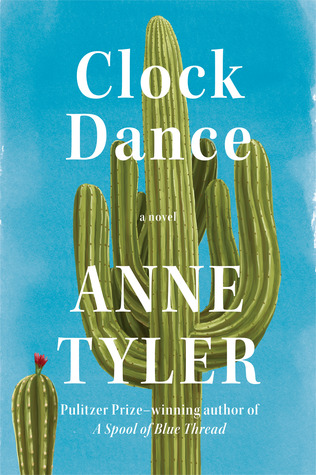
Clock Dance is distinguished from Anne Tyler’s other works because of its setting. Yes, Baltimore does figure into the plot, but not immediately. Other locales provide the initial settings. The story doesn’t come alive, though, until the main character arrives in Charm City.
Three phases of Willa Drake’s life ultimately influence her character: as a child when her mother randomly, and temporarily, leaves the family; as a college coed considering whether or not to accept a marriage proposal without finishing her degree; finally, in her sixties when she receives a call to come to Baltimore from Arizona to care for Cheryl, the 9-year-old daughter of her grown son’s injured ex-girlfriend, Denise. Yes, that’s a tenuous connection.
Before Baltimore, Willa is widowed when her boys are teenagers. They grow up, she remarries and has little communication with them. The surprise request is from Denise’s neighbor who sees Willa’s number on a list of emergency contacts. It takes some persuasion, but Willa agrees to help people about whom she knows nothing. In the process of caring for others who need her, Willa discovers a sense of belonging she hasn’t experienced.
Tyler’s characters are vulnerable, real and endearing. Cheryl is a no-nonsense kid whose strong sense of independence comes from being the daughter of a single mother. The author brings Baltimore to life through descriptions of Denise and Cheryl’s neighborhood and its quirky residents, of which there are many.
Although somewhat predictable, Clock Dance is a charming tale of the need to belong.
Clock Dance
Four+ Bookmarks
Alfred A. Knopf, 2018
292 pages



 The Blue Page Special