Archive for the ‘nature’ Tag
The subtitle of Fuzz by Mary Roach: When Nature Breaks the Law is an early indication of the author’s sense of humor. After all, who thinks about nature’s creatures as potential crooks?
Turns out, not all birds and animals are above suspicion, and many are often repeat offenders.
The work jumps right into it with Roach participating in a Wildlife-Human Attack Response Training in Nevada. There, readers can see the similarities between a murder investigation where people are the suspects. The trainees look for clues to determine whether another human was involved, and if not, what type of animal might be in question. Roach calls this “a wildlife whodunit.”
Bears, elephants, leopards, gulls and even noxious weeds, among others, are fall under Roach’s scrutiny. She’s exhaustive, often to the extreme, in her research. She spends time with wildlife managers, attack-animal forensics investigators, and Vatican employees; also among many others. The work isn’t limited to one country, or even a single continent.
Some of the species are endangered; others have abundant populations.
Interspersed with Roach’s wit are serious statistics and concerns. When animals “jaywalk” whose fault is it? Ditto, for bears who break into cars and homes for food? Sometimes, humans simply make it too easy. Some of the species are endangered; others have abundant populations. As she illustrates the problems, Roach is well aware that human behavior is a contributing factor.
Fuzz When Nature Breaks the Law
Three- and three-quarters Bookmarks
W.W. Norton, 2021
308 pages, includes Acknowledgements and Bibliography; Reading Group Guide not included in page count
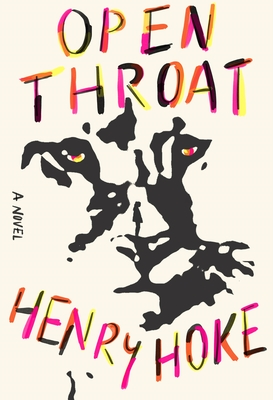
In Open Throat, a feral mountain lion roams the Hollywood Hills above Los Angeles (“ellay”). He’s hungry, but has his limits as to what prey he’ll pursue. He even protects a homeless camp, unbeknownst to its inhabitants.
Author Harry Hoke’s novel addresses climate change, homelessness and humankind’s encroachment on nature. Almost poetic in form, the lion narrates the story as he watches hikers and eavesdrops on their conversations. Some words he overhears often enough that they become part of his narrative: scarcity becomes scare city.
The lion witnesses the start of a manmade fire, something erroneously blamed on the homeless camp. The heat and smoke force the lion into a residential neighborhood where he finds shelter in the basement of a house he overheard someone say was owned by “slaughter.”
He’s soon discovered by the owner’s teenage daughter who calls him “hecat” and he refers to her “little slaughter.” (All quotation marks are mine, not the author’s).
There’s no punctuation no capitalization except for the personal pronoun I. Excluding the italicized statements from little slaughter, who treats him in as a pet and support animal, everything is from the lion’s perspective. When she takes him to Disneyland, suspending disbelief is challenged!
From 2012 to 2022, a puma known in the Los Angeles area as P-22 roamed Griffith Park. His presence was well known making him a celebrity of sorts. The only concern for Hoke’s predator comes from little slaughter; otherwise, interest in his wellbeing is, reasonably, overshadowed by fear.
Open Throat
Three bookmarks
MCD, Farrar, Straus and Giroux, 2023
160 pages
Throughout its 384 pages, Braiding Sweetgrass by Robin Wall Kimmerer has crafted an ode to the wonder of nature, all that it has to teach us and what is lost through neglect/apathy. If only, we were good students.
Kimmerer is a member of the Potawatomi Nation and an environmental biology professor. This combination lends itself to her role as an intermediary between the past lessons of First Nations people and current attitudes toward the world around us.
The author’s message is delivered in an engaging, almost conversational, manner as she shares personal experience, ancestral legends and perspectives from conservationists, family members and others.
In her preface, Kimmerer writes of the beauty of sweetgrass, which is often braided to honor the earth. In place of the physical grass, she “offers in its place, a braid of stories meant to heal our relationship with the world.” Like a tangible braid, it’s “woven from three strands: Indigenous ways of knowing, scientific knowledge, and the story of an Anishinabekwe scientist trying to bring them together in service to what matters most.”
For me, this was a slow read, but not because it slogged along. Rather, it seemed important to savor and consider the points made.
Braiding Sweetgrass
Four Bookmarks
Milkweed, 2013
384 pages, plus notes, sources and acknowledgements
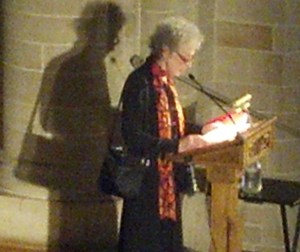
Usually, I’m not a Margaret Atwood fan. She makes it so difficult, through depressing stories and odd characterizations, to appreciate her wit, imagery and intellect. Reluctantly, I read The Year of the Flood. It was the choice for my book group, and the All Pikes Peak Reads 2012 selection. As part of the APPR festivities, Atwood spoke about sustainability and survival: two prevalent themes in her works.
Surprisingly, once I started reading I was anxious to continue. Although Atwood dismisses claims The Year of the Flood is a post-apocalyptic tale, nothing better describes it. The story takes place in a time when mutations, genetic engineering and an order of fear prevail. The flood refers to an unknown deluge caused by man’s errors and destructive predispositions. It is not a natural phenomenon; it’s a “waterless flood.”

God’s Gardeners is a small cult with a foundation in Christianity that celebrates the lives of such people as Rachel Carson and Euell Gibbons, among others, for the contributions they made to saving the environment. The Gardeners strive to protect nature and prepare for (and later survive) the flood. Within the cult, Toby and Ren, represent maturity and youth, respectively. Their narratives move the story forward. Atwood said she purposely incorporates multiple voices in her works because “I don’t like everyone to sound the same.” Toby is represented in third person, while Ren offers a first person perspective. The sermons of Adam One, the Gardeners’ leader, begin each chapter using second person voice.
I’m glad I read this and even more pleased to have heard Atwood speak. It provided insight into her work, but mostly served to demonstrate her keen sense of humor, which fortunately surfaces in this novel. A novel, by the way, which has, as Atwood stated, “A ray of hope.”
The Year of the Flood
Four Bookmarks
Anchor Books, 2009
431 pages



 The Blue Page Special