Archive for the ‘love’ Tag

The title of Kathleen Flinn’s experience at Le Cordon Bleu in Paris is what initially caught my eye: The Shaper Your Knife, The Less You Cry. These words are advice from one of her chef instructors as begins the first of three sections required to earn a diploma from the prestigious cooking school. The subtitle offered more foreshadowing than I would have liked, though: “Love, Laughter and Tears in Paris at the World’s Most Famous Cooking School.”
Flinn’s account combines her background, her romance and her Parisian education, which involved much more than cooking as she learned to navigate a new city with only un petit peu knowledge of French.
The book is divided into the three parts that correspond with the units at the school: Basic, Intermediate and Superior Cuisine. Flinn’s culinary undertaking is humorous, honest and, unfortunately, predictable. Of course she grows through this journey; of course she learned techniques that were as foreign as the language; and of course she is with the man of her dreams. The latter requires no spoiler alert; this is revealed early in the narrative.
Despite its predictability, Flinn gives an insider’s view of how the classes are taught, the types of people who enroll (not surprisingly from all over the world) and the friendliness of the French people. She also includes several recipes and even includes a menu guide for book groups. Fortunately, none require deboning a chicken or dealing with dead rabbit heads.
The Sharper Your Knife, The Less You Cry
Three-and-a-half Bookmarks
Penguin Books, 2007
278 pages

I’m a fan of Alice Hoffman’s prolific work and her most recent, The Marriage of Opposites, reminds me why. She often incorporates elements of little-known history with a touch of the mystical. On the surface that may not sound enticing, but in Hoffman’s hands it is never overwhelming.
Set on the Caribbean island of St. Thomas in the early 1800s, Rachel’s father is among a group of Jewish immigrants who fled persecution from the European Inquisition. To describe his daughter as headstrong is an understatement.
The narrative primarily focuses on Rachel’s life, but later alternates with others. While still in her teens, Rachel is forced to marry Isaac, a man nearly twice her age. Following his death she’s left without property of own and seven children – three from Isaac’s first marriage.
This is not a tale of survival, though. It is part biography but largely a love story. It’s full of passion that emerges when Rachel meets Isaac’s young cousin, Frederic Pizzaro*, who arrives from Paris to take over the family business.
Going against their religion and social mores, Rachel and Frederic marry. Their youngest son, Camille, shares his mother’s obstinate nature; she acknowledges him as her favorite, although the two are often in conflict. The story soon becomes his as he struggles to pursue his artistic endeavors and eventually find his place among the French Impressionists.
Hoffman’s tale is also about of the influence of the island’s bright colors, cultural expectations and what happens when they collide with dreams.
The Marriage of Opposites
Four Bookmarks
Simon & Schuster, 2015
365 pages
*Camile changed the spelling of the name when he moved to Paris.

I am humbled and surprised when I run into someone who tells me my blog is enjoyable and a good place to learn about books (and restaurants when I write about them). When I started The Blue Page Special nearly three years ago, that’s what I hoped for. What’s even better is when one of my readers shares a book title with me, introducing me to a new author or genre. Such is the case with The Rosie Project by Graeme Simsion.
Simsion presents Don Tillman: a nerd. This renowned genetics professor at a Melbourne, Australia, university has created a life so structured that all of his activities are scheduled to the minute. He finds the slightest deviation unnerving. This, along with his intelligence and inclination to view the world through literal eyes, makes him socially inept.
Nonetheless, he decides it’s time to find a life partner and creates the Wife Project, complete with a multi-point questionnaire which has no place for romance. That is until Rosie Jarman, a graduate student in psychology, unwittingly becomes a candidate in the project. Don quickly dismisses her as a viable contender because of what he perceives as her many (human) faults.
The novel is predictable which might warrant a spoiler alert, but I encourage reading it anyway. Don’s voice and personality quirks are well-developed — complete with a few laugh-out-loud moments. Also, Rosie’s criticism that the Wife Project objectifies women is unarguable. Yet, the premise results in a fun read where transformations occur on several, some even surprising, levels.
The Rosie Project
Four Bookmarks
Simon & Schuster, 2013
292 pages

Our youngest son recently graduated from Knox College; I’d been vaguely aware of it years before because of Sixteen Pleasures, a book I enjoyed for its setting (Florence, Italy) and strong female narrator. This same son gave me an autographed copy of Hellenga’s most recent work, The Confessions of Frances Godwin, which had been languishing on my nightstand far too long.
The setting is mostly Galesburg, Ill., with Knox figuring prominently; other locales include Milwaukee, Rome and Verona. With Frances, Hellenga introduces another female narrator. I admit I’m intrigued by his ability to create such true female voices.
It’s 2006 and Frances has retired from a career as a high school Latin teacher. At first, the novel appears to be a vehicle for her to reflect on her past because she soon recounts how she met her husband, Paul, a Shakespeare scholar from whom she took classes (at Knox). She tells of their affair, their eventual marriage and life together in Galesburg. They have a daughter, Stella, who as a grown woman appears to make a series of bad choices when it comes to men.
The story is occasionally heavy handed. Consider, Frances’ name: Godwin. Several times, she converses with God, who, among other things, entreats her to go to confession. By this point it’s clear that she does have more than a few things to own up to.
Love and guilt are not unusual companions; for Frances, they’re a large part of who she is.
The Confessions of Frances Godwin
Four Bookmarks
Bloomsbury, 2014
305 pages

I’m usually not drawn to apocalyptic novels, but Emily St. John Mandel’s Station Eleven is so much more than a foreboding tale about a small group of people who survive a pandemic. It’s also about getting through the trials of what we might consider the normal elements of life: existence before the disaster. She blends the backstory of the half dozen characters she masterfully introduces with their lives following the devastation; and it works!
The story follows the characters whose lives shared parallel paths with Arthur Leander, a famous actor, and which orbit around the fall of society. Unrelated to the flu that kills most of the world’s population, Arthur dies of a heart attack. Nonetheless, he remains a substantial character as viewed by those who knew him: one of his ex-wives, his best friend, a young girl who watches him die and the man who tries to save him. Another ex-wife and Arthur’s son have important, albeit tangential, roles. Each character is connected to Arthur, although they don’t all intersect with one another.
St. John Mandel creates a bleak, but not black and white picture, which is often the case in similarly-themed novels. Cormac McCarthy’s The Road comes to mind as a portrayal of a dismal post-catastrophe world. Sure, there is plenty of anarchy and death in Station Eleven, but somehow they don’t overshadow the power of friendship, love and art.
The author deftly illustrates that fear and loss exist before and after the collapse of civilization – as does hope.
http://www.emilymandel.com/bio.html
Station Eleven
Five Bookmarks
Alfred A. Knopf, 2014
352 pages

The Storied Life of A.J. Fikry by Gabrielle Zevin is the literary equivalent of a triple chocolate dessert. It’s rich, nuanced and meant for those who love chocolate, or in this case, books.
A.J. is an ill-tempered man running a bookstore on an Atlantic coastal island. The store does a brisk summer tourist business. Otherwise it’s a slow, quiet livelihood for A.J., whose wife has been dead for almost two years. But, he’s not old. He’s not even middle-aged. He is, however, a snob, particularly when it comes to literature, and he’s set in his ways, such as they are, as a lonely and often rude man.
Parts of this novel are entirely predictable, but in all the right spots. A.J. meets someone, actually three someones, who change his life: Amy, a publisher’s sales rep; Lambiase, the local police chief; and Maya, the two-year-old child abandoned in his shop. Despite some unsurprising turns, Zevin writes with humor and poignancy. She also displays a knowledge of books.
The relationships also allow A.J. to accept the greater world around him, for better and worse. It helps that the three persons who share his life are book nerds. Lambiase, who is only ever referred to by his last name, is the last to jump on board as a reader. His evolution from a by-the-rules cop is fun and warm. It’s A.J.’s connections to Amy and Maya that resonate the loudest through their shared passion for pages that need to be turned by hand.
The Storied Life of A.J. Fikry
Four-and-a-half Bookmarks
Algonquin Books, 2014
260 pages
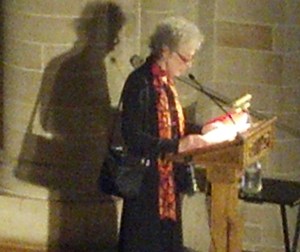
Usually, I’m not a Margaret Atwood fan. She makes it so difficult, through depressing stories and odd characterizations, to appreciate her wit, imagery and intellect. Reluctantly, I read The Year of the Flood. It was the choice for my book group, and the All Pikes Peak Reads 2012 selection. As part of the APPR festivities, Atwood spoke about sustainability and survival: two prevalent themes in her works.
Surprisingly, once I started reading I was anxious to continue. Although Atwood dismisses claims The Year of the Flood is a post-apocalyptic tale, nothing better describes it. The story takes place in a time when mutations, genetic engineering and an order of fear prevail. The flood refers to an unknown deluge caused by man’s errors and destructive predispositions. It is not a natural phenomenon; it’s a “waterless flood.”

God’s Gardeners is a small cult with a foundation in Christianity that celebrates the lives of such people as Rachel Carson and Euell Gibbons, among others, for the contributions they made to saving the environment. The Gardeners strive to protect nature and prepare for (and later survive) the flood. Within the cult, Toby and Ren, represent maturity and youth, respectively. Their narratives move the story forward. Atwood said she purposely incorporates multiple voices in her works because “I don’t like everyone to sound the same.” Toby is represented in third person, while Ren offers a first person perspective. The sermons of Adam One, the Gardeners’ leader, begin each chapter using second person voice.
I’m glad I read this and even more pleased to have heard Atwood speak. It provided insight into her work, but mostly served to demonstrate her keen sense of humor, which fortunately surfaces in this novel. A novel, by the way, which has, as Atwood stated, “A ray of hope.”
The Year of the Flood
Four Bookmarks
Anchor Books, 2009
431 pages



 The Blue Page Special