Archive for the ‘India’ Tag
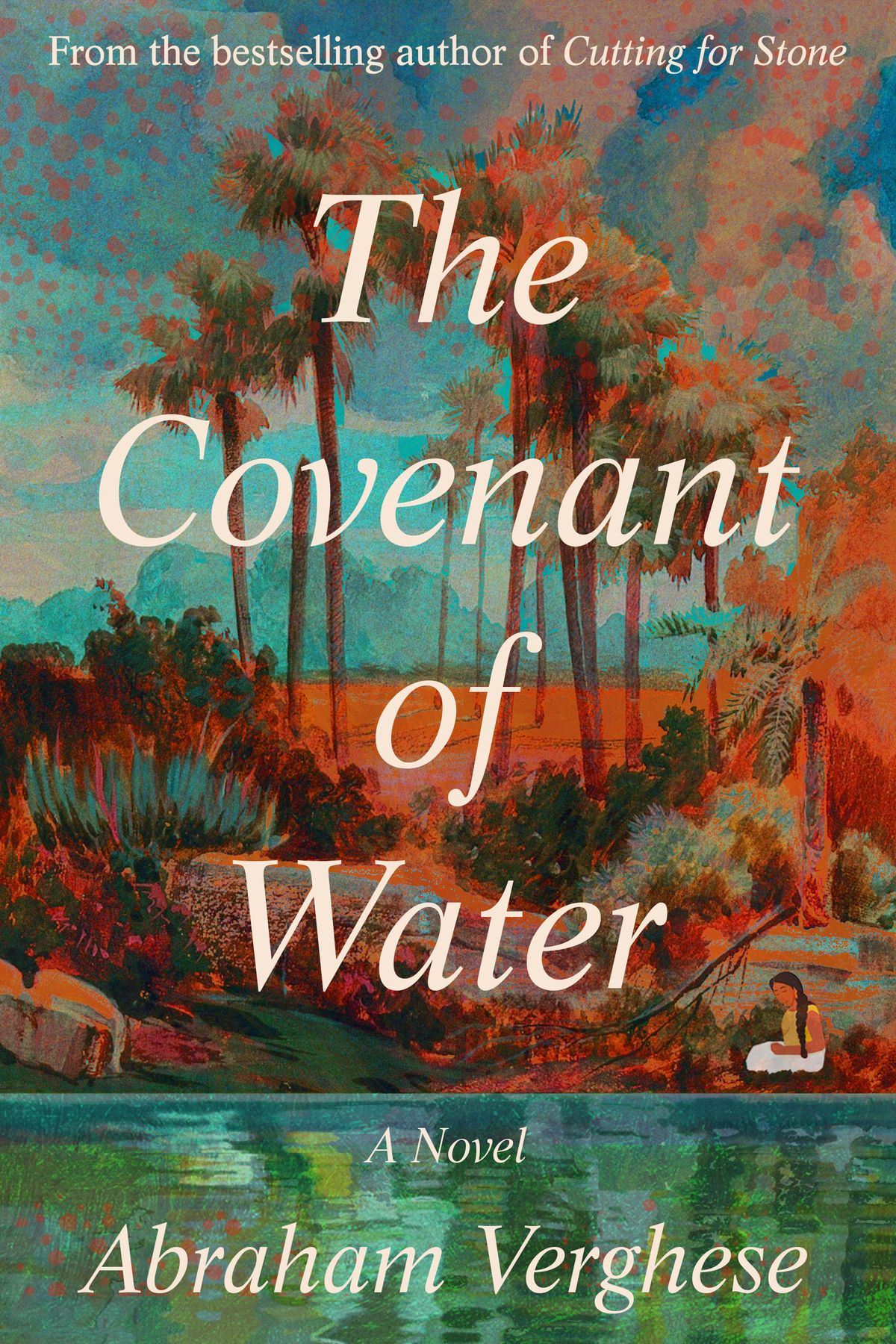
Whether it’s referred to as a tome, an extravaganza, or even a whale of a novel, all are apt physical, and some are literary, descriptions of Abraham Verghese’s The Covenant of Water. At more than 700 pages, if nothing else, it’s a marathon of a read.
Set in southwestern India, it encompasses 1900 to 1977. The narrative follows three generations of a family whose members have a history of drowning, known as “The Condition.” Besides the expanse of time, much of what adds to the book’s length is the number of characters introduced, then seemingly discarded only to eventually resurface.
Big Ammachi is the (direct and indirect) loving force binding all of them together. It begins with her as a 12-year-old girl betrothed to a much older widower with a young son and thriving farmland.
The author’s fortes are evident in the descriptions of the numerous evolutions of the relationships among those populating the book. This is rivalled only by the portrayals of the characters and the imagery of the various landscapes visited in the novel. Along with the family’s farmland, the latter includes Madras and a leper colony. Everything is connected; it just takes a while to see how.
Indian history, the caste system, British Raj and medicine are significant elements.
Tragedies and joys abound throughout this epic, with themes of faith and resilience. After questioning whether so many characters, settings and, ultimately, pages were necessary, it’s difficult to see how the story could have been told any other way.
The Covenant of Water
Four-and-a-half Bookmarks
Grove Press, 2023
724 pages, including acknowledgements and notes
The Age of Vice is a massive novel about inequity, corruption and loyalty. Despite its hefty size (more than 500) pages, Deepti Kapoor has crafted an epic story that is equal measures mystery and love story – my favorite combination.
Ajay is the manservant of Sunny Wadia, the son of one of the wealthiest and most powerful man in India. Ajay is imprisoned when he’s identified as the driver of the speeding Mercedes that kills five people. The narrative then jumps back 13 years when Ajay is a poor, barely-educated child in a rural area of India. When his father is beaten by the village leaders, Ajay is sold to help pay the family’s debts. He’s sent to a mountain farm where his situation is improved, although he’s still looked down upon for his station in life.
How Ajay came to be Sunny’s servant and charged with manslaughter is a circuitous tale of excessive wealth and waste amplified by exploitation. By contrast are Ajay’s strong work ethic and his gradual rise to Sunny’s shadow, something that comes with numerous perks but many strings attached.
Sunny is an addict and womanizer, but falls in love with a journalist. Their relationship is complicated. She’s not what Sunny’s father envisions as the perfect wife for his heir.
Bunty and his brother’s influence span much of the country and little goes unnoticed by either, including how Ajay came to be behind the wheel in the deadly crash.
Kapoor’s characters are vividly depicted as are India’s extremes.
The Age of Vice
Four+ Bookmarks
Riverhead Books, 2023
548 pages
The White Tiger is one of many names the narrator Balram Halwai gives himself in a series of letters he writes describing his life as a servant, driver, wanted man and entrepreneur. The letters, written over the course of seven nights and addressed to the Chinese premier, are confessional while providing insight into Indian life. Early in the narrative, Balram admits he’s wanted for the murder of his employer.
Aravind Adiga’s novel, through the letters, details Balram’s life as the son of a rickshaw driver in a small village. Although intelligent, Balram’s education is cut short when he’s forced to do menial work in a tea shop to contribute to his family’s nominal income. Eventually, he learns to drive and becomes the driver for a wealthy family. This is a change of fortune in many ways, including a move to Delhi.
This is not simply about the haves and have-nots. Balram can’t help but see the differences between the rich and the poor. As a servant he’s barely acknowledged as a human. Yet he’s philosophical as he earns a token wage which includes a place to sleep, albeit one teeming with cockroaches.
Balram is attentive to the activities and, particularly, the conversations of his employers. His awareness of the discrepancies around him helps set in motion a plan for change. The letters are more than Balram’s history; they also foreshadow his future. Adiga incorporates humor, mystery and commentary to create an engaging story about survival and success.
The White Tiger
Four bookmarks
FreePress, 2008
276 pages

Shilpi Somaya Gowda’s first novel, Secret Daughter, is about families – especially mother-daughter relationships. Two women, one unable to have a child and the other unable to keep hers, are the primary focus – along with Asha, the daughter given up by one and adopted by the other.
Somer, a pediatrician in the San Francisco Bay area is married to Kris, a surgeon originally from Mumbai. Across the world in an Indian village, Kavita gives birth to a daughter she knows her husband does not want, and will not let her keep. Although the women never meet their lives are unwittingly bound when Kavita leaves her child at an orphanage. Through a series of coincidences that often only occur in fiction, the girl, Asha, is adopted by Somer and Kris.
Gowda’s narrative moves from the Bay Area to Mumbai, as it shifts from one woman’s perspective to the other, before, thankfully, settling on Asha. Somer‘s character is whiney and distant; Kavita is mostly sad and compliant. Despite environment and genetics working against her, Asha grows up to be an intelligent, inquisitive young woman. That’s not to say, she is flawless. At her worse, as a teenager, she is rude and insensitive; at her best, as a college student interning at a Mumbai newspaper, she is empathetic and appreciative. Of course, it takes time for the latter qualities to evolve.
Gowda’s writing is strongest describing the contrasts between India’s wealthy and the destitute. The colors, sights, and smells are vivid – even when the reader might prefer otherwise.
Secret Daughter
Three Bookmarks
William Morrow, 2010
339 pages

Although I read a fair amount of nonfiction, my preference has always leaned toward fiction. As
I read Katherine Boo’s Behind the Beautiful Forevers, I had to remind myself this is a true
story – in in fact, many true stories; it’s simply written with the smooth, eloquent narrative that
makes it read like a really good novel. But, it’s sad and it’s true.
Boo writes of the Annawadi slum in Mubai, India. For three years she follows the lives of several
families and child-scavengers all trying to survive in an overcrowded, rat-infested community of
makeshift structures that serve as homes. Mubai has numerous slums that fit this decription, but
Annawadi is the one located in the shadow of the international airport with its cosmopolitan hotels.
What makes Boo’s chronicle so intriguing are the people and their efforts to make more of their lives.
As if poverty alone were not enough to keep them down, they face government corruption, lapses of
moral judgment, and fear generated by religious differences. Boo’s account includes the experience
of Abdul who, with his father and older sister, is charged with murder when a vindictive neighbor
lights fire to herself. The family’s efforts to move out of Annawadi are thwarted as income is lost and
bribes must be paid.
This description of trying to exist in Mubai’s slums is much, much more than what most think of as a
hard-knock life. Yet, for their individual and collective foibles, these people continue to dream that
someday they will have more.
Behind the Beautiful Forevers
Four Bookmarks
Random House, 2012
256 pages




 The Blue Page Special
