Archive for the ‘Flatiron Books’ Tag
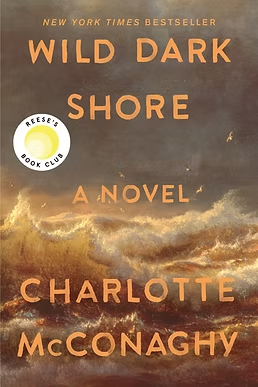
Grief, isolation, broken relationships and climate change are beautifully and tragically addressed in Wild Dark Shore by Charlotte McConaghy.
Dominick Salt and his three children are the caretakers and lone residents of Shearwater Island, near Antarctica. They’re organizing and packing the contents of a seed bank awaiting a ship to return them to the mainland. Rising tides, harsher weather conditions and the island’s isolation make it uninhabitable or a viable environment for continued study. Shearwater is a critical element of the story.
When a barely-alive woman washes ashore during a severe storm there’s an immediate sense of foreboding. Rowan’s reasons for traveling to Shearwater are suspect given Shearwater’s remoteness; when she reveals that she’s looking for her husband who had been in charge of the seed bank, the Salts’ reticence makes her suspicious.
As Rowan’s wounds heal she gets to know each of the children, while remaining mistrustful of Dom. The five characters are richly portrayed, each nearly eclipsed by grief and none able to communicate their feelings.
McConaughy’s writing maintains a palpable sense of tension throughout the narrative. It’s nerve-wracking and impressively captivating with numerous unanswered questions: what happened to the other members of the research team; how will the Salts adjust from their extremely secluded life; can their brokenness be mended; and more.
First person voice tells Rowan and Dom’s side of the story, while third person voice is used for the children. Short chapters further heighten a sense of dread, but also offer occasional glimmers of hope.
Wild Dark Shore
Five Bookmarks
Flatiron Books, 2025
302 pages, includes acknowledgements
Raquel Toro is a first-generation university student in her third year at an Ivy League school studying art history. She’s never heard of Anita de Monte but the two share several commonalities though they’re a generation apart in Xochitl Gonzalez’s novel Anita de Monte Laughs Last.
Anita was an up and coming artist in the mid-1980s before she’s found dead. Her husband, Jack, is a well-known, successful sculptor who, although professes his undying love, manipulates his wife to suit his moods/needs.
Jump ahead to the late 1990s, Raquel is certain she wants to do her senior thesis on Jack, with neither awareness of his deceased wife, nor knowledge of how she died. Although Raquel doesn’t realize it, readers will quickly see similar behaviors between Jack and Nick, the graduating art student from a wealthy family, with whom she becomes romantically involved.
There is passion in both relationships, but there are also strings attached. As she researches Jack’s work, Raquel identifies a period in which he produced little, if any, art. This is roughly the same time of Anita’s death, which is noted as either a fall from or push out of a high-story New York City window in the novel’s early pages. A subsequent trial following her death is also new to Raquel.
The engaging storyline is driven by chapters narrated by Anita, Raquel and occasionally Jack. Those revealing Anita’s side of the story require accepting the perspective from someone who’s dead, but very much alive in the spirit world.
Anita De Monte Laughs Last
Three and three-quarter bookmarks
Flatiron Books, 2024
341 pages
Of Women and Salt by Gabriela Garcia is a novel I wanted to fall in love with. Unfortunately, despite it having so many elements I’m drawn to, that didn’t happen.
With the exception of a Mexican immigrant and her young daughter, Garcia’s debut work focuses on the women in a Cuban family, several generations removed. Immigration, abuse, mother/daughter relationships, addiction, miscommunication and loss are brought together through glimpses into each woman’s life. The result is a disjointed narrative.
Loss is the most dominant thread, beginning with Maria Isabel in a cigar-rolling company in rural Cuba in 1866. As the only female roller, hers was the most compelling story. To keep the workers engage, a man read either from a novel or newspaper until war made it impossible to continue.
The next chapter is a leap to Miami 2014, where Jeanette, Maria Isabel’s great-great granddaughter is a grown woman and substance abuser. She’s a much less engaging character; yes she makes poor choices, but more is needed than illustrations of her bad decisions. Although she briefly helps the young daughter of the Mexican neighbor who’s apprehended by ICE, there’s little else appealing about her.
The characters need to be fully developed. It’s as if they’re faded photos without any nuance. While this is a work of fiction, the experiences the women endure are important because, unfortunately, they’re not unique. The impact would be greater if, instead of multiple situations, more details were limited to only a few.
Of Women and Salt
Two-and-a-half bookmarks
Flatiron Books, 2021
207 pages



 The Blue Page Special