Archive for the ‘family’ Tag
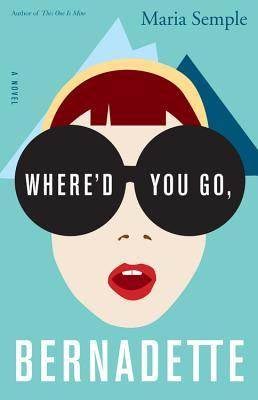
Where’d You Go, Bernadette by Maria Semple is engaging, funny, poignant, and even a bit silly. Set primarily in Seattle, the story also includes a few situations in Los Angeles and the Antarctic as Bernadette Fox tries to ward off a nervous breakdown in an environment seemingly designed to push her over the edge.
Bernadette is a semi-misanthrope; she dislikes nearly everyone except her husband, Elgie, and their daughter, Bee. Bernadette doesn’t make it easy to like her. She refuses to get involved with the parent groups at Bee’s school, and she avoids interaction – no matter how casual – with others to such an extreme that she relies on a virtual personal assistant who lives in India.
Semple has created an appealing dysfunctional family that has trouble meshing with an often-dysfunctional world. Bernadette, a one-time architect, is, in fact, a genius; she’s a past recipient of a McArthur Foundation Genius Grant. But she responds to stressful situations through radical reactions, including disappearing. Bernadette’s story is told through emails, letters and mostly Bee’s eyes. Bee is no intellectual slouch herself. She’s convinced there’s a logical explanation for her mother’s absence. And here’s where the real adventure begins as Bee sets off to find Bernadette.
Russian spies, potential identity thieves, private school students, and parents blind to their children’s excesses and foibles are just a few of the extras populating Semple’s novel. There are plenty of laugh-out-loud situations as well as a few shoulder-shrugging moments as Bee, who has a very good understanding of her mother, refuses to stop looking.
Where’d You Go, Bernadette
Four-and-a-half Bookmarks
Little, Brown and Co., 2012
326 pages

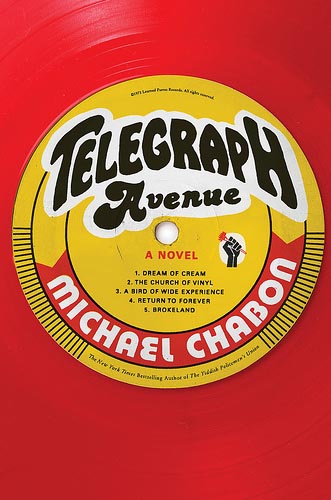
While wondering at the necessity, I marvel at the kind of concentration and craftsmanship it takes to write a single sentence that makes sense and holds interest as it spans 12 pages rife with characters, each distinctly different, who share a common struggle against fate, karma, some elusive and nebulous hand manipulating a game board with varying designs and obstacles; yet this engaging contest in Michael Chabon’s most recent novel, Telegraph Avenue, is played with swagger and fear by men, women and teenage boys fighting to hold onto dreams while desperately needing to relinquish the realities of their colorful lives.
I lack the skill, and inclination, to take a 100+ word sentence any further. Chabon can, but that’s the least of his mastery. Set in Oakland, his story about two men who run a (old school vinyl) record store in danger of being razed to accommodate a mega urban renewal project is a tribute to friendship, music and, oddly, especially family.
The novel is drunk with sensory images. Consider: “At 9:45 a.m. the first batch of chicken parts sank, to the sound of applause, into the pig fat.” Or: “… the loose weather stripping that peeped like a gang banger’s drawers from the seams around the back door.”
The major flaw lies in the glut of characters; initially, it’s difficult keeping track of who’s who. Nonetheless, it’s clear everyone, from actors to midwives, is just trying to get by in life while a poor economy, outdated technology and children get in the way.
Telegraph Avenue
Four Bookmarks
HarperCollins, 2012
465 pages

A Good American is not only an engaging tale about immigrants, it’s also a captivating
account of the power of family and community. Alex George’s novel begins as a love story,
which ultimately becomes a chronicle spanning four generations. George starts with the un-
likely courtship of Frederick Meisenheimer and Jette Furst in Hanover, Germany. The uncon-
ventional Frederick woos Jette, a robust independent woman, by singing Puccini from behind
a privet wall; thus setting a precedent for the importance of music in the Meisenheimer house-
hold. The pair soon relocates to Beatrice, Missouri.
Narrated by James, Frederick and Jette’s grandson, the novel is an absorbing examination
of domestic life. The story is abundant with an eccentric cast of supporting characters, rang-
ing from a giant to a midget. And, as James notes, “While we were growing up, so was America.”
Rural America is the perfect backdrop for the Meisenheimer portrait. This is not a glowing
portrayal because the members have their share of faults. Yet these only to serve to make
everyone more believable. As with any family, dysfunction does exist in the bloodline. Its
manifestation simply, and oddly, makes everyone even more endearing. The beauty, and
strength, of the novel is that it is filled with not just one good American, but many. It may
be easy to overlook the concept of America as a melting pot today, but George’s narrative,
even while acknowledging the negative elements lurking in the shadows, reflects the best
ingredients that make this country what it is.
A Good American
Five Bookmarks
G.P. Putnam’s Sons, 2012
387 pages

What begins campy and comic book-like soon assumes a more serious tone about
familial dysfunction in Karen Russell’s Swamplandia! This enigmatic coming-of-
age story is set in Florida’s Everglades, where the harsh environment is full of danger-
ous creatures and rich in bittersweet memories for the Bigtree family.
Thirteen-year-old Ava Bigtree is the narrator for most of the novel; when the setting
switches to the nearby coastal town of Loomis, Russell narrates. Swamplandia! is the
name of the Bigtree family’s alligator theme park. When Ava’s mother, the main attract-
ion as an alligator wrestler, dies, the family disintegrates. Ava’s 16-year-old sister is in
love with a ghost; Kiwi, the older brother, leaves to work at the competing theme park
in Loomis; and Chief, the children’s father, leaves Swamplandia to look, he says, for
funding. Through most of the novel, Ava is the most level-headed, so when she shows
her age, it’s a good thing for the reader, but not so much for Ava.
This is one whopper of a tale, but Russell creates complex characters facing difficult
issues in their lives, not the least of which is dealing with the mother’s death. The back-
drop of the theme park and alligators provides some levity on one hand and heavy-duty
allegory on the other. Russell’s beautifully-written descriptions and sentence structure
are captivating. There are some laugh-out-loud moments countered by creepy events.
Several times I considered closing the book to stop what was likely to happen, but
needed to keep reading just in case I was wrong.
Swamplandia!
Four Bookmarks
Alfred A. Knopf, 2011
316 pages




 The Blue Page Special