Archive for the ‘books’ Tag

Mark Haddon’s The Red House is a metaphor for the definition of family; the meaning can be obscured by comfort or serve as boundaries through which no one should cross. Haddon emphasizes the latter. Estranged brother and sister, Richard and Angela, meet for a family vacation shortly after their mother’s death. Richard’s a doctor and newly married to his second wife. Her 16-year-old daughter is part of the package. Angela and her husband have three children, but she mourns the still-born daughter she lost 18 years ago. These eight family members spend a week together in the English countryside as they tentatively reveal themselves to each other – some with better results than others.
Haddon’s approach is interesting. Each chapter represents one day of the vacation, and everyone’s perspective is provided to set the scene. Initially, it’s difficult, even confusing, keeping track of who’s who. However, as the storyline evolves, more about Angela’s grief is explained, not just from her viewpoint but her husband’s, too. Also, Richard is not as professionally secure as he projects, this from his wife.
Haddon blends the familiar (sulky teenagers) with the uncomfortable (sulky parents). Slowly, observations and experiences round out each character. Jumping from one person to another becomes less awkward. Mostly, the time together leads to everyone’s better understanding of him or herself. Haddon writes, “Behind everything there is a house … compared to which every other house is larger or colder or more luxurious.” Sounds a lot like the way all families are perceived.
The Red House
Three-and-a-half Bookmarks
Doubleday, 2012
264 pages

Similar themes, character types and unusual situations find their way to John Irving novels. His latest, In One Person, is no exception. Despite these commonalities, it’s an original look at acceptance and the secrets families hide in plain view, particularly when it comes to sex. The most covert issue is the sexuality of young Billy Abbott, the protagonist/narrator. Billy struggles with this; it’s also something family members have insight into but refuse to reveal – hoping they’re wrong. Yet all around him are mixed messages, from Billy’s loveable cross-dressing grandfather to the cruel teenage wrestling superstar. Billy’s story spans more than 50 years, and it’s clear his family’s hopes were dashed. Billy isn’t gay, he’s bi-sexual, but that’s not what they’re hiding.
Among the characters populating Irving’s novel are angry mothers (several), wrestlers (many), and transgenders (numerous, although Billy’s generation used the term transsexuals). A residential boys school in rural Vermont – another typical Irving element – is among the settings. Perhaps the strongest of the similarities is the power of friendship. Billy’s true friends are an eccentric bunch with shared worries. The complicated town librarian (my favorite character) probably knows Billy best.
The novel is like a one-sided conversation Billy has with the reader. Billy repeats some details, tells some things out of sequence and offers a few teasers. As in his other work, Irving’s irony and descriptive writing prevail.
A Prayer for Owen Meany is not just my favorite book by Irving, it’s one of my favorite books by anyone. In One Person is not on that pedestal, but it’s close.
In One Person
Four-and-a-half Bookmarks
Simon & Schuster, 2012
425 pages

James W. Hall writes crime thrillers and teaches college-level courses about popular
fiction, specifically bestsellers. Although it’s interesting, his recent nonfiction endeav-
or, Hit Lit subtitled Cracking the Code of the Twentieth Century’s Biggest
Bestsellers, reads like a textbook, but one likely to end up on the bargain table in a
bookstore.
The concept is intriguing: analyze 12 novels and identify the characteristics that
make them bestsellers. Included in the list is To Kill a Mockingbird, Gone
with the Wind, The DaVinci Code, The Exorcist, Valley of the Dolls,
The Godfather, The Dead Zone, The Firm, The Hunt for Red October,
The Bridges of Madison County, Peyton Place and, Jaws. I admit I’ve
only read six. Interestingly, the dozen were also made into popular movies – but
that’s another story. Hall, apparently stuck on the number 12, establishes that same
quantity of criteria to examine and actually makes a good case for why, say, Valley
of the Dolls struck a chord with so many readers. What might be even more worth-
while would be to compare these with less popular tomes. to me, the titles selected
by Hall are the equivalent of white bread. It’s easy enough to slap together a sand-
wich between two pieces of nutrition-lacking, tasteless slices, but there are so many
other varieties that go well beyond mere basic sustenance.
I can easily envision using Hall’s work in the classroom, with the caveat that the num-
ber twelve, both in the book selections and the characteristics reviewed, is not neces-
sarily a magic number.
Hit Lit
Two-and-a-Half Bookmarks
Random House, 2012
287 pages (includes index)

A Good American is not only an engaging tale about immigrants, it’s also a captivating
account of the power of family and community. Alex George’s novel begins as a love story,
which ultimately becomes a chronicle spanning four generations. George starts with the un-
likely courtship of Frederick Meisenheimer and Jette Furst in Hanover, Germany. The uncon-
ventional Frederick woos Jette, a robust independent woman, by singing Puccini from behind
a privet wall; thus setting a precedent for the importance of music in the Meisenheimer house-
hold. The pair soon relocates to Beatrice, Missouri.
Narrated by James, Frederick and Jette’s grandson, the novel is an absorbing examination
of domestic life. The story is abundant with an eccentric cast of supporting characters, rang-
ing from a giant to a midget. And, as James notes, “While we were growing up, so was America.”
Rural America is the perfect backdrop for the Meisenheimer portrait. This is not a glowing
portrayal because the members have their share of faults. Yet these only to serve to make
everyone more believable. As with any family, dysfunction does exist in the bloodline. Its
manifestation simply, and oddly, makes everyone even more endearing. The beauty, and
strength, of the novel is that it is filled with not just one good American, but many. It may
be easy to overlook the concept of America as a melting pot today, but George’s narrative,
even while acknowledging the negative elements lurking in the shadows, reflects the best
ingredients that make this country what it is.
A Good American
Five Bookmarks
G.P. Putnam’s Sons, 2012
387 pages

The Black Minutes by Martin Solares is a two-tiered crime novel held together by in-
teresting characters and captivating murders over a 20-year time span. The writing is
icing. Solares creates easy to envision situations in a fast-paced style. The only problems
occur in the transitions from reality to dreams and the number of personalities filling the
pages.
Thankfully, Solares includes a three-page Cast of Characters to help keep track of who’s
who. Most are corrupt law enforcement, politicians, clergy, and businessmen; but not
everyone is a bad guy. While there may not be any white knights, there are a few gray
ones. The story begins with the murder of a young journalist investigating a serial kill-
ing spree that took place 20 years ago in his town of Paracuan, a Mexican port and home
of a drug cartel. Ramon Cabrera is the honest police investigator who is removed from the
case shortly after he connects a few dots. Cabrera establishes a relationship between the
journalist’s death, the past murders and a scrupulous detective, Vincente Rangel, who
led the investigation two decades ago. This is where it gets fun.
Solares incorporates different narrators, while maintaining his role as storyteller. Certain
chapters are identified as “testimony” wherein the first person voice of one of the characters
tells his version before the writing reverts to third person. The majority of the book tracks
Rangel’s investigation, followed closely by Cabrera’s. Several surprises surface that make
the past more closely linked than one can imagine.
The Black Minutes
Four Bookmarks
Black Cat, 2010
436 pages

The smoke and flames rose into the sky beginning Saturday afternoon. As the
proverbial crow flies, the fire was probably five miles from my home, and many
friends live in areas of imminent danger. They were evacuated immediately. In
the early hours of Sunday morning the entire town of nearby Manitou Springs
was evacuated. Although residents there were allowed home less than 24 hours
later, it was unsettling for everyone. As neighborhoods around our home received
evacuation notifications, my husband and I discussed what we would take: not
surprisingly, photos and family mementos topped the list. When we got word we
were in a pre-evac area, it was time to really consider what to pack. This difficult
task was made even more daunting by the fact that by this point thousands of people
had been displaced and many had lost their homes.
We have shelves and shelves of books. Looking at them I knew I would not be able
to select just a few to carry away. Only one of our sons is home from college this
summer. He packed a box filled with what he called his “theatre and geek books.”
My husband packed his Bible. I looked at my nightstand stacked high; I searched
the shelves near my desk, in the living room, in the study. I even looked at the titles
my absent sons have in their rooms.
Finally, like a scene from Moonrise Kingdom, I packed the library books in a suit-
case. What books would you take?

I am not sure I would have chosen Corinthia Falls off the bookshelf on my own,
but I volunteered to judge a competition. Kim Hutson’s book is what I received in
the mail, along with a list of reading criteria. It was entered in the Fiction Category,
but that should’ve been amended to Christian Fiction. There’s nothing wrong with
that genre, I just think it warrants a heads up. Or maybe I should have paid more
attention to the photo of a church on the cover.
The book gets its name from the small town in Oklahoma where most of the story
takes place. The first two-thirds is narrated by 18-year-old Timber Oaks who has a
strong sense of faith, a group of best friends, loving parents, and an impressive golf
game. The town is full of the requisite eccentric characters, many of whom initially
don’t get along. An itinerant evangelist arrives to help the Corinthia Falls Church,
the townspeople, and Timber fully realize the presence of God in their lives.
The book’s final third begins 30 years after Timber’s narrative ends. Priscilla Luke,
a long-time journalist and, as it turns out, Oaks’ family friend takes over as narra-
tor. This change in voice is interesting. Pris brings the reader up to date on the
major changes many of the characters have experienced, and tells Timber’s story
from the outside looking in.
Some editing and grammar issues distract from what is otherwise a story strong on
faith with occasional lapses in believability.
Corinthia Falls
Three Bookmarks
Outskirts Press, 2011
404 pages
Sorry for the delay in posting, but the wildfire here in Colorado Springs was a major distraction this weekend. We still need some rain.
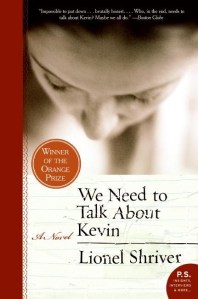
If you read Lionel Shriver’s We Need to Talk About Kevin be sure you have
someone with whom you can talk about it.
This disturbing, yet compelling, story unfolds through a series of letters written by
Eva to her absent husband, Franklin. The purpose of the letters is to try to under-
stand how their 15-year-old son, Kevin, could murder seven classmates, a teacher,
and a school cafeteria worker.
Through a clear almost detached, yet very personal, perspective Eva expresses the
difficulty she has in relinquishing her independence to become a mother. Following
Kevin’s birth, she continues to lack a natural maternal instinct. Still, Eva is not
without heartfelt emotion and empathy; she simply has difficulty showing these traits
to Kevin.
On the other hand, neither is Franklin completely blameless; although his side of the
story is not told. As seen through Eva’s eyes, Franklin maintains a vise-like grip on
the image of a happy, American family. His perception does not include discipline,
respect to others, or a recognition that there are two sides to every story.
Kevin is simply a bad kid, albeit an exceptionally bright one. The concept of uncon-
ditional love falters under Shriver’s pen. Parents are bound to examine their parent-
ing style and question whether it is the right approach. It is easy to be critical of
Eva and Franklin, but it’s hard to know if anyone else could have parented Kevin with
a different outcome.
We Need to Talk About Kevin
Three Bookmarks
HarperCollins, 2006
432 pages
(I wrote this review several years ago, but decided to post it here.)

What begins campy and comic book-like soon assumes a more serious tone about
familial dysfunction in Karen Russell’s Swamplandia! This enigmatic coming-of-
age story is set in Florida’s Everglades, where the harsh environment is full of danger-
ous creatures and rich in bittersweet memories for the Bigtree family.
Thirteen-year-old Ava Bigtree is the narrator for most of the novel; when the setting
switches to the nearby coastal town of Loomis, Russell narrates. Swamplandia! is the
name of the Bigtree family’s alligator theme park. When Ava’s mother, the main attract-
ion as an alligator wrestler, dies, the family disintegrates. Ava’s 16-year-old sister is in
love with a ghost; Kiwi, the older brother, leaves to work at the competing theme park
in Loomis; and Chief, the children’s father, leaves Swamplandia to look, he says, for
funding. Through most of the novel, Ava is the most level-headed, so when she shows
her age, it’s a good thing for the reader, but not so much for Ava.
This is one whopper of a tale, but Russell creates complex characters facing difficult
issues in their lives, not the least of which is dealing with the mother’s death. The back-
drop of the theme park and alligators provides some levity on one hand and heavy-duty
allegory on the other. Russell’s beautifully-written descriptions and sentence structure
are captivating. There are some laugh-out-loud moments countered by creepy events.
Several times I considered closing the book to stop what was likely to happen, but
needed to keep reading just in case I was wrong.
Swamplandia!
Four Bookmarks
Alfred A. Knopf, 2011
316 pages

I’ve always loved to read, but there are times I just can’t bring myself to pick
up a book. Suffering overwhelming grief, experiencing mind-numbing fatigue,
and finishing an exceptionally well-written book have all, at one time or anoth-
er, contributed to a reading lull. I’ve had a bit of trouble picking up a book since
finishing The Dovekeepers. This made me think about other books that have
stopped me in my reading tracks*: Cutting for Stone, The Night Circus, A Prayer
for Owen Meany, among others, I’m sure.
Occasionally there are times I stop reading a particularly good passage just to
relish the image or writing. This happens frequently when I read Barbara King-
solver. But that’s pleasurable. I truly do savor good books. I get lost in them. I
think about them. I want characters to move into my home. Some stories I just
don’t want to end. When the especially good ones do, I sulk. I want more of the
same, not something new.
Perhaps I’ve been over-reading, a concept I’ve never really considered until now.
Is it possible to read too much? I hope not, but I am satiated from my last read,
and I’ve been reluctant to start anything new. Fortunately, this usually doesn’t
last long.
When I can’t read, no matter what the reason, I feel unmoored. The great thing
about books, though, is that I know there are others certain to stop me yet again.
I can’t wait.
*This is obviously taking that end-of-a-good-book feeling to the extreme.



 The Blue Page Special