
This week my younger brother reaches a milestone birthday. Late last year he published
a book. Both of these events are significant, but it’s the latter that makes me exceptionally
proud and very jealous. He wrote a book! And it’s published! Although I have the copy he
gave me, when I saw the book in a bookstore, I was thrilled beyond words – so I took a
photo.
Once I decided to start my blog I knew I did not want to review meals made by friends or
myself, and I thought I should not review books written by friends or family members. I
didn’t really think the issue would arise regarding books by people I know; but it has, and
I feel the same. I don’t want to review my brother’s book because of my background as a
journalist and my, perhaps misplaced, desire for objectivity. I can say with all sincerity he
has written an attractive, informative book about architect Wallace Neff whose fascinating
building process involved the use of balloons and concrete. I’d never heard of this before.
I can say the book is well-researched and well-written. But I can’t, I won’t, rate it because
to say I love it could be misconstrued as sisterly-love-induced bias. Conversely, if I say I
despise it that could be chalked up to good old fashioned sibling rivalry. I don’t hate it, and
I do love my brother.
Happy Birthday, Jeffrey! Keep writing. You make me envious – and proud!
No Nails, No Lumber: The Bubble Houses of Wallace Neff
By Jeffrey Head
Princeton Architectural Press, 2011
176 pages

Small plates don’t mean little flavor; and a tapa here a tapa there while din-
ing at Nosh make it impossible to leave hungry. In fact, it’s easy to eat dish
after dish, just because they’re smaller portions and served separately. It’s
also possible my husband and I simply over-ordered.
To start, we selected the tempura Calamari served with tart, spicy dipping
sauce. The menu changes frequently at Nosh, but I was glad to see a long-
standing favorite still available: Roasted Cauliflower with caramelized onions
and cashews, enhanced with fresh basil. We also had the Nosh Burger, Fried
Chicken with Waffle, Housemade Potato Chips, and dessert – I’ll come back
to that.
We overheard our server describe the fried chicken and waffle as a “breakfast-
for-dinner kind of thing,” and then add, “And guys seem to like it more than
women.” Hah! It’s nothing like breakfast, especially since the syrup drizzled
around the plate was flavored with smoked Serrano. As for it being a guy thing,
I’m amazed at sexism in women. I thoroughly enjoyed the combination of an
airy Belgium Waffle with a crispy fried chicken; the honey butter was overkill
though. The burger is a slider on steroids served with wisps of fried onions on
a bun made in-house.
Desserts are exceptionally small: think shot glasses with baby spoons. This is
good and bad. It’s bad because it makes Chocolate Pot de Crème, Crème Brulee,
and Chocolate Chip Cookie Dough Pop seem like controlled substances, and
good because we’d already over-eaten.
“Nosh”
Four-and-a-half Plates
121 S. Tejon St.
Colorado Springs, CO

I’m a careful driver, but some days I forget having passed a certain roadside
marker, or I have no recollection of having turned left at the light. Based on
Charles Duhigg’s The Power of Habit, it has less to do with a faulty memory
and is more about habit – the consistent recurrence of a deliberate choice.
Duhigg looks at habit from three perspectives: personal, corporate, and socie-
tal. The first two are the most fascinating and well-developed. With thorough
research and a conversational style, Duhigg relates scientific studies about
individuals and the patterns their brains establish to create habits. The author
considers individuals who completely alter their lifestyles by choice, as well
as those whose lives are changed by trauma or illness. He identifies three ne-
cessary elements: cues, routines, and rewards needed to establish habits.
The most interesting, albeit disturbing, aspects are found in the corporate view.
Duhigg reinforces what we already know: our spending habits are not secret.
This loss of privacy is not a new concern, but how we lose it is disconcerting.
Duhigg examines everything from how employees are trained to respond, to how
data is manipulated. The book’s weak link comes as Duhigg combines habitual
actions that evolve into addiction with those resulting from a physical medical
condition when examining societal aspects.
Although the focus of the book is to consider “why we do what we do in life and
business,” Duhigg does offer some suggestions for breaking the triad of habit,
which might be worth a try.
The Power of Habit
Three-and-a-half bookmarks
Random House, 2012
291 pages, plus notes and index

Rather than write individual reviews of the places we ate on our recent trip
to San Francisco, I decided to just share some brief impressions.

Our hotel was close to Japantown, so that’s where we went for a late dinner. We
found a Japanese Barbecue restaurant across from a small ramen house. The lat-
ter had a crowd lingering at the door. We noticed very few people at the barbecue
place. I thought the line at Suzu, the noodle shop, said something we needed to
discover for ourselves. Suzu makes three types of noodles: ramen; udon; and soba.
I ordered ramen with cilantro, which came in a large bowl deep enough for me to
put my face into. This was a good thing since it made it easier to slurp the long, silky
noodles soaking in a seasoned broth. Scallions, bamboo shoots, cilantro, of course,
and thinly sliced pieces of pork were mixed with the ramen. It was comforting, filling,
and the wait was surprisingly short.
1825 Post St.

Bambino’s Ristorante, located in the Haight, is small with an attentive but unob-
trusive staff offering a range of traditional Italian dishes. Although I suspect the food
can stand on its own to create a perfect dining experience, I think the dining party
also played a huge role in the meal’s success. My husband and I enjoyed asking our son
and niece about life in San Francisco. In their mid-20s, they embrace their experiences
and opportunities with humor and appreciation. Yes, my Angel Hair Pasta with arti-
hoke hearts, tomatoes, pepper flakes and shrimp was delectable. We shared tiramisu
and crème brulee for dessert. On the heels of an appetizer of perfectly fried calamari,
the pasta, bread, and wine, they were excessive – but enjoyable. Yet, I think the laugh-
ter, the conversation, and the ambiance of the restaurant contributed to a completely
pleasurable evening.
945 Cole St.

The Ferry Building Marketplace is a tourist mecca with good reason. It features a vari-
ety of shops with a range of fresh ingredients and locally-sourced products; and it has
several good restaurants. Since it was midday we opted for Gott’s Roadside. Given its
location, it obviously wasn’t roadside – that’s reserved for the Napa and St. Helena sites.
The menus are the same though. Gott’s started as a walk-up burger joint, but has evolv-
ed into an upscale gourmet dining establishment with fresh ingredients as a driving force.
Food is ordered at the counter, wrapped in paper and served in plastic baskets, but that’s
where the ties to the past end. I had blackened shrimp tacos with avocado, creamy cole slaw,
peppers and sour cream. The thick strawberry milkshake had bits of fruit and lots of
flavor. What a treat!
1 Ferry Building, Space 6

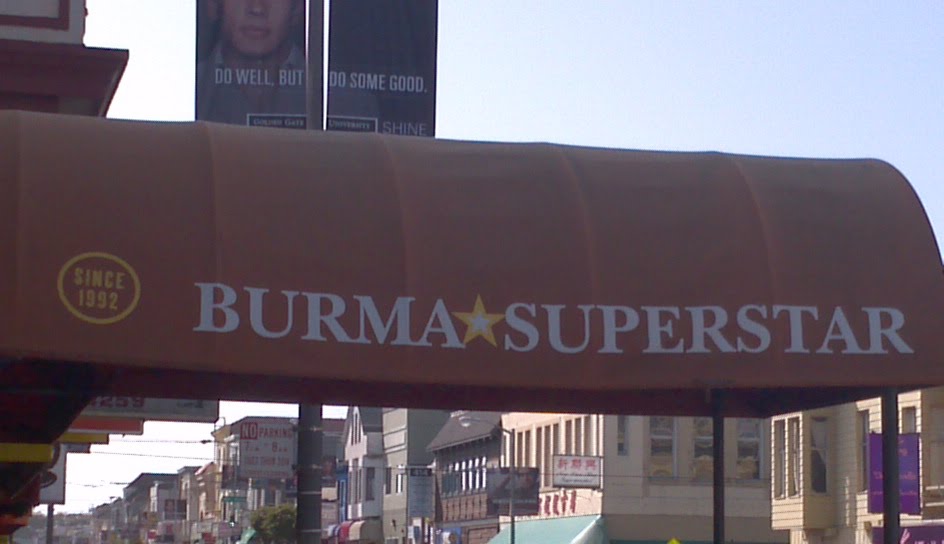
One possible way to avoid the wait for a table at Burma Superstar might be to
show up as soon as the doors open at 11:30 a.m. Otherwise, be sure to bring some
patience along with your appetite because this ultra-popular eatery in San Francisco’s
Inner Richmond neighborhood attracts quite a crowd throughout the day. Nonethe-
less, the food is worth every minute spent in anticipation.
Although I am unfamiliar with Burmese food, it’s still easy to appreciate fresh,
distinctive flavors – and equally effortless to take some cues from other diners
and the wait staff. We started with the Vegetarian Samusa Soup, which boasts a
creamy base with a hint of cumin and is full of an unusual but remarkably well-
matched combination of ingredients including samusas, cabbage, onions, and lentils.
Our graduate student son insisted we dine at Burma Superstar during our week-
end visit. He suggested we order a noodle dish and mango beef. However, it turns
out the latter is a seasonal dish, so it wasn’t available. Instead our server recom-
mended Steak Kabat, a medium-spicy blend of tender pieces of beef, tomatoes, onions,
peppers, and mint. He stressed that it was not overly-spiced; apparently the super-
spiced dish is the Chili Lamb. “The chef cannot even make this medium,” he said. The
Kebat was fiery enough. A cool complement was the Nan Pia Dok, coconut curry chicken
with flour noodles.

The small restaurant itself is rather nondescript, which is fine since the focus is so
clearly on the food and service.
Burma Superstar
Four Stars
309 Clement St.
San Francisco, CA

Julian Barnes’s The Sense of An Ending succintly examines the lackluster
life of Tony Webster, an uninspiring British gentleman deficient in confidence
and family background. Tony narrates the story of his very ordinary life from his
school days to his retirement; but don’t worry, it’s not as tedious as it sounds.
Whole elements, from marriage to parenting to divorce, are simply allotted a
passing mention. Although, intrigue is found, as contradictory as this may seem,
in the mundane when Tony’s conventional past rear-ends his present day exist-
ence forcing him to scrutinize incidents more closely.
Tony’s story relies on his memory, which is like everyone’s: a bit faulty. The
novel’s retrospective focus is on Veronica, Tony’s first real girlfriend, and Adrian,
his school chum. Both play a large part in Tony’s younger life, although Barnes’s
tone is particularly casual toward them. It’s as if these relationships are no more
significant than passersby on the street. Herein is one of Tony’s major flaws, as
identified by Veronica: nothing excites him. This inability to be moved, or even
demonstrate it, is part of Veronica’s palpable frustration with him. Not that she
is free from fault either. He admits he sees only the obvious, which is interesting
given that he is oblivious to so much. Nonetheless, a mystery ensues with Tony
trying to finally understand the connection with Veronica, her family, and Adrian
to vague recollections of long-past incidents and snippets of conversations.
This terse novel suggests a lot about how and what we choose to remember.
“The Sense of An Ending”
Four Bookmarks
Alfred A. Knopf, 2011
163 pages

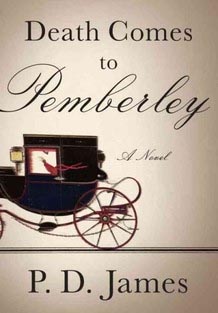
I imagine it’s entirely possible to enjoy Death Comes to Pemberley even if, heaven for-
bid, you’ve never read Pride and Prejudice; but I especially appreciate P.D. James’s latest
mystery because I do know about the Bennet and Darcy families. The novel begins six years
after Jane Austen’s Elizabeth and Darcy are married.
A few new minor characters are introduced, but James, for the most part, extends the lives
of those created by Austen in a completely believable manner: the Darcys have two young
boys; Jane and Bingley are regular visitors to Pemberley, the Darcy estate; and Wickham,
the troublemaker in the original work has a similar role, with his wife Lydia not far behind
in her ability to exasperate.
The story begins on the eve of the annual ball overseen by Elizabeth as she continues a
tradition started by Darcy’s mother. The preparations are interrupted when an uninvited,
hysterical Lydia appears believing Wickham has been shot nearby. The characters’ react-
ion to this news, subsequent discoveries, and a trial in London’s Old Bailey are sheer en-
tertainment. In James’s hands, the story is plausible. The characters react just as one
would expect of proper, early 19th century British gentry. Family obligations and public
perceptions dictate their behavior.
The numerous and recent spinoffs, including combining zombies with Pride and Prejudice,
even if only meant to introduce or reacquaint readers to Jane Austin, have never appealed
to me. However, James has created something completely original from classic literature
without diminishing appreciation for Austen’s writing.
“Death Comes to Pemberley”
Four Bookmarks
Alfred A. Knopf, 2011
291 Pages

Any place that goes by the name Hell’s Kitchen must be pretty confident that its
food is actually divine. At Ruffrano’s Hell’s Kitchen Pizza that doesn’t mean
the place is heavenly. In fact, far from it, but the pizza is, well, damned close.
Attitude is everything and the guys (I haven’t seen any women) stretching the
dough and taking the orders are no-nonsense whadda-ya-want pizza pie poten-
tates. Sometimes the pizzas are ready when expected, and other times they’re
not. You wanna make a deal out of it, go somewhere else. This isn’t something
I’ve seen or heard, it’s just a feeling; I’ve never left without my pizza though.

The crust is firm without being a brick, and thin without taking the shape of my
hand as I ate. The best thing about it is the sauce that graces the top. Thick and
full of intense tomato flavor, I almost wanted to pour it over a bowl of pasta.
Almost. The sauce with the crust and smoky mozzarella cheese is the food of
quasi- angels. We ordered Grandma’s Pie Bake, which is described as a “reverse
pan bake,” but no one explained what that means. The rectangular-shaped pizza
is simplicity at its best: sauce, cheese and basil. It’s too hearty to be a Margherita.
The only problem was charred corners. The Four Cheese White Pizza with ricotta,
mozzarella, provolone and parmesan is decadently gooey.
I recommend take-out. The surly staff may make you feel like hell, but the pizza
doesn’t.
Three-and-a-half plates
Ruffrano’s Hell’s Kitchen Pizza
9 Ruxton Ave.
Manitou Springs, CO

For some reason quality isn’t the only thing I associate with price, it’s also ambiance.
So I was surprised by the tony Famous Steak House where red meat reigns amid
a stylish but noisy dining room.
My friends and I had been anxious to try The Famous, and Restaurant Week literal-
ly afforded us the perfect opportunity. For $50 per couple, choices included the Caesar
salad or iceberg wedge with blue cheese; filet, ribeye or salmon; and cheesecake or
chocolate torte. The regular price of the filet is $38, so this was quite the deal.
The place was packed, which was most obvious from the sound level. I would not
choose this restaurant for a romantic evening. Although I did see a couple enjoying
their evening together – based on their proximity to one another in their circular
leather booth. I tried not stare, but since we were seated facing them, in a similar
booth, they were in my direct line of vision.
The iceberg wedge was almost a meal in itself. This, our server said, is a perfect salad
for blue cheese lovers; it was. Three of us ordered the filet and we all agreed it was
cooked very well but wasn’t fork-tender. Our odd-man-out ordered the ribeye and
was disappointed because it lacked the heartiness he associates with the cut.
The creamy cheesecake was perfect to end the meal, but we had to walk down the
street to a wine bar afterward to be able to hear each other talk.
The Famous Steak House
Three Plates
31 N. Tejon
Colorado Springs, CO
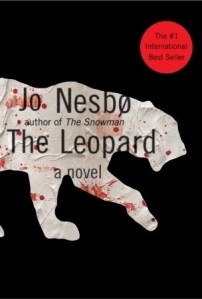
I’m not a fan of blood and gore thrillers in film, but put the stuff in a book
and I’m hooked. Jo Nesbo’s latest in the genre begins with terror and rare-
ly allows the reader time to breathe a sigh of relief. The Leopard starts
roughly where The Snowman left off, with Harry Hole now living in Hong
Kong where gambling and opium dictate his life – but not for long since
the Norwegian police need help solving another murder spree back on his
home tundra.
Hole doesn’t take long to determine the murders are related. Just as he
did in the previous novel, Nesbo takes readers on a hold-onto-your hats,
whiplash-inducing ride from one possibility to another, then back again,
and again. Additionally, he throws in several subplots just to keep things
really moving. The lure that actually brings Hole back to Norway is not
the challenge of the chase, it’s his near-death, elderly father. As Hole
unpacks the emotional baggage this creates, he establishes the connect-
ion of the murders, pines for his ex-wife and stepson, is attracted to a
female investigator, and is entangled in a turf war between the Oslo crime
unit and state police. This may sound like standard mystery ingredients, but
they’re not. And, it may make Hole seem like a superhero, but no way.
The beauty of Nesbo’s writing is the attention to detail, the depth of his
characters, and the thrill he creates as they battle to thwart or uphold
justice in very human ways.
The Leopard
Four Bookmarks
Adolph A. Knopf, 2012
517 pages








 The Blue Page Special