
It’s not unusual for museums to have exceptional gift shops and restaurants. The National Museum of Wildlife Art earns kudos for both. The aptly named Palate offers a creative menu and expansive views of the National Elk Refuge just north of Jackson, Wyo.
Several bronze sculptures are visible from U.S. Highway 191, but the collection is more impressive in the museum’s parking lot and lobby. Still, it’s the food that recently garnered our attention.
Salads, pasta, soup and sandwiches comprise the menu. An extensive wine list also available.
We opted to share three plates: the Pork Belly BLT, Bison Gyro and Roasted Green Beans.
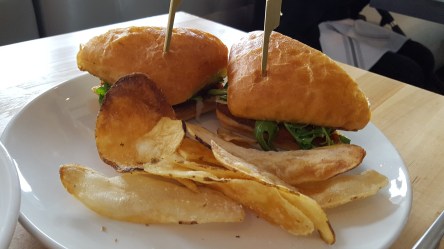
The BLT had several spins, besides the fact that it featured pork belly. With arrugula and tomato jam, the sandwich was further elevated thanks to lemon caper aioli and sunflower pesto. The works were served on ciabatta making this no ordinary diner mainstay. House-made chips completed the plating.
The gyro was, perhaps, my least favorite. This may have been only because the BLT was so exceptional. Shredded meat with creamy, whipped feta, pickled onion and cucumbers were served on Indian frybread. It was also accompanied by chips.

Almond vinaigrette and thin crispy slices of onion covering the roasted green beans. These were hard to share.

Harder to share was the Peanut Butter Chocolate Bar not only because it was delicious, but it was difficult to cut. The rich peanut butter mouse on a pretzel crust topped with chocolate was like an upscale Reese’s Peanut Butter Cup.
Palate
Four Plates
National Museum of Wildlife Art
2820 Rungius Rd.
Jackson, Wyo

For most, Rock Springs, Wyo., isn’t exactly a destination spot, but if traveling in either direction on Interstate-80 or heading north to Jackson Hole, it’s good to know there’s at least one spot to grab a quick, and tasty, meal. Besides, it’s hard to pass up a place called Chill Grill.
This is mostly a burger and fountain joint, without a counter. The space is small and decorated with 45s, and 33s on the wall. There’s a tribute to Elvis on one side and Marilyn Monroe on the other. Chill Grill evoke memories of the Fonz and Happy Days even without carhop service.
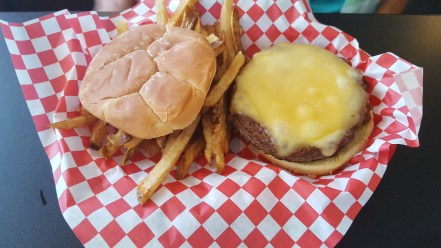
The menu offers sandwiches, burgers, hot dogs and salads, along with multiple pages of ice cream treats.
The juicy cheeseburger came with fresh-cut French fries. A “burger bar” lets diners add their own basic extras like pickles and onions.
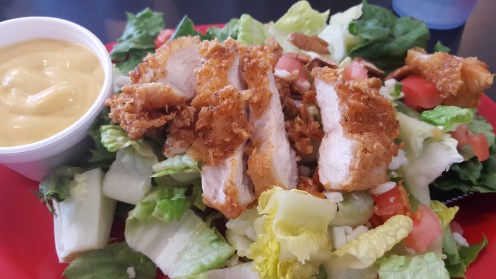
Crispy chicken caught my eye; it’s available as an entrée or on top of salads. I had the latter. Sliced chicken breast served on a bed of greens with tomatoes and honey mustard dressing. I wasn’t a fan of the dressing, but the chicken was indeed crispy and I let myself believe I was having a healthy meal.
I was tempted to have a strawberry shake, but resisted only to succumb to a chocolate chip cookie dough ice cream cone so large I couldn’t finish it. The hot fudge sundae featured the real stuff, although the topping wasn’t hot enough to even threaten melting the vanilla ice cream.
Chill Grill
Four Plates
1758 Elk St.
Rock Springs, Wyo

Not all mysteries are thrillers; I like those that make me want to sleep with the light on – lots of lights. I expected to be kept awake by Ruth Ware’s The Woman in Cabin 10. I wasn’t. I enjoyed it as a mystery, but it fell short as a thriller.
The story is intriguing enough: a small group of passengers aboard a boutique luxury cruise liner bound from England to Norway’s fjords. The 10-cabin ship is owned by an exceptionally wealthy man who has invited a few friends and members of the media for the maiden voyage. Part of the problem is the main character: Laura “Lo” Blacklock, a travel magazine low-level journalist who lucked into the assignment. Ware doesn’t imbue Lo with many attributes that evoke much empathy or interest.
The mystery begins when, after drinking too much on the first night of the cruise, Lo is convinced that the woman in the cabin next door (#10) was thrown overboard. It’s the same woman who had earlier lent mascara to Lo. The problem is, according to the ship’s manifest, the cabin is unoccupied.
Lo knows the woman existed; she had proof. The narrative follows her efforts to determine what became of the woman in the face of incredulity from others. In this, Ware is successful. However, the lack of intensity as Lo strives to prove the reality of what she saw, keeps the novel from reaching the level of thriller. It was easy enough to turn off the lights.
The Woman in Cabin 10
3.5 Bookmarks
Scout Press, 2017
340 pages
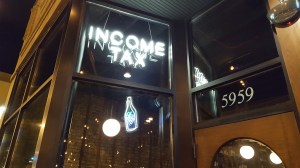
Full disclosure: I have known the executive chef at Income Tax since he was in first grade; his line cook all his life: he’s my youngest son. Although I had nothing to do with Ryan Henderson’s rise to his role, I will take a little credit for Andrew’s interest in food and cooking.
It might be better if I had no knowledge or familiarity with the kitchen staff since it could be perceived that my judgement is clouded. It is. Nonetheless, the meal ranks high among my most deliciously memorable.

Income Tax, located in the Edgewater neighborhood of Chicago, and Ryan have garnered numerous accolades since its opening December. All are well deserved and the result of careful planning by the owners and Ryan. The concept is a wine bar with food designed to pair with wines representing Spain, Germany, France and Italy. Rest assured wines of other countries are also available. The contemporary vibe and wonderful service complete the dining experience.

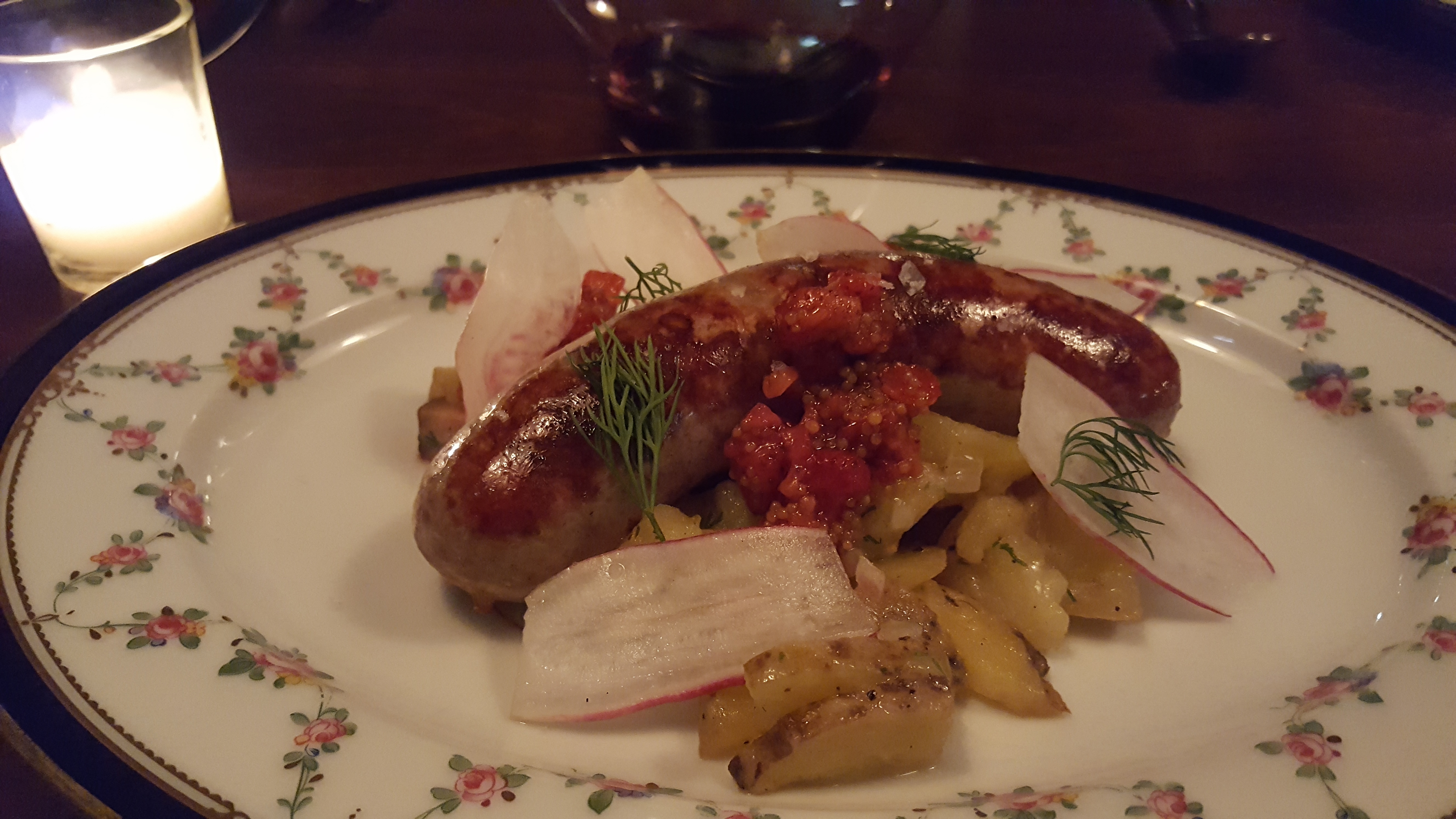
I was especially impressed with the elements of creativity. Among the appetizers is a house-made pretzel served with a savory and sweet cherry mustard. That’s right, cherry mustard. Scallops are paired with chorizo for a lively blend of flavors. A house made bratwurst features strawberry relish. A soup made with ringlets of caraway crepe adds lamb bacon (made in-house). The list goes on.
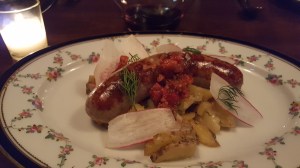

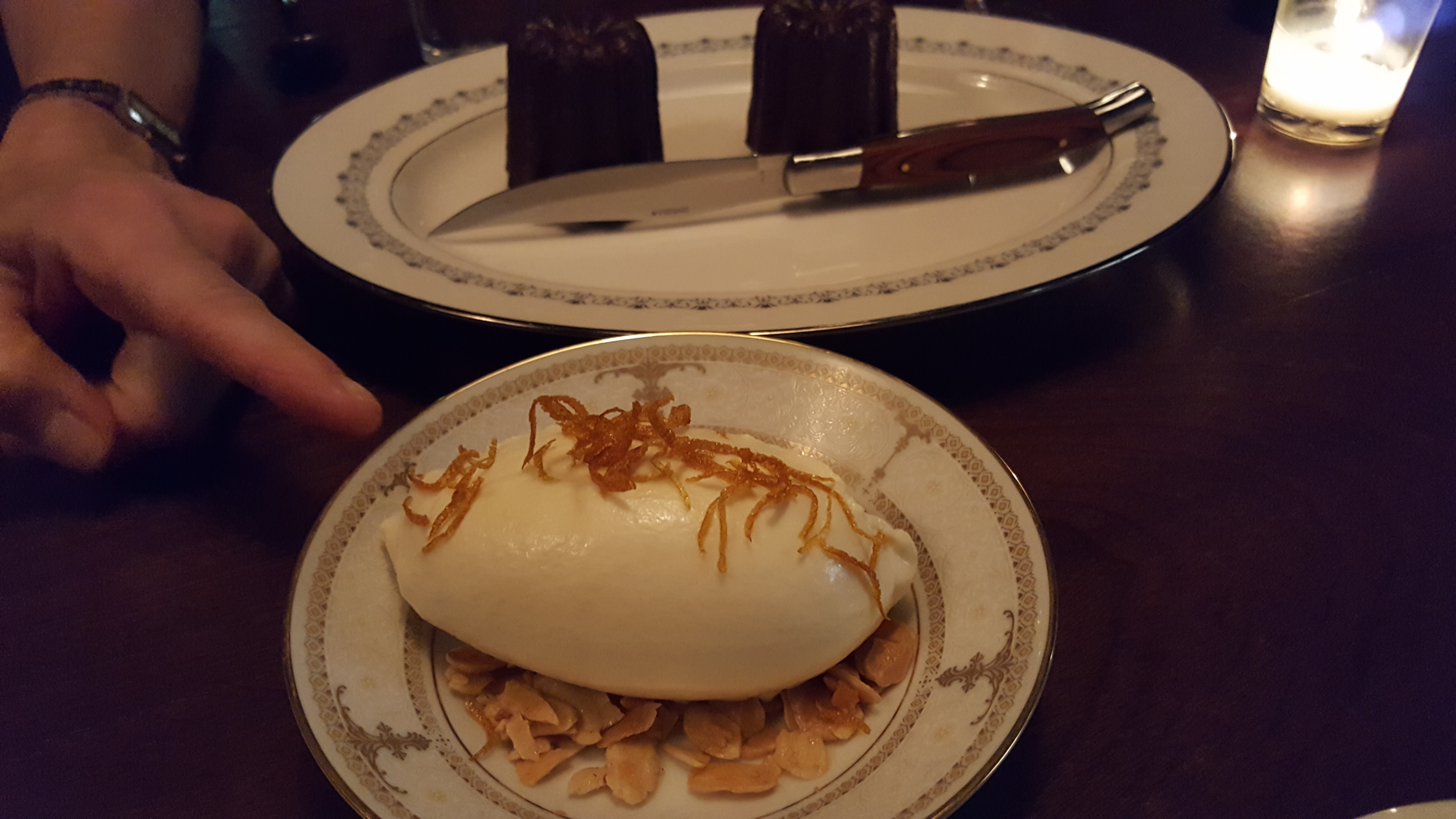
Of course, no meal is complete without dessert: rich chocolate caneles, port ice cream and chocolate mousse are the ideal way to end a perfect meal.
Excellent work, kitchen crew — even if our ties are long standing!
Income Tax
Five Plates
5959 N. Broadway
Chicago, IL

Lincoln in the Bardo is a mash-up. It’s part Greek tragedy, part play, part poem and completely imaginative. George Saunders has crafted a novel that can best be described as unusual, and that’s meant as a compliment.
Amid a graveyard setting, following the death of Willie Lincoln, the 11-year-old son of the U.S. president, Saunders’ tale is about grief, the afterlife and the disenfranchised. It includes a lot of humor.
Bardo comes from the Buddhist thought regarding a state between life and death; a purgatory of sorts. The characters are largely those trapped in this transitional stage. Although they are definitely dead, Saunders brings them to life through references to their foibles when they were alive as well as through their attitudes and deeds among the nonliving. They aren’t zombies, but they are supernatural.
There is no dialogue. Instead, observations on the action are shared through statements from the characters or from accounts in books, newspapers, conversations and other sources. It’s a blend of having each statement presented as lines in a play with footnotes. For example, this about Abraham Lincolns’ grief:
“It was only just at bedtime, when the boy would normally present
himself for some talk or roughhousing that Mr. Lincoln seemed truly
mindful of the irreversibility of the loss.”
In “Selected Memories from a Life of Service,”
By Stanley Hohner
Initially, it was a bit difficult to embrace the format and the narrative. However, it becomes evident that Saunders is creative and appreciates a good laugh.
Lincoln in the Bardo
Four Bookmarks
Random House, 2017
343 pages

It’s not often that I give up on a book, but I’m calling it quits after 78 pages of The Night Ocean by Paul La Farge. I tried, I really tried to get into this book. I wanted to, but it wasn’t happening.
In less than 100 pages I knew little more of what novel was about then I did on page one: zilch. That’s an exaggeration; I had gleaned a little info from the book jacket. The problem is that the synopsis and the narrative didn’t mesh well — at least not in the first 80 pages.
The Night Ocean is part of The Tournament of Books Summer Reading Challenge. I’m a fan of the Tournament of Books, which happens around the same time as the NCAA basketball tournament following a similar bracket formula. The Summer Challenge involves two books, La Farge’s and A Separation. I put library holds on both; I’m still waiting for the latter.
The premise of The Night Ocean is a woman’s search for her presumed-dead husband, his obsession with H.P. Lovecraft, the 1930s horror writer who had an affair with a 16-year-old boy (who later gained fame as an Aztecs scholar). Why wouldn’t that be intriguing?
Most of what I read involved Lovecraft, including pages and pages of his journal entries. His style and tone were off-putting: “Down at y’Dockes againe this night, seeking Subjects for y’Worke.”
Challenge or not, I don’t want to toil this hard for a summer read.
The Night Ocean
Penguin Books, 2017
389 pages

It’s always good to learn something new from a book, but I admit I hadn’t expected it to be the explanation of the distinction between rowing and paddling. I got this and only a little more in History of Wolves by Emily Fridlund. I anticipated many references to the predatory animal.
Instead, the theme is about parental neglect, in one case benign and another intentional based on religious beliefs. (This reference is meant as foreshadowing, which the novel heavily incorporates.)
Linda, the teenage narrator, lives with her parents in a cabin once part of a commune. They are the only ones left from that off-the-grid lifestyle. The setting is a mostly-isolated wooded area on a northern Minnesota lake. Linda is an observer, rather than a participant. Her parents have a minor role in her life since she generally navigates the world on her own.
A family moves in across the lake and captivates Linda’s imagination. She watches them from a distance, but eventually meets Patra and Paul, the mother and her young son. She soon becomes part of their world by babysitting and being away from her own home.
Interspersed with the development of the relationships among the characters are references to a trial (thus the foreshadowing) and descriptions of Linda’s life as a young adult.
The narrative is slow paced which doesn’t improve as discomfort surfaces when Leo, who’d been away on business, returns to his wife and child.
By the way, paddling is what propels canoes; rowing is done in boats.
History of Wolves
Three-and-a-half Bookmarks
Atlantic Monthly Press, 2017
279 pages

Although Colson Whitehead’s Pulitzer Prize-winning novel, The Underground Railroad, is about slavery in the pre-Civil War era, it remains timely. Timely in the unfortunate way that malice and marginalization still exist.
The narrative follows Cora, a slave on a Georgia cotton plantation. She’s ostracized by the other slaves and hated in particular by the plantation owner, Terrance Randall, who embodies cruelty. Cora was abandoned by her mother who escaped years earlier.
Following a brutal beating, Cora agrees to flee with Caesar, an educated slave. Whitehead’s railroad is the real thing, complete with underground tracks, conductors and station masters.
Randall hires Ridgeway, a tenacious slave catcher, whose only blemish on his otherwise perfect record of returning slaves to their owners is Cora’s mother. Whitehead’s descriptions of the brutality, fear and first taste of freedom are gripping. They hold the reader throughout as Cora moves in her new world. Nonetheless, the horrors of what await her if caught cast long shadows.
Cora and Caesar arrive in South Carolina where they find paying jobs. Eventually, complacency, missteps, and a relentless Ridgeway force Cora back to the railroad. Her journey takes her to North Carolina and, later, Indiana where she encounters kindness, fear, deceit and Ridgeway.
Whitehead begins each section with an advertisement posted by a slaveholder offering a reward for the return of his property: runaway girls. The novel is often harrowing, but rousing. It’s also disappointing to consider that American society hasn’t necessarily progressed as much as we’d like to believe.
The Underground Railroad
Four Bookmarks
Doubleday, 2016
306 pages

I admit I decided to read Villette by Charlotte Bronte because of the Masterpiece Theatre program “To Walk Invisible The Bronte Sisters.” I knew some background about the women who had to first write under male pseudonyms; the show whetted my appetite for more. I thought I should read something new-to-me.
It was difficult reading for many reasons — primarily the language and perspectives. I wasn’t surprised that reading the story written in 1853 might prove a little formidable, but I expected to eventually find my groove. I didn’t.
Villette is a fictional Belgian village. Consequently, Bronte incorporated a lot of French into the dialogue, as if things weren’t difficult enough. Translations are provided among the notes in the back of the book. But who wants to keep turning pages back and forth all the time?
The novel follows Lucy Snow, a young English woman without means. She leaves England, and finds work as a nanny and then a teacher at a private girls’ school in Villette.
Lucy is an introvert and at times also appears misanthropic. She does allow a few to enter into her world. She’s reconnected with her godmother, whose son is now a doctor. He and Paul Emmanuel, also a teacher at the school, stir Lucy’s interest. The relationships with the two take many twists. Yet, none are particularly captivating. This may be due, in large part, to the era in which the novel was written: relationships moved at an aggravatingly slow pace.
Villette
Three bookmarks
First published in 1853; Penguin Books Classic Edition, 2004
611 pages, this edition includes a chronology of the author’s life; a brief history of the Bronte family, an introduction, suggested additional reading, notes and glossary.
As names go, 71 Above is not exceptionally creative. It’s an obvious, albeit appropriate, appellation for a restaurant on the 71st floor of the tallest building in downtown Los Angeles.

The views include the ocean far off to the west, the hills, other skyscapers, the Staples Center, Dodger Stadium and freeways – lots of traffic-clogged freeways. Each window table has a compass to help establish direction. Fortunately, the menu is mush easier to navigate.
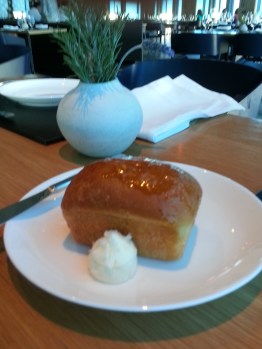
Eight first courses and eight second courses are offered. The firsts range from soup to Brussels sprouts, from steak tartare to grilled salad. Ricotta gnocchi was on the menu, but unavailable. Two of us opted for the charred Brussels sprouts served over a small amount of plain yogurt. This combination resulted in a creamy and smoky sauce. This dish could have easily been shared, but I’m glad I had it all to myself. The grilled salad featured two heads of bibb lettuce topped with green olives, golden raisins and shredded grana – a parmesan-like hard cheese.
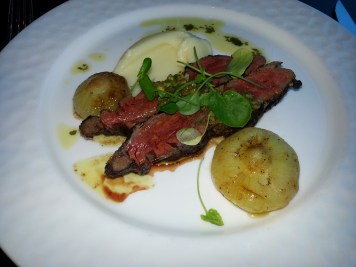
For the entrees, we each ordered something different: chicken, pork loin and flat iron steak. The latter, my choice, was the best of the three. Grilled to a perfect medium rare pink center and topped with chimichurri sauce, it was also a colorful plate. The pork, served with pears and mashed parsnip, was a little on the dry side. I didn’t sample the chicken, but it looked juicy and I coveted the grilled cherry tomatoes on the dish.

71 Above
Four+ Plates
633 W. 5th St.
Los Angeles



 The Blue Page Special