Archive for the ‘Reviews’ Category

Bacon. It’s one of those foods that evoke smiles and salivation no matter when it’s served. Bacon Nation by Peter Laminsky and Marie Rama illustrates that bacon isn’t just for breakfast – as if.
In addition to 125 recipes, from the obvious Bacon-Wrapped Shrimp to the creative Bacon Jam – and that’s just among the appetizers, side dishes, salads, desserts, even poultry, featuring the favored pork product are included.
Last Christmas a friend shared her recipe for what she called “Bacon Crack” due to its addictive qualities. It featured a sweet and savory rub. Bacon Nation doesn’t contain this particular tasty treat, but has several others in the same category, such as Peanut Butter Bacon Cookies. Although not as sinful as Bacon Crack, they are easy to eat.
As with most well-executed cookbooks, Laminsky and Rama don’t rely on recipes alone, even though they could. The authors’ first chapter is dedicated to tips for purchasing and cooking bacon. They recommend thick cut for most of the recipes, and explain the difference between dry and wet cured. The former is rubbed with salt (often pepper, occasionally salt;) and the latter is brined.
Each section, or chapter, features a brief prologue, and individual recipes are accompanied by an also-brief introduction. These range from explanations of how the recipes came about or what was done to modify them for the home cook.
Chapter 12, by the way, is entitled “Breakfast Means Bacon.” Since it comes near the end, I really don’t believe the authors/chefs.
Bacon Nation
Four Bookmarks
Workman Publishing, 2013
310 pages, including photos and index
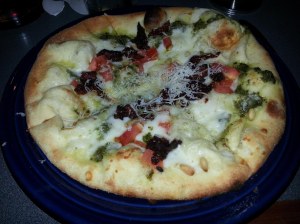
Typically, I have plenty of time to study the menu on the wall at Il Vicino. That’s because the line is long enough that I can read through the descriptions of pizzas and other offerings while waiting to place my order at the counter. Recently, however, there was no line, so even though there was no pressure to make a quick decision, I felt uneasy. I worried that people aren’t frequenting this gourmet pizza place like they should.
The small eatery offers more than dozen types of pizza, several calzones and Panini, salads and a few pasta dishes. From a traditional Margherita to pies with roasted chicken, tuna, even spicy shrimp. It’s often difficult to decide. Even with no one in line behind us I was torn.

We eventually settled on two salad/pizza combinations. The Pizza al Pesto is embellished with fresh pesto, sun-dried and fresh tomatoes, pine nuts and mozzarella. The bread-like crust was thick with wood-smoked flavor. The Spinach Salad was the perfect complement with a fresh pesto dressing, roasted red peppers, red onions, pine nuts and Gorgonzola cheese over a bed of spinach. The other combination included the Campagnola: a traditional marinara, sausage, mushrooms, and, instead of goat cheese, Asiago cheese. The sausage stood out in the crowd of ingredients. The beautifully-plated Insalata Il Vicino was a rift on a Cobb Salad with rows of chopped roasted chicken, diced egg, Gorgonzola, artichoke hearts and walnuts.

While leaving, the line in front of the menu board began to back up. Whew!
Il Vicino
Four Plates
11 S. Tejon St.
Colorado Springs, CO

In a twist on the what-did-you-bring-me refrain from my kids’ childhood reactions to out-of-town trips, my oldest son brought me a book. I appreciate that it made him think of me. Shaggy Muses by Maureen Adams examines the relationships between five female writers and their dogs. I’ve had several dogs in my life and all hold special places in my heart. My dog Jackson and I have a strong bond; although I’m not sure I consider him my muse, he might prove me wrong.

Adams’s book is subtitled The Dogs Who Inspired Virginia Woolf, Emily Dickinson, Elizabeth Barrett Browning, Edith Wharton and Emily Bronte. It’s part academic, largely anecdotal, and for dog lovers who happen to enjoy literature it’s particularly enjoyable. The book started as a series in scholarly journals on the bond between dogs and their humans.
The relationships between these writers and their dogs were strong to the point of distraction. In fact, the dogs served as buffers making it possible to limit expressing real emotion. Adams writes, “Elizabeth and Robert [Browning] used Flush as a symbolic go-between to help them express their feelings in conversations and letters.” The other women did the same.
Some of the writers had numerous dogs, other just a single source of inspiration. One narrative involving Bronte and Keeper, her large, intimidating part-Mastiff, is exceptionally disturbing. Bronte beat her dog, and then comforted him, which suggests the love-hate relationship often evident in abusive relationships. Fortunately, the other stories Adams provides are more endearing.
Shaggy Muses: The Dogs Who Inspired Virginia Woolf, Emily Dickinson, Elizabeth Barrett Browning, Edith Wharton and Emily Bronte
Three-and-a-half Bookmarks
The University of Chicago Press, 2007
299 pages, with notes and index

The Blue Moose in Breckenridge has several issues: lengthy waits, cash only, and limited hours. The best advice is to forget about those things. Instead, focus on the food and friendly staff, which, fortunately, is easy. Mud season may be the only time it’s possible to walk in and sit down without a wait. Even then, it’s iffy since the restaurant appeals to locals just as much as, or more than, skiers and summer tourists.

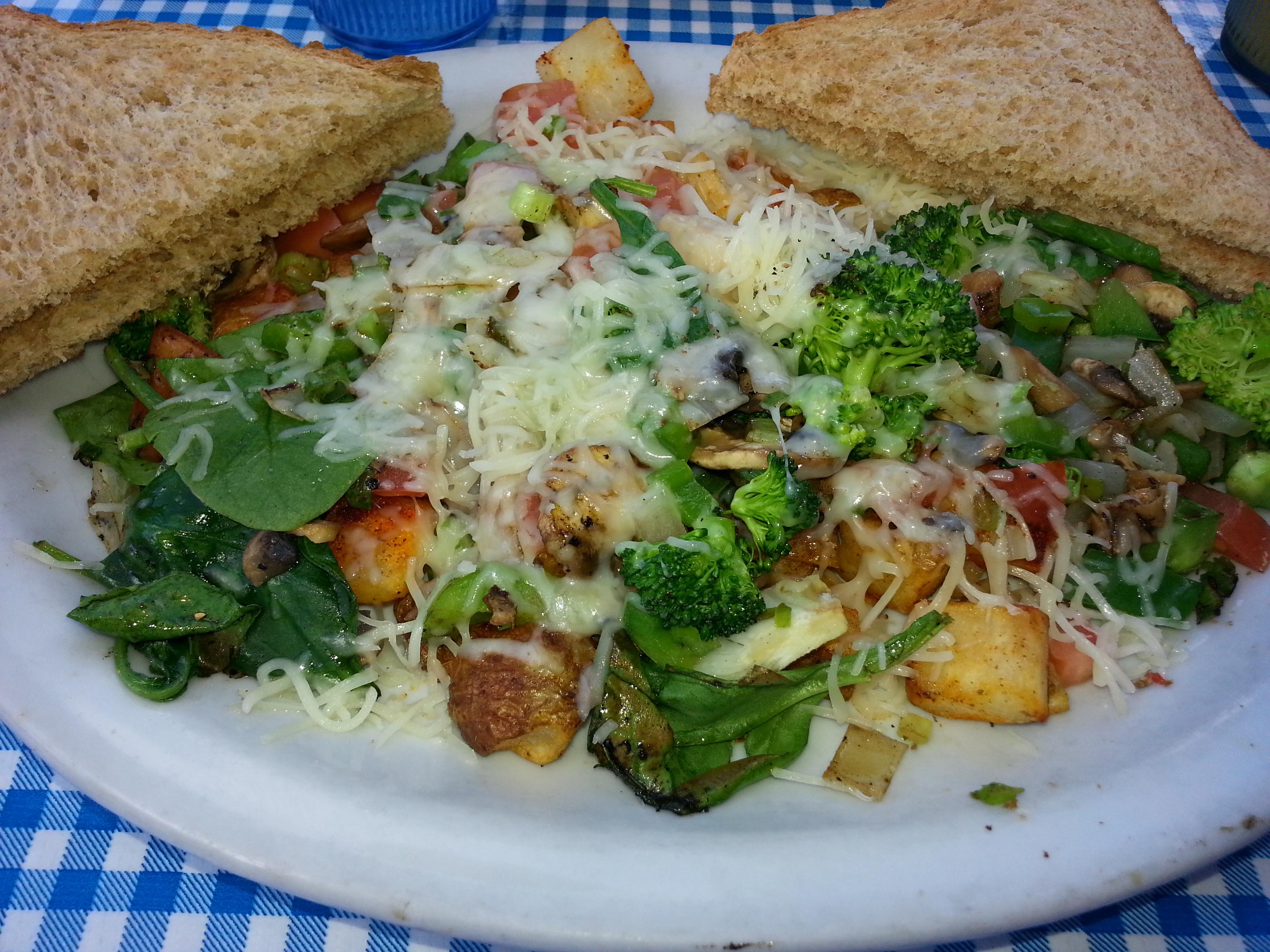
Recently, we braced ourselves for a long wait and made sure we had plenty of cash in our wallets. We got a table soon after arriving and didn’t have to spend everything we had. The appeal is fresh food, and lots of it, almost too much. The Spuds and Vegies is one of my favorites. Sautéed broccoli, onions, tomatoes, mushrooms, green peppers and spinach served over country potatoes. Eggs and cheese on top are optional. The meal is like eating a carb-building garden.

Several types of omelets and the usual parade of pancakes and French toast comprise the menu. Several items include names familiar to the central mountains, such as the Minturn Loop. It’s nothing more than choice of eggs, bacon or sausage, potatoes and toast. On the other hand, the English has everything to do with what’s served. It features plate-size pancakes, eggs and several meats: bacon, banger and ham. In case that’s not enough, toast and potatoes are included, as is a fresh tomato relish.
If you eat outside, nothing beats the mountain view — they’re worth the wait.
The Blue Moose
Four Plates
540 S. Main St.
Breckenridge, CO

Rainbow Rowell’s story of young love overshadowed by harsh realities is humorous, haunting, and hopeful. Alliteration aside, Rowell’s Eleanor & Park is a study in contrasts and seems to prove that opposites do attract.
The omniscient narrator alternates between the couple. Although this approach doesn’t establish distinct voices, the characters are well-defined. Bits and pieces of Eleanor’s unhappy home life are slowly revealed while suggesting impending misfortune. Park, on the other hand, has two loving parents and lives next door to his grandparents. Eleanor is the new girl in school. She’s overweight, has bright red, unruly hair and dresses in a way that only the addition of neon could attract more attention. Park isn’t Mr. Popularity, but he does straddle the line between acceptance and rebuff. He’s part Asian, dresses all in black, but has known the kids in his high school all his life. When Eleanor sits next to him on the bus, he’s embarrassed, but friendship, then romance slowly, oh so slowly, begins to emerge.
Among Rowell’s themes are bullying and abuse; these create tension in the novel. The sense of something going awry is palpable. Yet, so are the more positive aspects of emerging love and parental concern. References to Shakespearean tragedy add a sense of foreboding; nonetheless, this is a tale dependent on hope. The title characters are different, likeable, and prove that appearances aren’t everything. It’s unfortunate they live in world where extreme differences aren’t always appreciated and where it’s easy to hide dangerous secrets.
Eleanor & Park
Four Bookmarks
St. Martin’s Griffin, 2013
325 pages
 Union Station just east of the downtown Los Angeles is a beautiful historic landmark. It’s an actual train station. It also serves as a central public transportation hub, and it is the home of Traxx Restaurant.
Diners can choose from three dining areas: the small, dark dining room, an outdoor garden, or the small space cordoned off from the main hall. It’s the latter that provides lots of distractions, which is important, and people-watching opportunities. The muffled sounds announcing the arrival or departure of trains is exciting. The hall has natural wood, ceramic tile, ornate light fixtures and high ceilings.
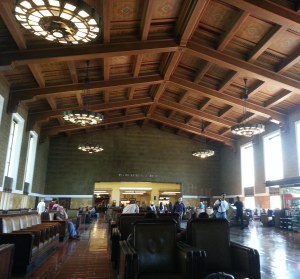
Back to the distractions, they’re necessary. The menu is ambitious, but doesn’t quite live up to the expectations imposed by Traxx’s environment. In some ways the dining area feels somewhat dingy, not dirty but worn. The sense of yesteryear evoked by the train station is very effective, but doesn’t work with the restaurant, at least at lunch when there’s too much light.
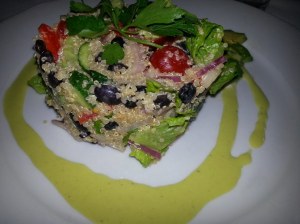
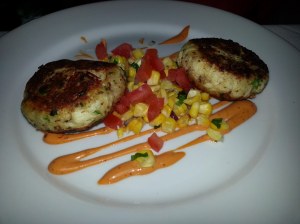
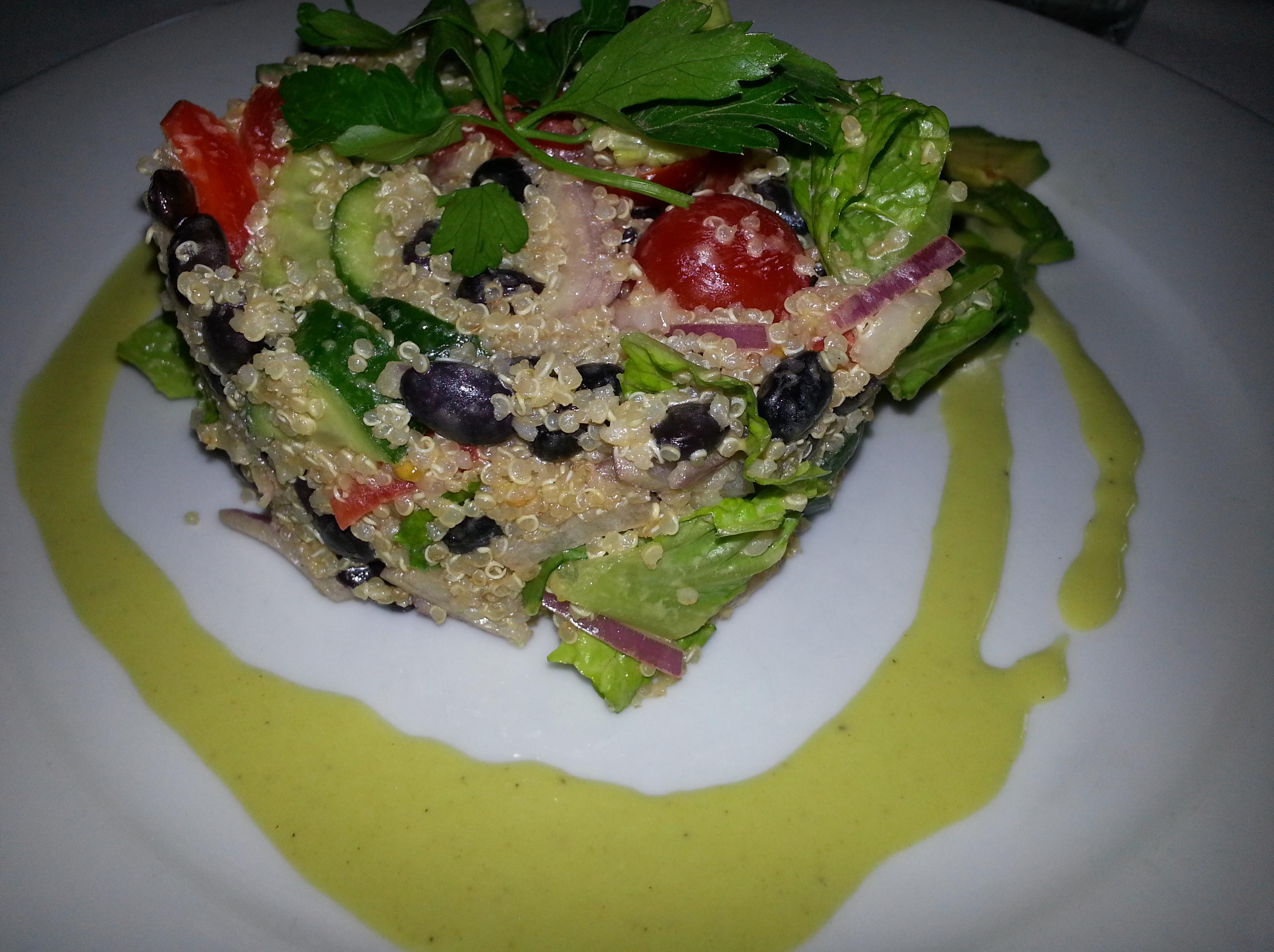
The Quinoa Salad was, nonetheless, beautifully plated. It featured cucumbers, eggplant, red onions, avocados, cherry tomatoes and lots of cilantro with an avocado vinaigrette. The onions were the bully on the plate; they overpowered everything. The Crabcakes were nicely cooked with a crunchy exterior and thick with crab served on a corn salsa with red pepper remoulade.
Even though I wasn’t traveling by train, I was more than ready to leave the station after discovering a long dark hair beneath the caramelized sugar layer of my crème brulee.
Traxx Restaurant
Three Plates
Union Station
800 N. Alameda St.
Los Angeles, Calif.

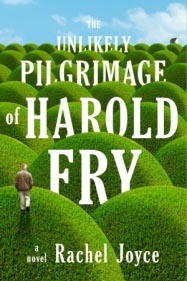
The Unlikely Pilgrimage of Harold Fry begins as a slow, methodical, unexpected journey – for the main character and the reader. Rachel Joyce’s novel practically crawls through the first few chapters. Then, like Harold, it picks up the pace only to falter on occasion like most adventures.
This poignant tale shares qualities of a love story and mystery, but is more the former than latter. And, it’s about different types of love: romantic, familial and companionable.
After receiving a letter from Queenie, a work colleague with whom he’s lost touch, Harold sets out to mail a response. Despite the fact that he left the house without his cell phone and is dressed somewhat formally, he decides to embark on a 600+ mile trek from one end of England to the other to talk to Queenie in person. He has no backpack, water bottle, map or other equipment. In fact, he walks in boating shoes.
The elements of a mystery come in the form of questioning the relationship between Harold and Queenie, as well as between Harold and his estranged son, David. There’s also the fact that Harold is married, although he and his wife, Maureen, do little more than share a past and the same house.
The characters’ imperfections are what make the story work, albeit inconsistently. As personalities evolve, foibles become more defined, but so do strengths. Harold loses his way in more than one manner, but he, like the reader, gains perspective even if it is not particularly satisfying.
The Unlikely Pilgrimage of Harold Fry
Three Bookmarks
Random House, 2012
320 pages

It’s obvious before entering the doors that Pizzeria Mozza isn’t a typical neighborhood pizza joint. The valet parking stand gives it away.
The menu is another clue; there’s also the fact that the owners are Nancy Silverton, Mario Batali and Joe Bastianich. Not surprisingly, their marks are everywhere: Silverton with the baked goods, and the men with their rustic Italian flair evident in everything, and all of them, of course, in the menu.
Our server would have happily explained the unfamiliar items, but it was fun studying the menu in advance. For example, Arancine alla Bolognese. I will eat almost anything with Bolognese, but it’s nice to know that at Mozza it’s served with rice balls made from creamy risotto, rolled in bread crumbs and fried. The texture is a marriage destined for bliss.

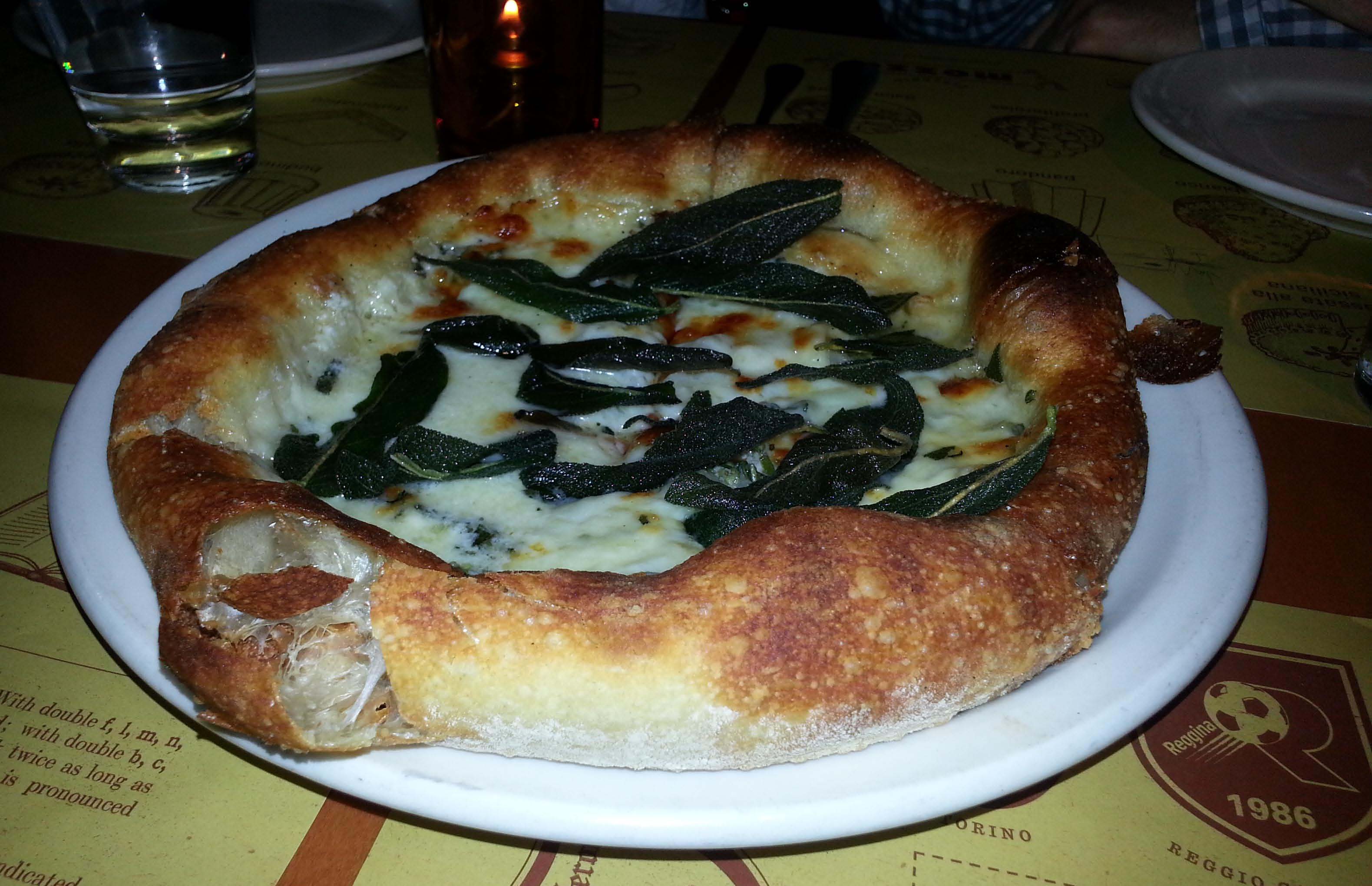
Although I don’t recall the sequence of arrival, each dish seemed to be better than the one before. The Fried Squash Blossoms filled with ricotta looks like an ugly duckling on the plate, but the burst of flavor reveals the literal inner beauty. The Bone Marrow al Forno is rich, beautifully plated, and decadent. It’s served with roasted garlic and toasted bread, and oozes fatty beefy flavor. The Chicken Wings alla Diavola, Prociutto di Parma, and Mozzerella di Bufala, and the Bianca pizza completed our meal. The latter, served with crispy fried sage and sottocenere, is just the kind of upscale pizza associated with valet parking. By the way, sottocenere, is white cheese with truffles.

Pizzeria Mozza
Four-and-a-half Plates
641 N. Highland Ave.
Los Angeles, Calif.

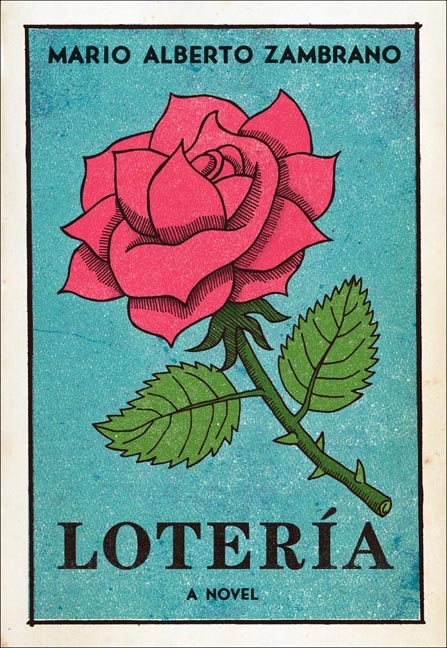
Eleven-year-old Luz Maria Costilla has a gut-wrenching way of storytelling. She’s a lot like Scout, daughter of Atticus Finch. Unfortunately, Luz’s father is nothing like Harper Lee’s heroic character. Nonetheless, in Mario Alberto Zambrano’s debut novel, Loteria, Luz is full of grit and independence.
Loteria is a game of chance, popular in Mexico, designed around cards each of which features an image rather than a number. The images, through riddles, are called out by the game’s dealer. The novel of the same name is built around the cards as Luz recounts the disintegration of her family and how she became a ward of the state of California. It’s rich with humor, sorrow and vivid imagery thanks to the game. The irony is that Luz isn’t talking; she has a journal and the cards to speak for her. Some knowledge of Spanish is helpful.
Luz loves her father. She sees past his many faults: he’s violent, he drinks, and has questionable parenting skills. In his own way, he loves his wife, his elder daughter Estrella and Luz. A few other relatives come in and out of the narrative, but the focus is on this nuclear family. For the El Borracho card, Luz recounts, “When Papi sang in the backyard I’d dance to whatever song he sang. He’d be a little drunk under the light of the porch, and for every four sips he took, I took one.” Not every card is as obvious in its intent, but as Luz puts them together they come to life.
Loteria
Four Bookmarks
HarperCollins, 2013
270 pages

Bouchon Bistro used to only offer fried chicken dinners once a month. Reservations filled within minutes; sometimes it felt like having one wrong lottery number. Now the odds are a little better: the crispy fried chicken in Thomas Keller’s restaurant is served twice monthly.
Although, the regular menu is available, I have to wonder why anyone would consider it. The sides, aren’t always the same, but by all accounts the chicken has a consistently high wow factor. Recently, the meal included fork-crushed potatoes, pole bean salad and Parker House rolls. The chicken is the star of the night. Plump from soaking in a lemon/herb brine for more than 12 hours, it’s deep-fried for a coating that shatters as soon as it meets your lips.
(Keller has numerous dining establishments. He’s authored several cookbooks, including Ad Hoc at Home featuring the fried chicken recipe. The description of the process and lengthy list of ingredients intrigued me, so last winter I tried it. It was good to know that, with fortitude and lots of time, the chicken can be made at home very close to what Bouchon serves. Keller also edits Finesse, a beautifully-designed magazine with articles celebrating the beauty of kitchens: design, cooking, gadgets and techniques.)

Back to that chicken, it’s juicy on the inside and crunchy on the outside for the perfect combination of texture and taste: buttermilk, rosemary and thyme. The bean salad in bacon vinaigrette, although flavorful, wasn’t as stellar as the creamy potatoes and rolls; even with a chicken-only meal I’d feel like a winner.
Bouchon Bistro
Five Plates
235 North Canon Dr.
Beverly Hills, Calif.











 The Blue Page Special