Archive for the ‘Books’ Category


With so many recent literary references to tigers it’s easy to think
The Tiger’s Wife has something to do with Asia. That’s not the
case with Tea Obreht’s lyrical, engaging debut novel. Instead, she
writes about fear, imagination, survival, and war’s shadow – on an-
other continent altogether.
The title’s namesake and the “deathless man” are told like fairytales
along with the narrator’s, Natalia, desire to know the circumstances
of her much-loved grandfather’s death. These tales also figure promi-
nently in how he lived his life; he was a doctor and survived an earlier
war. It’s his demise that propels Natalia, and even though death is a
constant throughout the book, it is not disheartening.
Natalia, too, is a young physician in a devasted eastern European
country, whose story begins with her memories of going to the zoo
with her grandfather: to see the tigers. Other animals are mentioned,
but the tigers drive their visits. As Natalia grows up, the threat of war
is never far removed, yet she is surprised at her cavalier attitude
toward it. Later, when she treats children orphaned by war, she still
never appears to believe it’s real.
Although, she’s preoccupied with her grandfather’s death, the more
she looks for understanding, the more she explains the myths he shar-
ed. There actually was a tiger and a young girl known as its wife in
the grandfather’s childhood village. By contrast, the deathless man
was known only to the grandfather, and Natalia clearly wants to know
more about both men.
Four Bookmarks
Random House, 2011
338 pages

It’s difficult to like a character who doesn’t like herself, especially when
as a reader it is just as easy to see the positive qualities as the foibles.
Victoria Jones is Vanessa Diffienbaugh’s problematic protagonist in The
Language of Flowers.
Granted, Victoria has every right to be troubled. Abandoned at birth, in
and out of foster care most of her life, and emancipated at age 18, she has
no skills or acknowledged support system. Yet, on those few occasions
when things do go her way, Victoria is a master of sabotage.
However, this is no victim of the system story. Rather, it a poignant look
at what makes a family (for better or worse) and how people communicate
when words fail. There is, in fact, a language associated with flowers. It’s
known as floriography. Each flower has a meaning that goes beyond its
shape, color or bloom. Victoria knows this, and her knowledge isn’t just
a marketable skill, but a way for her to express herself.
Ironically, Victoria is the narrator. The short chapters alternate between
her past, which includes life in foster homes, group homes and a near-miss
adoption, and her life as an 18-year-old trying to survive alone on the streets
of San Francisco.
Unfortunately, Diffenbaugh throws in a few clichés, like the over-extended
social worker, and abandons several likeable characters. Nonetheless, this
novel is a bouquet of peonies, primrose, ginger, mustard, moss, amaryllis
and fennel. They may seem an unusual grouping, but Victoria reflects all
their meanings.
The Language of Flowers
Three Bookmarks
Ballentine Books, 2011
322 pages (including “Victoria’s Dictionary of Flowers”)

I love receiving books as gifts, especially when it’s obvious the bearer has
decided it’s something I would particularly enjoy. I try to do the same,
but am not – admittedly – always successful. I’m pleased to say my friend,
Esteban, was on the money in giving me Tracey Lawson’s A Year in the
Village of Eternity.
Lawson writes of food and Italy (two of my favorite things) and longevity.
The secret to a long life has nothing to do with a fountain of youth. Instead,
it is a cascade of fresh, organic, seasonal food augmented by family, friends
and an active lifestyle. That’s Lawson’s premise as she describes Campodimele,
Italy, where the average life expectancy, for men and women, is 95 years!
Lawson provides a month-by-month account of a year in Campodimele, thus
sharing seasonal experiences that coincide with weather, festivals, crops and
food preparation. The village is located between Rome and Naples in the
mountains above the Tyrrhenian coast. The focus is on the people, individuals
who shared their kitchens, produce and recipes, but it’s their lifestyle that is
particularly intriguing. Numerous studies have been conducted linking longe-
vity to the Campomelano diet which is low in salt, includes moderate amounts
of wine, and is full of protein-rich beans, fish and chicken. All this in addition
to fresh produce, which is canned, dried or otherwise preserved to last through-
out the year.
A bonus, besides Lawson’s vivid, sensual imagery of the landscape, people and
meals, is the collection of photographs and recipes.
A Year in the Village of Eternity
Three and a half Bookmarks
Bloomsbury, 2011
374 pages

I’ve had three dogs in my adult life, so I found the first line of Jill Abramson’s
The Puppy Diaries – Raising a Dog Named Scout powerful: “The truth
about getting a new dog is that it makes you miss the old one.”
Still, I struggled with Abramson’s combination memoir/how-to guide which
chronicles the life she and her husband share with their blond golden retriev-
er. How he came into their lives is interesting and the joy he brings is palpable,
but not necessarily unique. I don’t want to disparage the connection she has
with her dog, but anyone who has played or lived with a dog will be familiar
with everything Abramson writes about. This may be a source of reassurance
for some dog owners, but for readers it is the book’s major flaw. What sets
the story apart, and is given only a casual nod, is the way dog ownership has
changed, and that the Abramsons are “aging baby boomers with dogs …”
Don’t get me wrong, I have immense respect for Abramson. She is the first
female excutive editor of The New York Times. Her journalism creds are both
impressive and intimidating to me, a former reporter. No doubt, her journal-
istic background provided access to the sources she doles out like special
treats.
Writing about dogs is a sure-fire way to evoke emotion among dog owners.
Most wear their passion for their canine pals like a collar of pride. Clearly,
Abramson is no exception, but then neither am I.
“The Puppy Diaries”
Two Bookmarks
Times Books, 2011
242 pages

Some attributes of people like Bill Gates and Steve Jobs may find their way
into David Guterson’s Ed King, but the strongest similarity to anyone is
Oedipus Rex. This story begins in the 1960s introducing Ed’s birth parents,
a married insurance actuary and a 15-year-old British au pair. That’s the first
clue that something’s amiss. It moves from Ed’s conception to well into the
21st century in his prominence as an Internet wiz. A lot of similarities to
the title character and the modern day wunderkind exist, but those parallels
are garnish. They’re not nearly as intriguing, nor repelling, as the connection
with the ancient story of Oedipus.
At the risk of revealing too much, once the first half of this modern-day Greek
tragedy is identified, it’s easy to anticipate the completion. It is at this point
that Guterson changes tone and voice to suddenly directly address the
reader: “Who could blame you for being interested in this potential hot part …”
And just as quickly (well, little more than a page) reverts to the objective
third person narrative.
This book is heavy on characters, and many seem extraneous. Nonetheless,
a surprising number are well-developed, but the question is why? Set in the
Pacific Northwest, Guterson’s favored locale, the likelihood of many of the
events is about as possible as a talking sphinx; oh yeah, that was part of
Sophocles’s play, too.
Although the well-known plot’s twisted one, Guterson is a master storyteller
writing about destiny, desire, and manipulation.
Ed King
Three-and-a-half Bookmarks
Alfred A. Knopf, 2011
304 pages
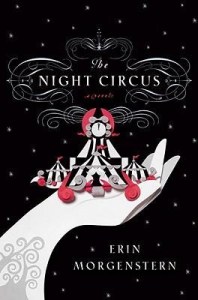
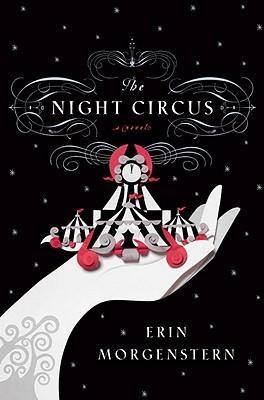
The Night Circus is like a fine etching, rich in detail and artistically crafted. Although
black and white are the dominant hues, the nuances of lighting and shading result in a
rainbow of detail.
The word magical to describe Erin Morgenstern’s novel is inadequate. The story is so
much more. The circus, only open at night and in various places around the world,
transports its audience members, and thus readers, to beyond the suspension of dis-
belief. Taking place between 1873 and 1903 the story moves from one time frame to
another, from character to character, from love story to mystery, while Morgenstern
tells a very tall tale that is engaging and exciting.
Magic, or the manipulation of what people believe they see, is the backdrop. The
circus is the venue for a battle of the beautiful and incredible between Celia and
Marco. They have been trained their entire lives by masters who have no regard
for emotion or repercussions. Although Marco and Celia are destined to try to sur-
pass each other through their skills of illusion, no one is prepared for the direction
their relationship takes.
The vivid cast of characters demonstrates the human element of magic and mystery.
Attachments develop among them, and with the reader, creating plenty of tension
wondering not only what will happen between Marco and Celia, but to those whose
lives depend on the night circus.
Morgenstern’s black and white portrait is as lively as any circus, but far more fantastic
than any that can be imagined.
The Night Circus
Four-and-a-half Bookmarks
Doubleday, 2011
387 pages

Just because everyone has a story to tell, doesn’t mean everyone should. It’s
nice, though, that Adriana Trigiani shares hers in the memoir, Don’t Sing at
the Table: Life Lessons From My Grandmothers.
Trigiani imparts memories and the advice given by both of her grandmothers:
Lucy (on her mother’s side) and Viola (on her father’s). Although the two
had little direct interaction with one another, they had a profound influence
on the author. Both were hardworking, independent women who raised families,
ran their own businesses, suffered personal losses, but lived long rich lives.
This describes many grandmothers today, but this was the 1940s and ‘50s.
These Italian-American women weren’t just role models to their granddaughter
(and others); they also had plenty of advice to dispense, from parenting to
femininity, from marriage to adventure. Trigiani’s writing is conversational.
It’s easy to imagine the time spent with Lucy and Viola, and to feel the im-
pact they had. These were tough but caring women who found success at work
and happiness at home.
The title is what caught my attention. Not singing at the table was one of
many family rules when I was a kid, but there was never an explanation.
Trigiani provides one. It comes from an Italian proverb: “Chi e canta a
tavola e piu stupido che fuma a letto, which translated means ‘He who
sings at the table is more stupid than the one who smokes in bed.’” This
is debatable, but it certainly makes for a good title.
Three Bookmarks
Harper Collins, 2010
204 pages

Even though my own name belies the family stories I’ve heard about Echo Park,
I admit I judged Brando Skyhorse by his. I didn’t expect him to know much, if
anything, about Echo Lake, Chavez Ravine, and Elyssian Park near downtown Los
Angeles. Lo siento. His novel, The Madonnas of Echo Park, proves that he knows
the geography well and the community, too. Although not written in an especially
unique format, he creates a cohesive portrait of Mexican Americans in a time when
it is easy to overlook the fact that one word is an adjective and the other a noun.
Skyhorse relies on different narrators, all of whom are Latino, to relate varied
perspectives of a series of coincidently overlapping events. In their quest to wake
up in the American Dream, they recount nightmarish experiences.
Aurora Esperanza is the character about whom everything is connected. The story
weaves in and out of her childhood in the Echo Park area (when its residents were
primarily Spanish-speaking families) to the gentrification now underway. The grown
-up Aurora acknowledges that she has trouble recognizing her old haunts. Skyhorse
plays and replays the theme of being cast out of one once-distained area into an-
other with numerous references to Chavez Ravine. Families were forced to leave
their homes there to make room for Dodger Stadium.
I know the verdant Echo Park that sits like an island in a sea of automobile traffic,
and Skyhorse doesn’t just describe a neighborhood, he portrays its heart and soul.
“The Madonnas of Echo Park”
Three and a half Bookmarks
Free Press, 2010
199 pages

I can’t remember all the books I read this past year. This says more about
my memory than necessarily reflecting poorly on the ones I can’t recall.
The standouts, however, are another story. They feature characters with
depth, situations I had never considered, and writing that practically
dances off the page in its lyricism and rhythm. In no particular order,
here are my favorite reads of 2011. Enjoy!
Room by Emma Donoghue
Cutting for Stone* by Abraham Verghese
State of Wonder by Ann Patchett
The Lonely Polygamist by Brady Udall
The Snowman* by Jo Nesbo
Freedom by Jonathan Franzen
Blood, Bones & Butter: The Inadvertent Education of a Reluctant Chef* by Gabrielle Hamilton
The Hunger Games (Catching Fire and Mockingjay) by Suzanne Collins
* The Blue Page Special reviews.

Two very sad things are conspicuous about Blood, Bones & Butter: The Inadvertent
Education of a Reluctant Chef by Gabrielle Hamilton: she was essentially abandoned
as a kid, and her parents probably have no clue what they missed. In spite of being
neglected, or perhaps because of it, Hamilton developed an inner strength and the
talent to express herself through food – and writing.
Hamilton appears as baffled by her life circumstances as any reader. She recounts
a happy early childhood as the youngest of five children in rural Pennsylvania.
However, those years were short-lived. Her family disintegrated through her parents’
divorce, and she was left to her own devices. With only a trace of bitterness
(mostly directed toward her mother), Hamilton recalls what it was like eking out
a living when she was still a kid.
By age 13, she knew she needed a job. She hasn’t stopped working since, and much of
her employment has been in restaurants or catering, it’s almost always been related
to food. Hamilton’s writing is vividly descriptive making it easy to not just see the
images she depicts, but also to feel the cool morning dew or to smell the smoke from
a pit fire or taste “a cold ham sandwich on good buttered grainy bread.”
Today, Hamilton is an accomplished chef and owner of Prune restaurant in New York City,
and her writing is stellar. Still, who leaves an almost-12-year-old to fend for herself,
even if the ultimate outcome appears to be exceptional?
Four and a half Bookmarks
Random House, 2011
291 pages





 The Blue Page Special