Archive for the ‘Books’ Category

What begins campy and comic book-like soon assumes a more serious tone about
familial dysfunction in Karen Russell’s Swamplandia! This enigmatic coming-of-
age story is set in Florida’s Everglades, where the harsh environment is full of danger-
ous creatures and rich in bittersweet memories for the Bigtree family.
Thirteen-year-old Ava Bigtree is the narrator for most of the novel; when the setting
switches to the nearby coastal town of Loomis, Russell narrates. Swamplandia! is the
name of the Bigtree family’s alligator theme park. When Ava’s mother, the main attract-
ion as an alligator wrestler, dies, the family disintegrates. Ava’s 16-year-old sister is in
love with a ghost; Kiwi, the older brother, leaves to work at the competing theme park
in Loomis; and Chief, the children’s father, leaves Swamplandia to look, he says, for
funding. Through most of the novel, Ava is the most level-headed, so when she shows
her age, it’s a good thing for the reader, but not so much for Ava.
This is one whopper of a tale, but Russell creates complex characters facing difficult
issues in their lives, not the least of which is dealing with the mother’s death. The back-
drop of the theme park and alligators provides some levity on one hand and heavy-duty
allegory on the other. Russell’s beautifully-written descriptions and sentence structure
are captivating. There are some laugh-out-loud moments countered by creepy events.
Several times I considered closing the book to stop what was likely to happen, but
needed to keep reading just in case I was wrong.
Swamplandia!
Four Bookmarks
Alfred A. Knopf, 2011
316 pages

Although somewhat entertaining, The Writing Class by Jincy Willett is a light
mystery with writing advice. Willett should have heeded some of her own tips,
particularly when it comes to character development. Oh wait, she didn’t really
address that. Still, plenty of other writing elements addressed go unheeded.
The class, comprised of 13 students, is actually a nine-week workshop. It’s taught
by one-hit writer Amy Gallup repeatedly described as “a loner who hated to be
alone.” That’s not necessarily the kind of thing that needs emphasis. Willett could
show this more, rather than tell it so frequently. Amy’s tired and cynical attitude
doesn’t mesh with her sense of humor and appreciation of good writing when it
surfaces. She’s quick to categorize her students when a new workshop gets under
way. However, she soon realizes she’s made some judgment errors, particularly
when someone in the group begins to send anonymous threats, which ultimately
lead to murder. Nonetheless, the group grows close and despite, or because of,
the murders everyone becomes friends and suspects.
Part of the problem lies in the suspension of disbelief which simply doesn’t happen.
The first threats should have triggered someone, if not Amy, to contact authorities.
Although, there is some acknowledgement this should be done, it doesn’t occur until
too late. Perhaps the best parts of Willett’s novel appear in the different voices creat-
through her students’ writings. They are far better representations than the one-
dimensional descriptions of the characters. If this was intentional, Willett was
successful.
The Writing Class
Three Bookmarks
St. Martin’s Press, 2008
326 pages

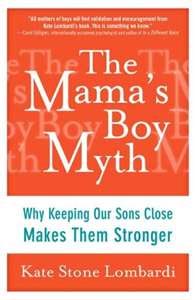
As the mother of sons I was compelled to read The Mama’s Boy Myth:
Why Keeping Our Sons Close Makes Them Stronger by Kate Stone
Lombardi. My oldest, in his mid-20s, often boasts of being a “mama’s boy,”
however, my other two have yet to claim to the same title. Nonetheless, I
feel close to all three. Of course, they don’t tell me everything, but they share
quite a lot. More importantly, I no longer feel the way I did when they were
younger: that our relationship would stop flourishing as they got older. That
is not happening at all, and, according to Lombardi, I am not the only mother
enjoying this experience.
Lombardi combines interviews with mothers of sons, excerpts from studies,
personal experience, and historic trends that have led her to conclude there
is nothing wrong with strong bonds between moms and their boys. In fact,
she highlights a number of benefits for males. These include possessing more
expressive and thoughtful qualities. Yet until now, little has been written to
correct the bum rap directed toward moms if their sons were too sensitive or
socially inept; and having a male role model was considered the way to over-
come “problems” caused by a mom with tight apron strings.
Dads, as Lombardi notes, don’t face such scrutiny in their relationships with
daughters. All parents should be encouraged to maintain close ties with their
children. For moms it should happen without Oedipus’s looming shadow.
The Mama’s Boy Myth: Why Keeping Ours Sons Close Makes Them Stronger
Three Bookmarks
Penguin Group, 2012
324 pages (includes notes)

Depending on perspective, the good or bad thing about historical fiction is knowing
how something will end – at least generally. Alice Hoffman’s The Dovekeepers
may have Masada in ancient Israel as its setting, but her novel about four strong,
captivating women is all new. It’s no spoiler to acknowledge that, yes, nearly every-
one dies; nonetheless, Hoffman’s characters are so vibrant and remarkable that
they make their home in our minds and hearts.
Hoffman typically combines the supernatural with the ordinary, but this is the first
time she blends these with history and religion. In her hands, the concepts are not
as incongruous as might be expected. Along with what could be perceived as a little
magic, other attributes shared by the women include survival, desire, love and relig-
ious conviction; these qualities move the fast-paced story toward its inevitable con-
clusion.
Hoffman clearly did her research. Rich with descriptive language of the harsh land,
the brutality of men, and Judaic traditions, Hoffman details the lives of the women
before and after their arrival in Masada. The four, Yael, Revka, Aziza and Shirah,
fill the pages with joy and heartache. They are of various ages, backgrounds, and
experiences; all are intelligent, sensual, even daring characters. Although each wo-
man shares her narrative, the voices are not that distinctly different.
In some ways reminiscent of The Red Tent for its portrayal of women in a Biblical
context, The Dovekeepers is a gripping representation not just about the existence
of faith but of its necessity.
The Dovekeepers
Four-and-a-half Bookmarks
Scribner, 2011
501 pages

Anne Tyler is a gifted story teller. Her characters are ordinary, and if you live in
Baltimore — her setting of choice — they could easily be your next door neighbors.
She makes the potentially banal into something sublime. Such is the case with
The Beginner’s Goodbye, a finely-threaded novel about a man, Aaron, left to
scrutinize his marriage following the death of his wife in a freak household accident.
The story’s beauty deepens as Aaron is ultimately forced to confront his relation-
ship with not only his deceased wife, Dorothy, but also with his sister, co-workers,
and others he’d rather ignore.
The beginner in the title comes from the succession of books published at Aaron’s
small, family-run publishing house. Humorously based on the Dummies’ series, the
Beginner’s books address everything from kitchen remodeling to dog training, from
wine tasting to bird watching. In a way, Tyler’s novel is about how to avoid dealing
with grief. Aaron is pathetic, and, if not for glimmers of humor, would be a completely
disagreeable protagonist due to his efforts to deflect expressions and gestures of sym-
pathy as well as support. By the way, Aaron stutters and his right side is crippled. He
has a history of impeding assistance, which he mistakes for pity. He has always kept
everyone at bay. From Aaron’s perspective, so did Dorothy. Ironically, Dorothy’s re-
appearance as an apparition helps him acknowledge this and other truths.
This is no ghost story or smoke and mirrors tale. Instead, it’s about love, loss and un-
derstanding.
Four Bookmarks
The Beginner’s Goodbye
Alfred A. Knopf, 2012
197 pages
Although I read a fair amount of nonfiction, my preference has always leaned toward fiction. As
I read Katherine Boo’s Behind the Beautiful Forevers, I had to remind myself this is a true
story – in in fact, many true stories; it’s simply written with the smooth, eloquent narrative that
makes it read like a really good novel. But, it’s sad and it’s true.
Boo writes of the Annawadi slum in Mubai, India. For three years she follows the lives of several
families and child-scavengers all trying to survive in an overcrowded, rat-infested community of
makeshift structures that serve as homes. Mubai has numerous slums that fit this decription, but
Annawadi is the one located in the shadow of the international airport with its cosmopolitan hotels.
What makes Boo’s chronicle so intriguing are the people and their efforts to make more of their lives.
As if poverty alone were not enough to keep them down, they face government corruption, lapses of
moral judgment, and fear generated by religious differences. Boo’s account includes the experience
of Abdul who, with his father and older sister, is charged with murder when a vindictive neighbor
lights fire to herself. The family’s efforts to move out of Annawadi are thwarted as income is lost and
bribes must be paid.
This description of trying to exist in Mubai’s slums is much, much more than what most think of as a
hard-knock life. Yet, for their individual and collective foibles, these people continue to dream that
someday they will have more.
Behind the Beautiful Forevers
Four Bookmarks
Random House, 2012
256 pages

This week my younger brother reaches a milestone birthday. Late last year he published
a book. Both of these events are significant, but it’s the latter that makes me exceptionally
proud and very jealous. He wrote a book! And it’s published! Although I have the copy he
gave me, when I saw the book in a bookstore, I was thrilled beyond words – so I took a
photo.
Once I decided to start my blog I knew I did not want to review meals made by friends or
myself, and I thought I should not review books written by friends or family members. I
didn’t really think the issue would arise regarding books by people I know; but it has, and
I feel the same. I don’t want to review my brother’s book because of my background as a
journalist and my, perhaps misplaced, desire for objectivity. I can say with all sincerity he
has written an attractive, informative book about architect Wallace Neff whose fascinating
building process involved the use of balloons and concrete. I’d never heard of this before.
I can say the book is well-researched and well-written. But I can’t, I won’t, rate it because
to say I love it could be misconstrued as sisterly-love-induced bias. Conversely, if I say I
despise it that could be chalked up to good old fashioned sibling rivalry. I don’t hate it, and
I do love my brother.
Happy Birthday, Jeffrey! Keep writing. You make me envious – and proud!
No Nails, No Lumber: The Bubble Houses of Wallace Neff
By Jeffrey Head
Princeton Architectural Press, 2011
176 pages

I’m a careful driver, but some days I forget having passed a certain roadside
marker, or I have no recollection of having turned left at the light. Based on
Charles Duhigg’s The Power of Habit, it has less to do with a faulty memory
and is more about habit – the consistent recurrence of a deliberate choice.
Duhigg looks at habit from three perspectives: personal, corporate, and socie-
tal. The first two are the most fascinating and well-developed. With thorough
research and a conversational style, Duhigg relates scientific studies about
individuals and the patterns their brains establish to create habits. The author
considers individuals who completely alter their lifestyles by choice, as well
as those whose lives are changed by trauma or illness. He identifies three ne-
cessary elements: cues, routines, and rewards needed to establish habits.
The most interesting, albeit disturbing, aspects are found in the corporate view.
Duhigg reinforces what we already know: our spending habits are not secret.
This loss of privacy is not a new concern, but how we lose it is disconcerting.
Duhigg examines everything from how employees are trained to respond, to how
data is manipulated. The book’s weak link comes as Duhigg combines habitual
actions that evolve into addiction with those resulting from a physical medical
condition when examining societal aspects.
Although the focus of the book is to consider “why we do what we do in life and
business,” Duhigg does offer some suggestions for breaking the triad of habit,
which might be worth a try.
The Power of Habit
Three-and-a-half bookmarks
Random House, 2012
291 pages, plus notes and index

Julian Barnes’s The Sense of An Ending succintly examines the lackluster
life of Tony Webster, an uninspiring British gentleman deficient in confidence
and family background. Tony narrates the story of his very ordinary life from his
school days to his retirement; but don’t worry, it’s not as tedious as it sounds.
Whole elements, from marriage to parenting to divorce, are simply allotted a
passing mention. Although, intrigue is found, as contradictory as this may seem,
in the mundane when Tony’s conventional past rear-ends his present day exist-
ence forcing him to scrutinize incidents more closely.
Tony’s story relies on his memory, which is like everyone’s: a bit faulty. The
novel’s retrospective focus is on Veronica, Tony’s first real girlfriend, and Adrian,
his school chum. Both play a large part in Tony’s younger life, although Barnes’s
tone is particularly casual toward them. It’s as if these relationships are no more
significant than passersby on the street. Herein is one of Tony’s major flaws, as
identified by Veronica: nothing excites him. This inability to be moved, or even
demonstrate it, is part of Veronica’s palpable frustration with him. Not that she
is free from fault either. He admits he sees only the obvious, which is interesting
given that he is oblivious to so much. Nonetheless, a mystery ensues with Tony
trying to finally understand the connection with Veronica, her family, and Adrian
to vague recollections of long-past incidents and snippets of conversations.
This terse novel suggests a lot about how and what we choose to remember.
“The Sense of An Ending”
Four Bookmarks
Alfred A. Knopf, 2011
163 pages

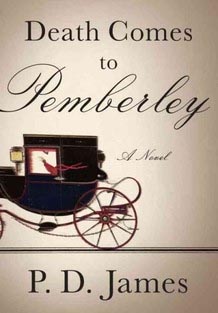
I imagine it’s entirely possible to enjoy Death Comes to Pemberley even if, heaven for-
bid, you’ve never read Pride and Prejudice; but I especially appreciate P.D. James’s latest
mystery because I do know about the Bennet and Darcy families. The novel begins six years
after Jane Austen’s Elizabeth and Darcy are married.
A few new minor characters are introduced, but James, for the most part, extends the lives
of those created by Austen in a completely believable manner: the Darcys have two young
boys; Jane and Bingley are regular visitors to Pemberley, the Darcy estate; and Wickham,
the troublemaker in the original work has a similar role, with his wife Lydia not far behind
in her ability to exasperate.
The story begins on the eve of the annual ball overseen by Elizabeth as she continues a
tradition started by Darcy’s mother. The preparations are interrupted when an uninvited,
hysterical Lydia appears believing Wickham has been shot nearby. The characters’ react-
ion to this news, subsequent discoveries, and a trial in London’s Old Bailey are sheer en-
tertainment. In James’s hands, the story is plausible. The characters react just as one
would expect of proper, early 19th century British gentry. Family obligations and public
perceptions dictate their behavior.
The numerous and recent spinoffs, including combining zombies with Pride and Prejudice,
even if only meant to introduce or reacquaint readers to Jane Austin, have never appealed
to me. However, James has created something completely original from classic literature
without diminishing appreciation for Austen’s writing.
“Death Comes to Pemberley”
Four Bookmarks
Alfred A. Knopf, 2011
291 Pages