Archive for the ‘Books’ Category
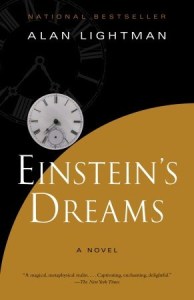
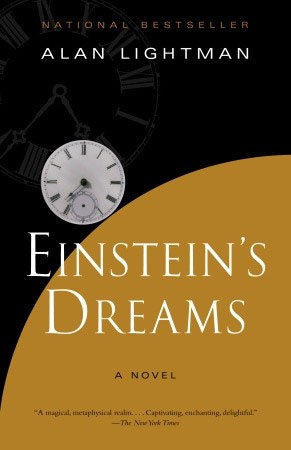
A physics background isn’t necessary to appreciate Einstein’s Dreams by Alan Lightman. This terse, yet philosophical, novel offers poetic vignettes, the dreams, based on what Albert Einstein might have wrestled with in his subconscious while developing his theory of relativity.
Each dream examines an altered way of experiencing time. Some are nightmarish, some sweet, others poignant, but all are interesting possibilities that, perhaps, other people have also considered, but never articulated. For example, time standing still, literally; or the opportunity to replay time for different outcomes. A variety of perspectives toward time also fill the dreams: parents who have lost children, lovers who grow apart, a baker who grows weary of extending credit. These are fleeting moments that haunt Einstein in his waking hours.
The dreams are offset by several “interludes” in which Einstein is awake. He meets with a colleague, seemingly his only friend, from the Swiss patent office. Although there’s a sense that Einstein wants to share his dreams, he always holds back. What is most obvious in the conscious interims is Einstein’s unhappiness. He feels a sense of drowning in his job and marriage. His desire to understand time buoys him.
Lightman’s writing is imaginative yet concise. It’s easy to imagine the vivid dreams with specific street names and recurring characters. From the very first dream, which begins “Suppose time is a circle, bending back on itself. The world repeats itself, precisely, endlessly,” it’s clear the author will explore the rhythms, pain and joy that comprise life.
Einstein’s Dreams
Four Bookmarks
Vintage Contemporaries, 1993
140 pages
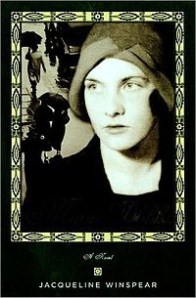
The more I read Jacqueline Winspear’s Maisie Dobbs, the more I wondered if it’s been a BBC or Masterpiece Theatre series. It’s familiar in the same way as Downton Abbey and Miss Marple: easy-to-like characters, strong spirit of place and impeccable English sensibilities.
A friend recommended Maisie Dobbs several months ago. I am thrilled that, unlike past initial encounters with mystery (in this case mystery-lite) writers, I was steered to the first in the series. Winspear’s Maisie is an exceptionally intelligent, caring young woman. Although I am sure subsequent books will provide the necessary backstory, I enjoyed meeting Maisie in the inaugural. Maisie is a private investigator in post-war London. Thanks to a benefactor, a mentor and her own gifts of curiosity and intellect, Maisie is given the opportunity to leave a life of service and pursue her education. She is out of her league on the social ladder, but is several rungs higher than most others she encounters in areas that truly matter.

Winspear begins with a small case for Maisie to investigate, which leads to a much larger issue that has the potential to impact her benefactor. Yes, it’s a fluke, but, as the author writes, “Coincidence was a messenger sent by truth.”
The distinction between classes, as indicated through the use of cockney dialect, is distracting. Winspear could easily rely on her descriptive talents to show the differences. Nonetheless, I look forward to the next adventure of Maisie Dobbs – and looking for it as a masterpiece classic.
Maisie Dobbs
Four Bookmarks
Soho Press, 2003
292 pages
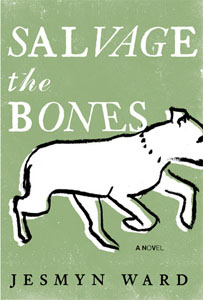
Salvage the Bones by Jesmyn Ward is one of those books that once it comes in the front door, makes itself right at home. At first, I was reluctant to let it in. The cover isn’t intriguing and I don’t always appreciate the same books as the friend who recommended this one. Ward’s book, however, is a winning guest. Literally: it’s the 2011 National Book Award Winner.
Fifteen-year-old Esch, her three brothers and frequently-drunk father live in rural coastal Mississippi. The story follows the 12 days leading up to, and including, Hurricane Katrina’s arrival. Despite what appears to be laissez faire parenting, Esch’s father is increasingly concerned about a possible powerful storm making land. In between drinking binges, he tries to ready the family’s ramshackle home.
Told from Esch’s point of view, Ward has crafted a beautifully poetic, heartbreaking story of family love, loyalty and misdirected affection. Esch is an intelligent young woman, but she lives without benefit of another woman’s perspective; her mother died seven years earlier. The only other female around is her brother Skeetah’s pit bull, China.
The impending hurricane and Skeetah’s concern for China are told as parallel accounts. China, bred for fighting, has just given birth to her first litter. Despite their father’s appeals for help to make the house secure, the kids go about their lives as usual: basketball, swimming and hanging out with friends. Even without the storm’s threat, it becomes quickly evident that all is not as carefree as it appears.
Salvage the Bones
Four Bookmarks
Bloomsbury, 2011
258 pages
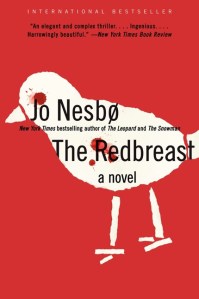
The Redbreast is the third of the Harry Hole series by Norwegian crime writer Jo Nesbo. It’s also the fifth one I’ve read. Clearly, I haven’t read them in order. Initially, it was difficult to find translations of Nesbo’s books, so I savored them as I found them. He is apparently so in vogue now, that all ten, including a newly released novel, are readily available. At this point, I don’t mind the leap frogging. Nesbo has always provided enough backstory that I never felt I missed anything. However, what’s particularly appealing about The Redbreast is the introduction of the love of his life: Rakel, and her son, Oleg. Both figure significantly in the later books. But I’m jumping ahead of myself, literally.
Unlike others in the Hole series, The Redbreast is slow to build momentum. Initially, it was like being a passenger on a local train, with lots of stops, before finally getting on the express.
Nesbo’s story travels effortlessly between modern-day Oslo and World War II. The latter sets the stage for the underlying threat of neo-Nazism, which becomes the focus of an investigation Hole pursues. His efforts to discover how, and why, a rare sniper rifle was brought into the country lead him to several men who were Nazi sympathizers during the war.
Several parallel love stories emerge, as does a particularly sad one about friendship. All demonstrate Nesbo’s ability to evoke emotion while wanting to make sure all the doors in the house are securely locked.
The Redbreast
Four Bookmarks
Harper, 2000
520 pages
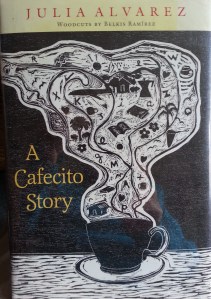
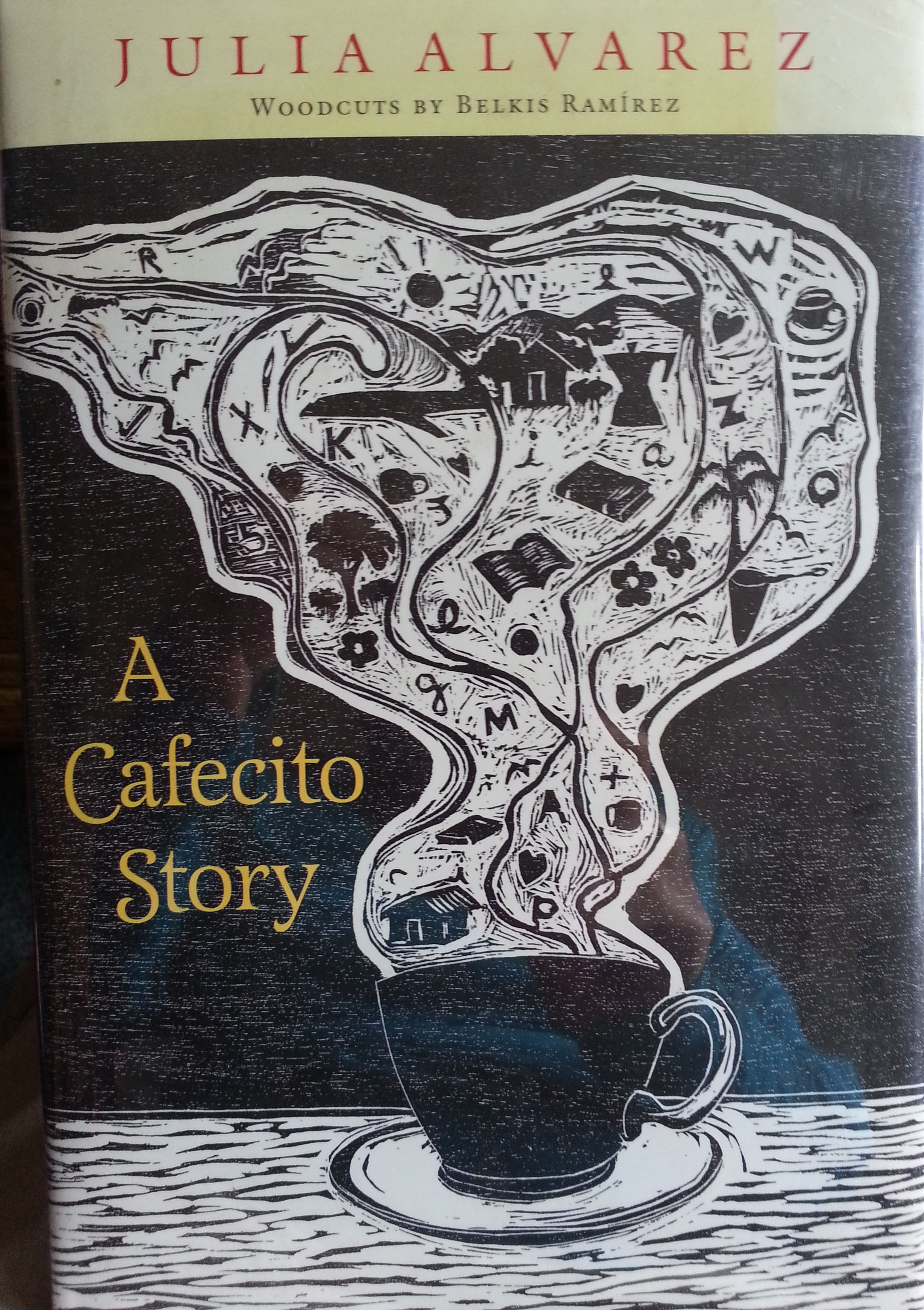
Much to my husband and mother’s chagrin, I don’t drink coffee. I still enjoyed A Cafecito Story by Julia Alvarez. Although to be honest, I might have skipped past it on the shelf had it not been for her name.
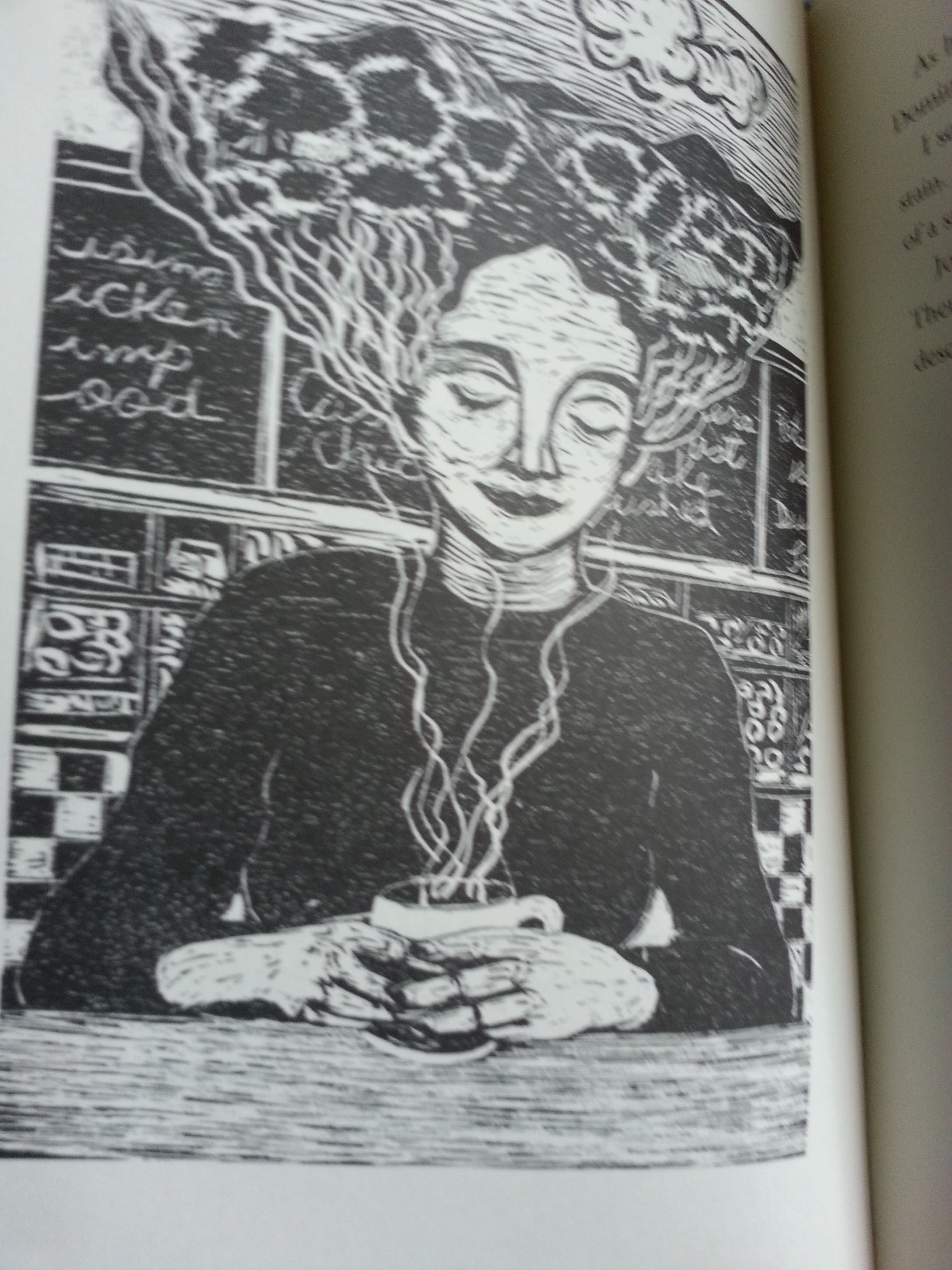
This slim hardback contains a 37-page novella; several pages of beautiful, often haunting, woodcuts by artist Belkis Ramierez; a seven-page afterward by Bill Eichner, Alvarez’s husband; and 11 pages of information about resources for fair trade items, co-ops and good business models. A Cafecito Story is a call to arms; it’s a quiet protest against big businesses that have the potential to eliminate people’s livelihoods, ways of life and quality coffee.
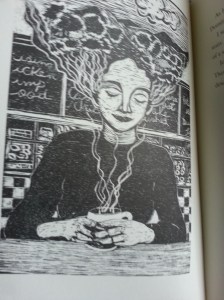
Coffee is more than a metaphor, but it does take center stage in the story about Joe, a disenchanted teacher, who leaves the Midwest to travel to the Dominican Republic. He’s not interested in seeing the tourist sites. Instead he is enamored with the coffee farmers who struggle to make a living while producing the best possible coffee.
The little cups of coffee, cafecitos, Joe is offered everywhere he goes intrigue him. Soon, he is befriended by Miguel who, with his family, has a sustainable coffee farm. Miguel teaches Joe about the slow, methodical practices necessary being threatened, while Joe teaches Miguel and his family how to read.
Summarizing a short work without revealing too much is challenging. The woodcuts alone are mesmerising, and Alavarez’s writing is descriptively rich. I imagine it’d go great with a cup of java.
A Cafecito Story
Three-and-a-half Bookmarks
Chelsea Green Publishing Co., 2001
58 pages

The blind date set up by the Pikes Peak Library District was okay. I might go out again with another Ray Bradbury book, but for now the novellas in Now and Forever are enough.
The stories blend a sense of otherworldliness with the familiar. First in Somewhere a Band is Playing, Bradbury plays with the themes of life and the afterlife. The story begins abruptly when a writer practically falls off a train near an isolated Arizona town. It’s beautifully described and seems an ideal place to live, at least until the writer begins to wonder what’s beneath the surface beauty. It’s an enjoyable story, but predictable. I was hoping for something other than a “Twilight Zone” twist.
In Leviathan ’99, Bradbury, by his own admission in the preface, has created a sci-fi version of Herman Melville’s Moby Dick, right down to the main character: Ishmael. Set in 2099, the beast is a big white comet pursued by a spaceship and its blind captain. It’s actually fun making the jump from being at sea to out in space. And, it’s not to be as big a leap as one might initially imagine.

It’s been years since I’ve read anything by Bradbury. Although I have long been intrigued by the titles of his numerous works, I am not a reader who’s made it through much of his literary oeuvre. I can certainly appreciate his imaginative approach and accessible tone, but the bottom line is that he’s not really my type.
Now and Forever
Three Bookmarks
HarperCollins, 2007
177 pages

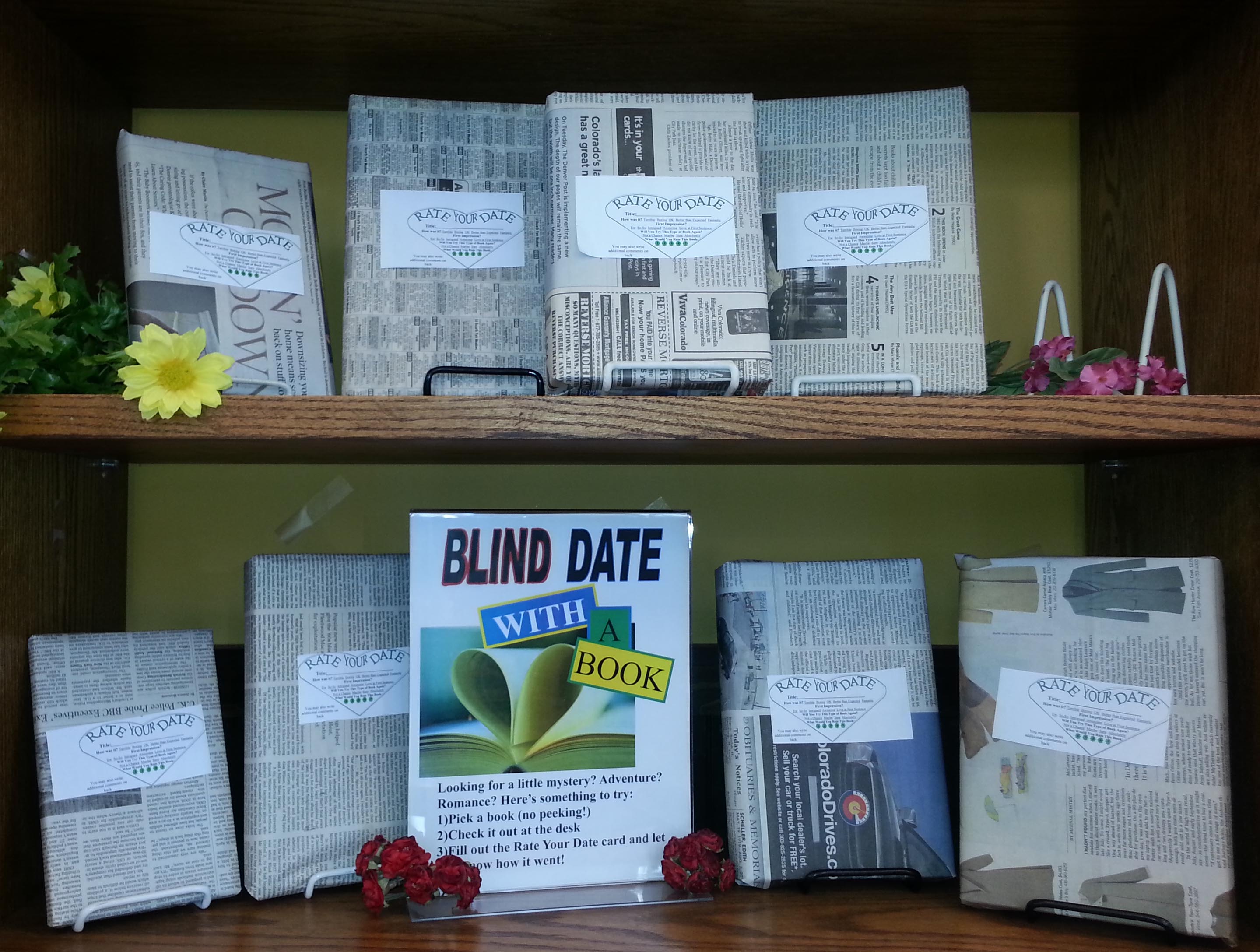
As I was leaving my neighborhood library, the Old Colorado City Branch of the Pikes Peak Library District, two shelves with books wrapped in newspaper caught my eye. They were near the backdoor in what seemed an out of the way location for a holiday display, although I realized it’s far too early to be in that mindset. Then I saw the sign: “Blind Date With A Book.”

The concept is to check out a wrapped book without knowing its title. I was intrigued. I picked up a couple of books/packages in much the same way I’d consider which gift to open first on my birthday or Christmas. Did I really want to commit to something I knew absolutely nothing about? What if it was one I’d already read? Yet, in a way, starting a book is very similar to a blind date anyway; there’s always a sense of the unknown, of possibilities and disappointments.
I considered another blind date. It’s how I met my husband, and that’s turned out very well. So, I decided to take my chances. I was paired with Now and Forever by Ray Bradbury. I haven’t read anything by Bradbury since my high school days, but this book contains two previously unpublished novellas: Somewhere a Band is Playing and Leviathian ’99.
I laughed when I opened book. It was dedicated to two women, which didn’t strike me as a very auspicious way to begin a date.
I’ll review the date, I mean, the novellas in a separate post.

Bacon. It’s one of those foods that evoke smiles and salivation no matter when it’s served. Bacon Nation by Peter Laminsky and Marie Rama illustrates that bacon isn’t just for breakfast – as if.
In addition to 125 recipes, from the obvious Bacon-Wrapped Shrimp to the creative Bacon Jam – and that’s just among the appetizers, side dishes, salads, desserts, even poultry, featuring the favored pork product are included.
Last Christmas a friend shared her recipe for what she called “Bacon Crack” due to its addictive qualities. It featured a sweet and savory rub. Bacon Nation doesn’t contain this particular tasty treat, but has several others in the same category, such as Peanut Butter Bacon Cookies. Although not as sinful as Bacon Crack, they are easy to eat.
As with most well-executed cookbooks, Laminsky and Rama don’t rely on recipes alone, even though they could. The authors’ first chapter is dedicated to tips for purchasing and cooking bacon. They recommend thick cut for most of the recipes, and explain the difference between dry and wet cured. The former is rubbed with salt (often pepper, occasionally salt;) and the latter is brined.
Each section, or chapter, features a brief prologue, and individual recipes are accompanied by an also-brief introduction. These range from explanations of how the recipes came about or what was done to modify them for the home cook.
Chapter 12, by the way, is entitled “Breakfast Means Bacon.” Since it comes near the end, I really don’t believe the authors/chefs.
Bacon Nation
Four Bookmarks
Workman Publishing, 2013
310 pages, including photos and index

In a twist on the what-did-you-bring-me refrain from my kids’ childhood reactions to out-of-town trips, my oldest son brought me a book. I appreciate that it made him think of me. Shaggy Muses by Maureen Adams examines the relationships between five female writers and their dogs. I’ve had several dogs in my life and all hold special places in my heart. My dog Jackson and I have a strong bond; although I’m not sure I consider him my muse, he might prove me wrong.

Adams’s book is subtitled The Dogs Who Inspired Virginia Woolf, Emily Dickinson, Elizabeth Barrett Browning, Edith Wharton and Emily Bronte. It’s part academic, largely anecdotal, and for dog lovers who happen to enjoy literature it’s particularly enjoyable. The book started as a series in scholarly journals on the bond between dogs and their humans.
The relationships between these writers and their dogs were strong to the point of distraction. In fact, the dogs served as buffers making it possible to limit expressing real emotion. Adams writes, “Elizabeth and Robert [Browning] used Flush as a symbolic go-between to help them express their feelings in conversations and letters.” The other women did the same.
Some of the writers had numerous dogs, other just a single source of inspiration. One narrative involving Bronte and Keeper, her large, intimidating part-Mastiff, is exceptionally disturbing. Bronte beat her dog, and then comforted him, which suggests the love-hate relationship often evident in abusive relationships. Fortunately, the other stories Adams provides are more endearing.
Shaggy Muses: The Dogs Who Inspired Virginia Woolf, Emily Dickinson, Elizabeth Barrett Browning, Edith Wharton and Emily Bronte
Three-and-a-half Bookmarks
The University of Chicago Press, 2007
299 pages, with notes and index

Rainbow Rowell’s story of young love overshadowed by harsh realities is humorous, haunting, and hopeful. Alliteration aside, Rowell’s Eleanor & Park is a study in contrasts and seems to prove that opposites do attract.
The omniscient narrator alternates between the couple. Although this approach doesn’t establish distinct voices, the characters are well-defined. Bits and pieces of Eleanor’s unhappy home life are slowly revealed while suggesting impending misfortune. Park, on the other hand, has two loving parents and lives next door to his grandparents. Eleanor is the new girl in school. She’s overweight, has bright red, unruly hair and dresses in a way that only the addition of neon could attract more attention. Park isn’t Mr. Popularity, but he does straddle the line between acceptance and rebuff. He’s part Asian, dresses all in black, but has known the kids in his high school all his life. When Eleanor sits next to him on the bus, he’s embarrassed, but friendship, then romance slowly, oh so slowly, begins to emerge.
Among Rowell’s themes are bullying and abuse; these create tension in the novel. The sense of something going awry is palpable. Yet, so are the more positive aspects of emerging love and parental concern. References to Shakespearean tragedy add a sense of foreboding; nonetheless, this is a tale dependent on hope. The title characters are different, likeable, and prove that appearances aren’t everything. It’s unfortunate they live in world where extreme differences aren’t always appreciated and where it’s easy to hide dangerous secrets.
Eleanor & Park
Four Bookmarks
St. Martin’s Griffin, 2013
325 pages







 The Blue Page Special