Archive for December 2015
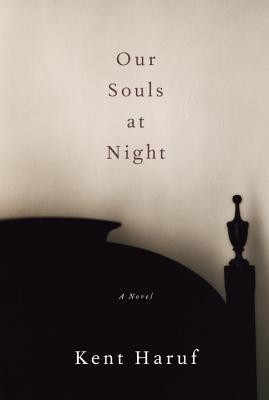
Our Souls at Night by Kent Haruf is best described as sweet. This terse novel was published posthumously, and its content makes me imagine that the author was in his final days when he penned it. This is a story of finding a way out of loneliness while believing that the opinions of others have little value or impact.
Addie Moore and Lewis Waters are widowed and living in the fictional town of Holt on Colorado’s eastern plains. This is Haruf’s preferred setting as many of his previous works have centered around this small communityand its residents. Anyone familiar with his writing will recognize names and places.
One day, Addie calls Lewis. They have known each other for years, but only peripherally. She wonders if he would like to spend the night. This is no brazen, immoral solicitation. It is one lonely heart reaching out to another.
Addie’s son and grandson figure into the narrative as does Lewis’s daughter. The townspeople make sure these adult children are aware of what their parents are doing.
Haruf provides a lot of detail such as teeth brushing and lawn care for someone trading in a scarcity of words (after all, the book is less than 200 pages long).
Unfortunately, the premise, which is touching and somewhat whimsical, overshadows the writing, which is too mundane to be enchanting. Anyone who has experienced a meaningful relationship (be it lover or friend) will appreciate the warmth drawn from conversations that happen just before sleep.
Our Souls at Night
Three bookmarks
Alfred A. Knopf, 2015
179 pages

For a minute forget that Elizabeth Gilbert wrote Eat, Pray, Love. It may take a little longer, but the idea is to not let this dissuade you from reading The Signature of All Things. Gilbert’s novel is as different from her memoir as ice milk is from ice cream. The latter is much richer and nuanced; it’s worth every moment of guilty pleasure spent under its grip.
Gilbert transports the reader from London, across the seas (on multiple occasions), and to Tahiti and Amsterdam. Philadelphia provides the lengthiest setting where the brilliant, unattractive Alma Whitaker is introduced to the world: her birth is literally the first sentence of this epic narrative. In Gilbert’s words, Alma’s childhood “was not yet noble, nor was it particularly interesting …” Thus, the focus turns, albeit temporarily, to Alma’s father, Henry Whitaker.
Henry stole his way out of poverty. He didn’t just acquire wealth, he attained knowledge and became a leading botanist and businessman. Alma’s mother, a stoic and harsh parent intent on fortifying her daughter’s intellect, also possessed a great mind and interest in botany.
Through humor, interesting botanical descriptions and strong, insightful characters, Gilbert creates a story that not only spans continents, but also scientific ideas along with notions regarding love and relationships. The vivid imagery of the various landscapes is a bonus.
Alma is a passionate character rich in curiosity (and foibles). Yet, despite the limits placed on her gender, she explores life in miniscule proportions and unexpectedly reveals its grand scale.
The Signature of All Things
Four-and-a-half Bookmarks
Viking, 2013
499 pages

The title of Kathleen Flinn’s experience at Le Cordon Bleu in Paris is what initially caught my eye: The Shaper Your Knife, The Less You Cry. These words are advice from one of her chef instructors as begins the first of three sections required to earn a diploma from the prestigious cooking school. The subtitle offered more foreshadowing than I would have liked, though: “Love, Laughter and Tears in Paris at the World’s Most Famous Cooking School.”
Flinn’s account combines her background, her romance and her Parisian education, which involved much more than cooking as she learned to navigate a new city with only un petit peu knowledge of French.
The book is divided into the three parts that correspond with the units at the school: Basic, Intermediate and Superior Cuisine. Flinn’s culinary undertaking is humorous, honest and, unfortunately, predictable. Of course she grows through this journey; of course she learned techniques that were as foreign as the language; and of course she is with the man of her dreams. The latter requires no spoiler alert; this is revealed early in the narrative.
Despite its predictability, Flinn gives an insider’s view of how the classes are taught, the types of people who enroll (not surprisingly from all over the world) and the friendliness of the French people. She also includes several recipes and even includes a menu guide for book groups. Fortunately, none require deboning a chicken or dealing with dead rabbit heads.
The Sharper Your Knife, The Less You Cry
Three-and-a-half Bookmarks
Penguin Books, 2007
278 pages

 The Blue Page Special