Archive for February 2015

I enjoyed Orange is the New Black, the book by Piper Kerman. I haven’t seen the Netflix series of the same name, but after reading Kerman’s account I’m now inclined to watch because Kerman’s account intrigued me.
The author, privileged and intelligent (except for the episode in her life that landed in her prison), writes about her year in a minimum security facility in Danbury, Conn. She is honest about her own fear at being incarcerated and the guilt she has for vicariously putting her family, fiancé and friends through her ordeal. Yet, she does so without self-pity, with humor and insightful respect for most of her fellow inmates.
It’s the latter that particularly garners the reader’s attention and doesn’t let go. Kerman learned to survive thanks in large part to the women around her. It’s no surprise that Kerman would undergo a transformation, but perceptions about prisoners and their crimes do, too. Although it wasn’t an easy 12 months, Kerman shares moments of fun, revelation, pride and friendship – in addition to the aforementioned guilt.
Of course, hers is not a summer camp experience, but neither is it as brutal as initially anticipated. At least that’s the case while in Connecticut. This changes, though, when just before her release she is transferred to Chicago to await testifying in a related trial. There she confronts the woman who years earlier revealed Kerman’s name to authorities. Nonetheless, the author’s honesty and humor make this a worthwhile read.
Orange is the New Black
Four Bookmarks
Spiegel & Grau Trade Paperback, 2013
302 pages
http://piperkerman.com/

The Book of Unknown Americans by Cristina Henriquez is a timely read with the issue of immigration never far beneath the political surface. Yet, the novel isn’t about politics, but people.
Arturo and Alma leave Mexico for Delaware because they want to do more for their teen-aged daughter, Maribel, who suffered a brain injury. They believe she’ll benefit in a better school. They’re not illegals; they have work visas. Each chapter is told from one of the character’s perspectives, some in greater detail than others; only never Maribel’s.
Woven in with the challenges of living in a new land with a new language is the relationship that develops between Maribel and Mayor.
Sixteen-year-old Mayor Toro lives in Maribel’s apartment building; his parents left Panama when he was less than a year old, but he’s never fit in. From Mayor’s perspective, Henriquez writes: “The truth was that I didn’t know which I was. I wasn’t allowed to claim the thing I felt and I didn’t feel the thing I was supposed to claim (Panamanian).”
This sums up the experience of those introduced in the book. Henriquez has created a montage of immigrants: from Mexico, Panama, Puerto Rico, Guatemala, Nicaragua, even Venezuela and Paraguay. These places are all part of the Americas, which is what makes the title so appropriate with its double entendre. In brief, compelling chapters, among those told in Alma and Mayor’s voices, the neighbors share their pasts explaining why they left their native countries for the U.S.A.
The Book of Unknown Americans
Four Bookmarks
Alfred A, Knopf, 2014
286 pages

Although I read a lot, it’s been a while since I held a book I didn’t want to put down. Even at 500-plus pages, I hated to turn the final one of Anthony Doerr’s All the Light We Cannot See. Doerr is garnering a lot of well-deserved attention including being named a finalist for the 2014 National Book Award and #1 New York Times bestseller.
This story is about hope and connections, those that are tangible and those we simply know exist. Marie-Laure, a young girl in Paris, is blind. Her story is told in turns with that of Werner, a German mining town orphan with an aptitude for science and gadgets. The novel jumps around the years just before WWII and during the August 1944 bombing of Saint-Malo on the French coast.
From the onset, there’s a sense the two youths will meet, but how and when leave much to the imagination. Werner builds a small, crude radio from scrap parts. This ability ultimately earns him a spot in Hitler’s army. Marie-Laure relies on her father who builds small models to recreate, first, their Parisian neighborhood and later Saint-Malo where they flee. The hand-crafted items are meant to aid communication with good intentions in a world rife with evil.
Doerr’s work is easy to embrace for its vivid descriptions of the kindness and fear individuals extended or induced during the war. Mostly, though, the characters are so finely fashioned that they come alive in the mind’s eye.
Five Bookmarks
All the Light We Cannot See
Scribner, 2014
530 pages
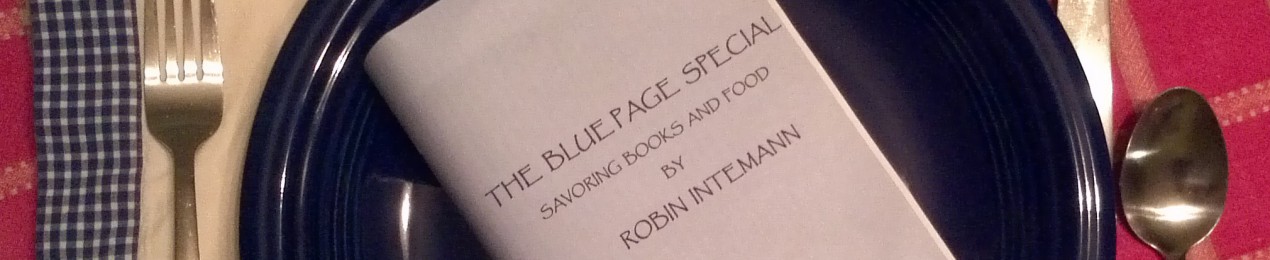

 The Blue Page Special