Archive for the ‘spies’ Tag
In Creation Lake by Rachel Kushner, “Sadie Smith” is a secret agent for undisclosed clients. She’s adept at manipulation, which she demonstrates while ingratiating herself, first with a Parisian man, and later a counter-culture group in rural France.
As she learns more about the group she becomes intrigued by a hermit, Bruno, who lives in a cave and mentors those in the commune. He does this via emails, which Sadie intercepts; she becomes enthralled by his writing on early man. He wants the group to return to pre-industrial, and even prehistoric lifestyles. But, there’s more to Bruno than his knowledge of prehistory (the recounting of the history of the medieval Cagots is fascinating); Sadie is captivated by his ideas for not just what it means for Bruno’s mentees, but what a less deceptive life could mean for her.
As the narrative expands, it becomes less clear who’s manipulating who. Sadie works with the group to plan a protest against the government’s plan to divert water meant for farming to “megabasins” to be used by agricultural corporations. However, her intent is to have the commune members make it a violent demonstration.
There’s a lot of intrigue and double-crossing, and Kushner’s fast-paced writing makes it difficult to keep up with who are the good guys, or if anyone is. Certainly, Sadie’s ability to disregard and/or exploit others makes her unlikeable, yet, strangely, she’s the character you care about who she trusts, while maintaining her cover, which has a bearing on her safety.
Creation Lake
Three and-a-half bookmarks
Scribner, 2024
404 pages
Real Tigers is the third of Mick Herron’s Slough House series. It’s just as gripping as its predecessors and equally rife with often-sardonic humor.
The discredited British intelligent operatives, known as Slow Horses, once again find themselves faced with overcoming expectations of their abilities when one of their own is kidnapped. In some ways it’s a comedy of errors in the face of real danger.
Herron hooks readers from the onset with his description of the shabby Slough House, the name given to the office space where the former spies are relegated to paper pushing busy work. The M15 higher-ups expect the meaningless jobs will encourage them to quit. Little do they understand the degree of hope each has of being able to find their way to good standing. These people are nothing if not optimistic.
Toward this end, the crew sets about to rescue their colleague. The kidnappers’ ransom request is a secret file they want the Slow Horses to retrieve. It’s a seemingly impossible task.
Among Herron’s fortes is his skill to imbue characters with distinct personalities including physical features, foibles and qualities.
Jackson Lamb oversees Slough House with an attitude akin to a broken umbrella: why bother?! He’s a disheveled chain-smoking, flatulent man who’d rather sit at his desk nursing a drink. However, when necessary he will take action albeit in a slothful manner – keeping in character.
M15 conspiracies and suspicions about who is good and who’s not are other elements Herron incorporates to keep readers engaged.
Real Tigers
Four Bookmarks
Soho Crime, 2016
343 pages
The disgraced, humiliated M-15 spies in London’s Slough House are as disgruntled as ever. Yet, each has aspirations of returning to action – if only given a chance.
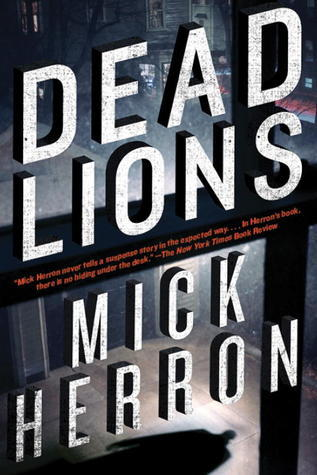
In Dead Lions, Mick Herron adds two new characters to Slough House, the rundown offices far from M-15’s sleek command center, while continuing to reveal more about those introduced in Slow Horses. This time the chance for redemption comes in the form of a one-time, low-level Cold War spy found dead of a heart attack.
Jackson Lamb, the slovenly, sharp-tongued superior of Slough House, suspects the death wasn’t accidental and begins an off-the-record investigation. He’s still supposed to report to M-15 headquarters, but resolutely follows his own rules.
Perhaps the most ardent in his determination to redeem himself is River Cartwright. He goes undercover in an English village after convincing Lamb to include him in the investigation.
Meanwhile, River’s colleagues Min Guy and Louisa Guy are approached by Spider Webb. He’s an M-15 underling with ambitions of making a name for himself by recruiting a Russian businessman to spy for the agency. Also off the record, Webb wants the pair to “babysit” the Russian before making his pitch.
Herron combines humor with intrigue. Like River, Min and Louisa believe these opportunities mean it won’t be long before they’re back in the agency’s good graces. Lamb’s motivation is driven by a need to understand why something occurred, especially if there’s a possibility of a national threat. Otherwise, he’s satisfied with things just as they are at Slough House.
Dead Lions
Four Bookmarks
Soho Press, 2013
347 pages
In Nick Herron’s Slow Horses, Slough House is where disgraced and shunned Great Britain’s MI5 agents are sent on the theory it’s where they can do no further harm.
Jackson Lamb is in charge of the has-beens who’ve been relegated to his watch for various security infringements. These include, among others, alcoholism; misplaced classified documents and misidentifying a terrorist in a training exercise. Besides being crude and disdainful, Lamb has his own reasons for being at Slough House.
Mostly, the disgraced agents do nothing but while away the hours. River Cartwright, whose task is to transcribe phone conversations, resents being among the misfits. He’s anxious to return to the spy game. He’s also the one accused of botching the training drill.
When a young man of Pakistani descent is abducted and his captors threaten to live broadcast his beheading, River sees an opportunity to restore his reputation.
A discredited journalist, an addition to the Slough House team and River’s family history contribute to the fast-paced narrative. At the risk of providing a spoiler, high level corruption is an evolving factor.
Different viewpoints are provided, as are brief histories of some of the other “slow horses.” That of the kidnap victim is compelling. He’s a British citizen with no ties to any radical groups. Yet, his racist abductors think otherwise.
Slow Horses is the first in a series by Herron, an award-winning crime writer. A television production of the same name closely follows the book, but lacks its character detail.
Slow horses
Four Bookmarks
Soho Crime, 2010
329 pages
Kate Atkinson’s Transcription blends humor, to be more specific it’s dry British wit, with espionage in 1940s London.
Juliet Armstrong is recruited by M15 to transcribe the recordings of conversations among British fascist sympathizers. Juliet is an unlikely candidate for such a role. She’s only 18-years-old, naïve and completely unprepared for the job, which she discovers is a learn-as-you-go experience.
Her role soon evolves from a transcriber to that of a spy – again something for which she has neither experience nor aptitude. She is somewhat successful, however, in inserting herself among the fascists; although she faces a number of close calls and near misses of having her true identify revealed.
Ten years later, Juliet is surprised to be approached by M15 again, long after she was certain her connection with the organization was over. Though older, she retains much of her naiveté and is again thrust into dealing with espionage related to a more subtle war.
Atkinson’s characters are easy to visualize. Their proper British mannerisms and decorum, even when dealing with undercover activities, is amusing. Some conversations and situations take on a near slap-stick style, resulting in some laugh-out-loud moments. Fortunately, it’s far more subtle than pie-in-the-face action.
An element of pathos exists in Juliet’s personality based on her inability to initially recognize the control M15 has on her life.
Transcription
Four Bookmarks
Back Bay Books, 2018
339 pages, including Author’s notes and sources

The phrase Catch and Kill, the title of Pulitzer Prize winner Ronan Farrow’s account of power brokers’ abuse of women, has its roots in journalism. It refers to a media outlet obtaining the rights to a story and then letting it rot. That is, the public never sees it.
Farrow writes of his efforts to expose Harvey Weinstein who used his power as a Hollywood producer to take advantage of women by promising, or at least suggesting, he would help further their careers in exchange for sexual favors. This isn’t about a singular or a few incidents; there are many, but it took Farrow’s determination to uncover the truth.
Although Weinstein is the focus, Farrow also recounts efforts by other men in similar roles to keep their secrets from surfacing. These included threats of intimidation to keep the victims of abuse silent; spies, financial payouts and efforts to kill the story – not just once but multiple times.
When Farrow began working on the story he was an investigative reporter for NBC News. The more information he obtained, including on-the-record statements from the victims, the more the was thwarted by upper management at the network. He was finally given approval to pitch the story elsewhere, which is how it came to be published by The New Yorker.
Farrow recounts the numerous fact-checking, the uncovering of documents and a general resistance to revealing the facts associated with how the story broke. He imbues the narrative with sensitivity, vulnerability, occasional humor and tenacity.
Catch and Kill
(subtitled: Lies, Spies, and a Conspiracy to protect Predators)
Four-and-a-half Bookmarks
Little, Brown and Co., 2019
448 pages (includes index)

American Spy by Lauren Wilkinson addresses a shopping list of timely topics: sexism, racism, politics and the meaning of family.
The story begins with a bang: the attempted murder of Marie Mitchell, an intelligence officer with the FBI. Marie’s story is told via a journal she writes to her young twin sons. She addresses them frequently, which reminds readers they’re privy to what a mother wants her children to know. As the novel progresses, the phrase in case anything happens could be added to most sentences.
Marie kills the would-be assassin who invades her Connecticut home, takes her kids and family dog to Martinique to hide in her estranged mother’s home. Marie’s narrative recounts her youth, including that she, her older sister and their father were left in New York City by their mother who returned to her island country.
Marie is intelligent and likeable, but her sister, Helene, has more personality as portrayed through Marie’s memories. The sisters are close. Helene decides she wants to be an FBI agent when she grows up; Marie follows suit after Helene mysteriously dies. However, because of gender and race, Marie’s given little opportunity for advancement.
Then, she’s approached to help undermine the revolutionary president of Burkina Faso Thomas Sankara.
Wilkinson takes the reader back to the 1960s, mid-1980s and early 1992 when the novel begins. At times fast-paced, at others more deliberate, Marie wonders about the role she’s assigned as she gets to know Sankara. Why she’s a target is the over-riding question.
American Spy
Four Bookmarks
Random House, 2018
292 pages






 The Blue Page Special