Archive for the ‘mystery’ Tag

I thought I had Ruth Ware’s The Death of Mrs. Westaway figured out about halfway through. I was close, but close doesn’t count when murder and deceit are involved.
Ware masterfully creates a sympathetic main character in Harriet “Hal” Westaway, a 21-year-old plagued by debt and loneliness with no known relatives. That is, until a letter arrives naming her as a beneficiary in the will of someone identified as her grandmother. Hal knows this isn’t possible but schemes to learn more, even going so far as to concoct a plan to gain some portion of the will by misrepresenting herself. She makes her living as a tarot card reader who has learned how to tell people what they want to hear based on what they reveal about themselves. Hal is certain she can use the same approach with the Westaway family.
Of course, Hal is not the only one keeping secrets. Much of the fun lies in trying to determine the evil player among the deceased’s other living relatives. It’s clear Mrs. Westaway, the grandmother, was not a loving mother and her grown sons, Hal’s uncles, claim they want nothing to do with anything from her will. That is until it’s revealed that Hal is to inherit the bulk.
A short-tempered, intimidating housekeeper and methodically revealed truths add to Hal’s distress.
It’s hard to go wrong with vivid descriptions of the cold, wet landscape surrounding the dark, old mansion. Thus, Ware sets the scene for an engaging mystery.
The Death of Mrs. Westaway
Four Bookmarks
Scott Press, 2018
368 pages
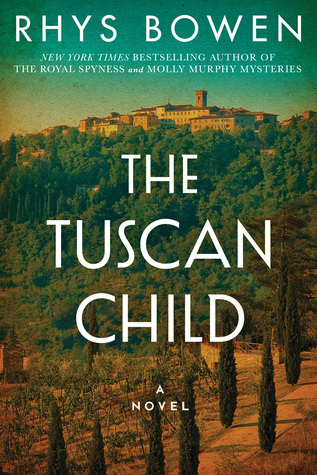
The Tuscan Child is a book that makes you hungry for Italy, especially its food. Rhys Bowen’s story alternates between two different time periods: 1944 and 1973.
The former recounts British pilot Hugo Langley’s efforts to survive after parachuting from his stricken plane over German-occupied Tuscany. The latter, and bulk of the novel, picks up with his daughter, Joanna, following Hugo’s death. She discovers an unopened letter addressed to Sophia in a small Tuscan village. The letter includes a reference to their “beautiful boy.” With little else to go on, Joanna travels to Italy learn more about Sophia and the boy, who could be her brother.
The chapters involving Hugo answer some of the mystery; others are left to Joanna to solve.
Sophia discovers the wounded pilot and helps keep in him hidden in a bombed-out monastery. She’s limited by scarce resources and the inability to leave home without raising suspicion among the townspeople and Germans. Although it is only a month, Hugo and Sophia fall in love.
Joanna is unable to learn anything about Sophia and none of the old timers in the village knew anything of a wounded pilot. Still, shortly after her arrival, one man suggests he has information for Joanna. Before he’s able to share anything, he’s murdered and Joanna becomes a suspect.
Bowen has crafted a double mystery: one involving the boy and the other the murderer. In the process of unearthing secrets, Joanna is treated to meals lovingly prepared by her guest house owner.
The Tuscan Child
Four Bookmarks
Lake Union Publishing, 2018
336 pages

The Dime by Kathleen Kent combines two elements atypical to most mysteries: a lesbian protagonist in a contemporary Dallas, Texas, setting. Betty Rhyzk is a transplant from Brooklyn who moves to the Lone Star State with her partner, Jackie who wants to be nearer her supposedly-ailing mother.
Betty is a no-nonsense detective whose often-sarcastic attitude, above average height and flaming-red hair keep her on everyone’s radar. When a drug bust goes awry, Betty unwittingly becomes a target from an unlikely group for an even more improbable reason.
Betty’s an interesting, smart character. Her sexuality is a minor part of her personality. This adds another dimension of dealing with bias in a nearly all-male police department as well as some instances of close-minded Dallas residents, including most of Jackie’s relatives.
In addition to Betty and her police colleagues, is the ghost of Betty’s Uncle Benny. He’s not so much a specter as a presence in her life. His influence and wisdom is a large part of who she is. She thinks of Benny often and the voice she hears in the back of her mind is attributed to him. She isn’t crazy, she just misses him and the guidance he provided.
Severed body parts, sexism and wayward evangelism converge to threaten Betty and those in her life. An abundance of suspension of disbelief is required as Betty encounters the novel’s real villains. Kent has created a strong, female central character, but at times Betty’s portrayed as much more than a superhero.
The Dime
Three bookmarks
Mulholland Books, 2017
343 pages

Still Waters by Viveca Sten is part of the Sandhamn Murders, a Swedish series set mostly on an island near Stockholm. It’s often safe to assume that when the words murder and Sweden appear in the same sentence a dark, somber mystery is in store – the kind that makes you want to keep a light on at night. Sten’s novel breaks the mold, sort of.
Forget the gloom typically associated with Scandinavian who-dunits: Sandhamn is a coastal resort and in a part of Europe where the sun barely disappears from view.
Thomas Andreasson, a detective in Stockholm, grew up on one of the small islands of the archipelago of which Sandhamn is a part. He’s assigned to investigate what initially appears to be an accidental drowning. However, when the dead man’s cousin also turns up dead on Sandhamn, Thomas – and the reader – know this is no mere coincidence.
Along with the detective is his childhood best friend, Nora; she’s a married lawyer and mother of two young sons. The friendship is platonic, although marital issues between Nora and her husband surface. The characters are likable and engaging, but the deaths of the cousins are less compelling. Sten does little to create tension as Thomas works to solve the case. The single event designed to keep one on edge is, unfortunately, predictable.
The only real grit comes from the constant references to the sand. Nonetheless, Still Waters makes for a good summer read with no worries about locking doors or having a night-light.
Still Waters
Three-and-three-quarter Bookmarks
Amazon Crossing, 2008
434 pages

Swedish author Lars Kepler is actually the husband and wife team of Alexandra and Alexander Ahndoril. It’s complicated. Nonetheless, Kepler’s The Hypnotist is a 500-page avalanche of a mystery. It quickly builds momentum from one dark crime to another only slowing its pace in the final pages.
The novel spans two weeks just before Christmas. Readers come to know and appreciate detective Joona Linna’s attention to detail and unwavering confidence in his ability to solve criminal cases. Dr. Eric Maria Bark, his wife, Simone, their son, Benjamin, are the good guys with Joona and a few others.
The short chapters, each identified by day and time, enhance the tempo. The story flows effortlessly from the first crime involving the murder of three family members; the seeming lone survivor is the son found at the scene covered in blood with life-threatening injuries Despite a promise made years earlier in which he vowed to never again use hypnosis on a patient, Eric is convinced it is the only way to help the injured boy.
Meanwhile, Benjamin is kidnapped and Eric must look to his past to find a connection.
Eric and Simone are flawed characters, which only enhances the novel’s appeal. Who wants to read about the perfect couple or family? Benjamin’s serious medical condition heightens the tension the longer he is held captive.
The prospect of reading a 500-page book may be daunting, but once started it’s difficult to put down. The lure of multiple mysteries and their resolutions is thrilling.
The Hypnotist
Four Bookmarks
Picador, 2009
503 pages
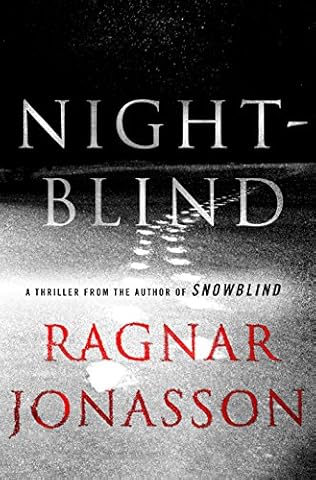
Once again, Ragnar Jonasson kept me in suspense throughout Nightblind. It picks up five years after Snowblind, the first in the Ari Thor Arason series set in a small town in northern Iceland.
Ari Thor’s new commander has just been murdered and Tomas, his old chief, is called in to investigate. Ari Thor was off duty thanks to being home sick. Part of the thrill is his feeling that had he been on duty, he would have been the victim.
Tomas has relocated to Reykjavik and doesn’t appear to mind being called back to his former stomping grounds. It’s apparent that Ari Thor is pleased to have his old boss around.
Of course, there’s more than just the murder to investigate. A new mayor, his assistant and an alleged drug ring in town arouse Ari Thor’s curiosity. Interspersed among the chapters focusing on the murder are excerpts from a journal written by an unnamed young man in a psychiatric ward. The reason for his presence there is only alluded to and never made entirely clear. It’s a tandem story: both mysteries with only the insinuation of a common thread.
Although Ari Thor is not officially part of the investigation since he’s a member of the local police, he still manages to keep busy following leads and trying to fit pieces together. Meanwhile, another murder and an uneasy feeling about the new mayor make for a fast-paced narrative.
Deceit, family secrets and small-town politics all figure into this engaging, satisfying mystery.
Nighblind
Four-and-half Bookmarks
Minotaur Books, 2015
206 pages
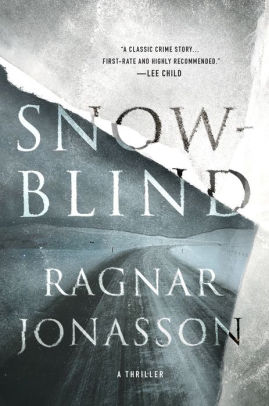
I get on book kicks and my latest has been mysteries; they’re my reading guilty pleasure. It’s especially satisfying to come across something as well-written and intriguing as Snow Blind by Ragnar Jonasson.
Set in a small town in northern Iceland, Jonasson’s novel is dark –thanks to the limited hours of daylight so close to the Arctic Circle – and is filled with intelligent characters with plenty of positive traits and foibles – like most of us.
Ari Thor is in the process of completing his exams at the Reykjavik police academy when he’s offered a job in a small, but once-thriving fishing community on the other side of the country. Without consulting his live-in girlfriend, he accepts the position and leaves her behind.
What he initially encounters is the difficulty of fitting in where most of the residents have lived, if not all at least most, of their lives. He’s an outsider. He’s repeatedly told by his captain “Nothing ever happens here.”
The narrative is told in two different parts: one beginning in spring 2008 and ending in January 2009; the other, set off in separate chapters and in italics, describing a murder. The reader knows the two will intersect, but the question is not just when but how. Jonasson deftly teases curiosity while leaving very few clues along the way.
In the place where nothing happens, Ari Thor deals first with an accidental death and then the brutal beating of a woman. Yet, these are only part of the plot.
Snow Blind
Four-and-a-half Bookmarks
Minotaur Books, 2010
302 pages

A friend has talked about Louise Penny whodunits for years. I finally decided to check out the appeal for myself. The real mystery is what took me so long?
Using humor, a strong sense of place and an exceptionally-likeable main character in the form of Inspector Armand Gamache, Penny has a formula for success. In Still Life, her first foray into the genre, Gamache is brought in from Montreal to investigate the murder of a well-liked member of the small community of Three Pines.
There is an abundance of rcharacters for such a small town, which is actually more of a village. The only one I found extraneous was Agent Yvette Nichol, who is part of Garmache’s team. She’s new to investigation and it’s clear the inspector hopes to serve as her mentor. Through a series of misunderstandings and her own stubborn nature, Nichol falls short of everyone’s expectations – including her own.
The murder and subsequent efforts to solve it are intriguing. The victim, Jane Neal, is offed early (as in the first few sentences), yet Penny imbues a strong sense of amiability in her. Neal is later seen through the eyes of her friends, so even though she is not a “living” character, she remains a prominent one throughout the novel.
The pool of possible suspects is large with plenty of nuance and depth. Of course, it’s Gamache whose intelligence, sensitivity and humor are enough to make me want to read more about him and the investigations he leads.
Still Life
Four Bookmarks
Louise Penny
St. Martin’s Paperbacks, 2005
293 pages

Coming of age can be a mystery, and Karen Brown has combined the two genres in The Longings of Wayward Girls.
The story begins with a 1974 news clipping about the abduction of a young girl, Laura Loomis, and moves back and forth between 1979 and the early 2000s. Laura remains a mystery throughout, while other secrets surface its place. The narrative instead focuses on Sadie Watkins as a creative, energetic young teenager and later as a married mother of two. It hardly seems possible that the two characters are the same; the adult Sadie lacks imagination. That is, until Ray Filey returns to town.
Set in a rural New England community, Brown’s descriptions of the landscape and close-knit neighborhood are intriguing and easy to visualize. The novel is also evocative of a time when parents thought nothing of letting their children roam nearby woods and streets. Or, when parents (in this case, mostly mothers) chain-smoked and drank their way through summer afternoons and evenings.
Sadie teeters on the edge of being a mean girl with childhood friend, Betty, following her lead. Ray is a few years older than Sadie. As a girl she was aware of his presence, although he was never part of her circle of friends. His interest in her as a woman is intriguing, but Sadie’s response to his appearance doesn’t entirely make sense, nor do her actions. However, Brown’s merging of the two themes does offersenough interest to see the novel to its conclusion.
The Longings of Wayward Girls
Three-and-a-half Bookmarks
Washington Square Press, 2013
337 pages

There’s a lot of hype surrounding Paula Hawkins’ The Girl on the Train and I’m not quite sure why. Words like thrilling and unpredictable are used to describe it. I thought it was just OK; I finished it, but its grip was weak. Perhaps if I had cared more about the characters I’d have been more invested in the outcome.
The story is told from the viewpoints of Rachel, Megan and Anna. Rachel’s is the primary version conveyed. This title character’s life is dismal. She’s recently divorced and is an alcoholic. It’s no surprise these elements lead to a series of bad choices. It’s from Rachel’s vantage point on the daily commuter train that she imagines an idyllic life for the couple she names Jess and Jason. Then she sees something, or thinks she does.
Interspersed with Rachel’s account, thrown into question because of her drinking and poor emotional state, is Megan’s. She’s a tougher personality and cheats on her husband, Scott. When she goes missing, he’s the prime suspect.
Anna is married to Tom, who just happens to be Rachel’s ex. Although Anna is now living the life Rachel once had, she’s disdainful of Rachel. Anna and Tom live a few doors down from Megan and Scott.
The voices of the three women are distinct only by the experiences they share. Megan is definitely the most mysterious. Rachel’s self-pity and lack of self-control, while vividly described, make her unreliable and pathetic. In this regard, Hawkins’s writing is successful.
The Girl on the Train
Three Bookmarks
Riverhead Books, 2015
323 pages


 The Blue Page Special