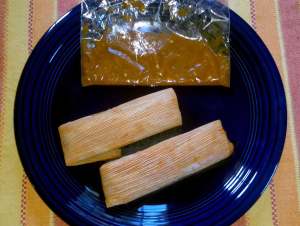
Having a tamale person is like having a good mechanic – something everyone needs, but
doesn’t always find. In the case of Olga & Sons Tamales, they found me. This is a mom and
pop –oops, hijos — operation; Olga makes tamales in her kitchen and her sons sell them
in offices and at farmer’s markets around Colorado Springs.
Olga’s son Omar has the route that includes the light industrial area where I go for my
Spanish class once a week. Usually, the available choices are pollo or queso. The shredded
chicken tamales have an appealing but unusual essence thanks to a green sauce made with basil.
When combined with the masa (dough made of ground corn meal and lard, yep lard) spread
inside the corn husk wrapper, the result is a subtle fiesta of flavors. The cheese variety
is filled with mozzarella wrapped around a thin sliver of jalapeno. It’s a small piece, so
more zip would be welcome.
Occasionally, the selection includes carne. Recently, there were two meats: shredded beef
and ground beef with jalapeno. I opted for the former. The meat was stewed in a red chile
sauce making it tender and savory. The masa was seasoned with a bit of the sauce for a
thoroughly flavorful tamale. The kicker came in a baggie of runny, but potent, eye-watering
salsa to pour on top.
Some tamale makers have a tendency to bulk up on the masa and skimp on the filling, but
Omar’s mom has just the right balance.
Tamales are $10 a dozen.
Three-and-a-half Plates
(Let me know if you want the phone number for Olga & Sons so you can place an order.)
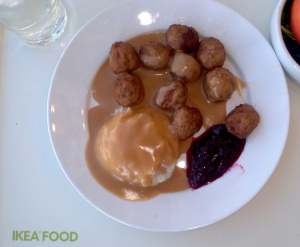 Shopping and lunch go together like peanut butter and jelly,
or soup and salad, or burgers and fries. Although Swedish
meatballs and IKEA are an appropriate duo, they have neither
the right ring nor the compelling taste of those other
lunch-food buddies.
That doesn’t stop shoppers from standing in line to
order – cafeteria-style – a plate of meatballs and mashed
potatoes smeared with what IKEA calls a cream sauce; most
would consider it gravy. Thank goodness for the dollop of
lingonberries for color and flavor. Of course, there are
other menu items: baby back ribs, spinach crepes, Caesar
salad and spaghetti with meatballs. I suspect, though, they’re the same meatballs covered with a
tomato-based sauce rather than the brown goo.
The beige, walnut-shaped meatballs are dense while the potatoes are creamy; however, the true star
of the plate is the cranberry-like lingonberry sauce. It’s sweet and tangy, the perfect foil to the
otherwise bland meatballs. It’s served as relish, but can also be used for pancakes, sandwiches
and other meats.
The price is alright at $4.99. If you forgo the accompanying undistinguished salad and beverage it’s
two bucks less. What the IKEA restaurant has going for it, of course, is location: it’s inside the
store. Based on the lines, shoppers do work up an appetite wandering through the maze of displays in
the upscale warehouse. Next time, though, I’ll go straight for dessert and grab the Chocolate Overload Cake,
because it just has to be better than the meatballs.
Two plates
My interest in crime fiction evolved from a casual guilty pleasure to an outright passion thanks to
Stieg Larsson’s Millennium Trilogy. Unfortunately, there were only three books, so the quest began
for other Swedish titles. A few surfaced, but once my search expanded to other parts of Scandinavia,
the result was a huge score thanks to Jo Nesbo’s The Snowman. I owe my new-found addiction to Scandinavian
crime fiction to the late Larsson, but Nesbo’s writing is what’s making me look behind doors before going
to sleep at night.
The terror he creates in The Snowman is palpable. This Norwegian who-dun-it boasts intelligent characters, a
rapid page-turning plot and vivid, frightening descriptions of a serial killer’s handiwork. Yet Nesbo adeptly
incorporates humor and compassion.
Nesbo offers a disheveled, self-loathing anti-hero, Harry Hole, versus “The Snowman” in a slalom course of twists
and turns. The Snowman targets married women who’ve had affairs and borne the children of those relationships.
The murders always take place during the first snowfall of the season. This along with a snowman and no trace of
the actual crime are hallmarks of the murderer. The quest to find the killer is augmented with numerous characters,
none of whom are superfluous to the story – although a few may seem to be at times. Nesbo’s Harry Hole is flawed
in the way of Columbo, and a would-be misogynist in the tradition of Sherlock Holmes.
Nesbo has eight Harry Holes thrillers on bookshelves. The Snowman is fourth in the series.
400 pages
Knopf 2011

Four Bookmarks
In The Social Animal, David Brooks blends research with fiction to create an
aggregate life situation. The result is a mostly-engaging look at not just how
people live successful lives, but why. The problem is that the book is about 100 pages too long.
Of the 406 pages devoted to the scrutiny to the scrutiny of accomplishment, notes
account for 25. Brooks an op-ed writer for The New York Times, cites
everything from the classics to Wired magazine and everything –
believe me, everything – in between. Harold and Erica are Brooks’s guinea pigs
to which the social and scientific studies are applied. Consequently, the range
of topics includes education, romance, parenting, business, politics and
general lifestyle. In fact, the chapters are a chronological life story.
Starting with dating rituals, Brooks introduces the courtship of Harold’s parents (who
disappear after Harold’s adolescence). References to phemerones and
intellectual capability put a damper on any semblance of romance. Yet, as
Brooks notes, hidden beneath the scientific and cultural references is a
relationship waiting to emerge. Although the book starts with Harold’s parents,
the focus is on Harold then Erica as individuals, and, finally, them as a
couple.
Brooks’s approach to why people are motivated to succeed is intriguing. Because Harold and Erica are,
essentially fictional characters, the author is able to get inside their heads and
remain an objective bystander as he cites the studies and surveys explaining
their behavior. Thus, the most appealing aspect of the composite couple is that
there is something of everyone in these two characters.
Random House 2011
448 pages

3-1/2 Bookmarks



 The Blue Page Special