Archive for the ‘Books’ Category

In The Sunlit Night by Rebecca Dinerstein, the never-setting sun has such a significant role that it’s practically a character alongside almost-18-year-old Yasha and 21-year-old Frances. These are not star-crossed lovers; in fact, they’re quite lucky. Their story begins with the two in New York City. They don’t meet until circumstances put them on a small island in the Norwegian Sea near the Arctic Circle.
Initially, the chapters alternate between Frances and Yasha’s voices. Eventually, they merge into one. Dinerstein evokes a strong sense of place in the isolated far north as the two find each other. As with any love story, there are obstacles including dysfunctional families, complicated backstories and quirky sub-characters.
Frances leaves Manhattan for a Norwegian artist’s community. Yasha arrives soon after to fulfill his father’s dream. Perhaps the most engaging part of the narrative is the life Yasha and his father have running their bakery in Brighton Beach. This is something they’ve done since immigrating from Russia 10 years earlier. Yasha’s mother, Olyana, was to join them; years pass and the family is never reunited.
Still, Olyana is among those in the quirky classification (it’s actually a long list). She’s an important part of the story, not only because she’s the mother of a protagonist but because of her lengthy absence as such. Meanwhile, Frances has family issues of her own. Among other things, her eccentric parents are separating.
Dinerstein injects humor with captivating prose to create something more than a tale of young love.
The Sunlit Night
Not-quite-four Bookmarks
Bloomsbury, 2015
249 pages

Although it’s only been in the hands of the general public for little more than a month, the reviews for Harper Lee’s Go Set a Watchman have been mixed. Now I see why, it’s difficult to know whether this is because long-standing images have been shattered, if the story is less engaging or if the writing simply isn’t as strong as To Kill a Mockingbird: an integral part of American culture since its publication 55 years ago. The 1961 Pulitzer Prize winning novel is still taught in classrooms, and Gregory Peck’s portrayal of Atticus Finch in the movie adaptation remains iconic.
Jean Louise Finch, aka Scout, returns to Maycomb, Ala., from New York City. Atticus is ailing and many of the familiar characters from Mockingbird reappear to remind Scout, and readers, how some things change and some never do.
Scout’s memories are mixed with her current day events as she begins to see her hometown and, especially, her father in a new, unflattering light.
My take is that the story, albeit worth reading, is less engrossing due to lackluster prose. In fact, I found it easy to put down and had to remind myself of its imminent library due date.
Racism and human imperfection are looming themes. Given what’s happening across the country, the former continues needing to be more openly addressed. Perhaps it takes seeing Atticus Finch as a racist, despite his efforts at justification, for us to see the deep-rooted problem. As for the latter, that’s something we just have to accept.
Go Set a Watchman
Three-and-three-quarter-bookmarks
Harper-Collins, 2015
278 pages

Our youngest son recently graduated from Knox College; I’d been vaguely aware of it years before because of Sixteen Pleasures, a book I enjoyed for its setting (Florence, Italy) and strong female narrator. This same son gave me an autographed copy of Hellenga’s most recent work, The Confessions of Frances Godwin, which had been languishing on my nightstand far too long.
The setting is mostly Galesburg, Ill., with Knox figuring prominently; other locales include Milwaukee, Rome and Verona. With Frances, Hellenga introduces another female narrator. I admit I’m intrigued by his ability to create such true female voices.
It’s 2006 and Frances has retired from a career as a high school Latin teacher. At first, the novel appears to be a vehicle for her to reflect on her past because she soon recounts how she met her husband, Paul, a Shakespeare scholar from whom she took classes (at Knox). She tells of their affair, their eventual marriage and life together in Galesburg. They have a daughter, Stella, who as a grown woman appears to make a series of bad choices when it comes to men.
The story is occasionally heavy handed. Consider, Frances’ name: Godwin. Several times, she converses with God, who, among other things, entreats her to go to confession. By this point it’s clear that she does have more than a few things to own up to.
Love and guilt are not unusual companions; for Frances, they’re a large part of who she is.
The Confessions of Frances Godwin
Four Bookmarks
Bloomsbury, 2014
305 pages

Kent Haruf’s Plainsong is among my favorite books. I haven’t read any of his other works for fear, I think, I’d be disappointed. After reading Benediction, one of the author’s last works before his death in late 2014, I realize I had no cause for worry.
Set in the (fictional) rural town of Holt, Colo., this is an agreeably slow-moving, intimate portrait of the bonds between families and community. The first paragraph sets the tone: Dad Lewis, a long-time resident of Holt and owner of the hardware store, receives the news that he’s dying of cancer. In his dying days, his grown daughter returns home to help; longtime friends and neighbors drop in to visit; and a few flashbacks surface to help tell the story of an imperfect man, beloved by his wife and daughter, estranged from his son, who tried to do his best.
The beauty of Haruf’s writing is that he provides just enough detail to hold the reader’s attention without overwhelming the imagination. That is, situations appear with gaps of information like potholes on a dirt road. Eventually, they get filled.
Interactions with those Dad has known for years intersect with a few new residents to Holt: the preacher and his family, including an angry teenage son and an even angrier wife. The young granddaughter of the woman across the street is another significant character. It would be heavy handed to feature a new-born, but Haruf’s circle of life is gripping, lyrical and not at all mawkish.
Benediction
Four Bookmarks
Knopf, 2013
258 pages

Maggie Rider’s self-deprecating humor and sharp intelligence as narrator of The Virus by Janelle Diller elevate this sky-is-falling novel about the increasing threat of diminishing privacy.
Maggie works for a tech company that requires a lot of travel. Her husband, Eddy, is a freelance web designer. He’s actually more tech savvy than his wife, which evolves as a significant characteristic.
The novel begins with a smallpox outbreak in Colorado. Maggie and Eddy live in Colorado Springs; the story settings also include the Bay Area and Nebraska. At first, vaccinations are scarce. The rush to meet demand is fueled by government regulations requiring all who travel, work in the health industry and /or attend school to receive inoculations. Thanks to her job, Maggie is among the first to be vaccinated; something she willingly, almost gratefully, accepts. Suddenly, the immunizations are plentiful. Meanwhile, Eddy isn’t buying. His skeptical nature makes him leery of the outbreak in general and the vaccination itself.
Thus begins a race-against-time as more deadlines surface requiring all U.S. residents to be inoculated within a short time span.
Part thriller, part subtle love story (Maggie and Eddy are happily married) and a lot of intrigue make Diller’s story engaging. There’s an element of Big Brother along with the vulnerability that comes from being active on social media.
In general, the novel maintains a fast-paced tempo. Although not necessarily new, Diller raises important issues for consideration regarding the government and the ease with which we all share information about ourselves.
The Virus
Four Bookmarks
WorldTrek Publishing, 2015
359 pages

FUDS: A Complete Encyclofoodia by Alfredo & Antonio Mizretti is neither for the weak of stomach nor the humorless. Let’s start with the fact it’s actually written by Kelly Hudson, Dan Klein and Arthur Meyer. This trio has taken the mystique and the occasional arrogance often associated with haute cuisine out of the kitchen and onto the equivalent of a culinary comedy stage.
The authors are irreverent, silly and occasionally gross in the manner of pre-adolescents. They’re also fun and creative. Although the book is “Dedicated to Food,” it could easily be earmarked for those who love food and don’t mind heavy-handed metaphorical flavoring.
The Mizretti personas assumed by the true authors are twin brothers who grew up in Denver eating Mama Mizretti’s homemade specialties, which, according to Alfredo and Antonio “was awful.” Eventually, they open a restaurant, FUDS, in Brooklyn with only three items on the menu.
The content is ridiculous, but for anyone interested in food, and not so full of him or herself that a good laugh can’t be appreciated, it’s entertaining.
The book is comprised of several chapters related to the Mizrettis’ background, food basics a la FUDS, satirical descriptions of kitchen tools and several chapters of recipes – the kind made up at summer camp or on a college campus. Some are, frankly, gross. All are absurd.
A little FUDS go a long way. Its 160 pages, of which many are illustrations, is just about the right length. Of course, it also lends itself to return reads.
FUDS: A Complete Encyclofoodia from Tickling Shrimp to Not Dying in a Restaurant
Four Bookmarks (0 plates)
Bloomsbury, 2015
160 pages

If you remember 1984 and Animal Farm from high school or college reading requirements, The Circle by Dave Eggers will sound familiar. It’s just that Eggers, who has nothing on George Orwell, offers a contemporary setting in a Googlesque-complex in Northern California. The concepts of Big Brother and following the pack are nearly the same.
Mae, short for Maybelline, has just been hired by the prestigious organization thanks to Annie, beloved by her work colleagues and Mae’s former college roommate. Landing a position not only gets Mae out of a dead-end job, it provides an opportunity to be on the cutting edge of social change.
The Circle, the company’s name, thrives on numbers in the form of clicks, responses to surveys, extracurricular activities and tracking followers that makes Twitter and Facebook look like make-believe social media.
Mae’s initial job is in customer service. Her employers, from lower management to the triumvirate who founded the Circle, manipulate through passive-aggression and let the numbers speak for themselves: the higher the percentage or score, the better – no matter at what cost.
The trouble is that Mae is not all that likeable. Annie is far more interesting, but it turns out that her role is not much than that of a door opener. A former boyfriend, Mercer, provides a dissenting voice, but he’s one-dimensional with little chance of being heard.
Privacy, transparency, friendship and trust are all addressed here. While these are important themes, the characters are not strong enough to bear their weight.
The Circle
Three Bookmarks
Alfred A. Knopf, 2013
491 pages

There’s a lot of hype surrounding Paula Hawkins’ The Girl on the Train and I’m not quite sure why. Words like thrilling and unpredictable are used to describe it. I thought it was just OK; I finished it, but its grip was weak. Perhaps if I had cared more about the characters I’d have been more invested in the outcome.
The story is told from the viewpoints of Rachel, Megan and Anna. Rachel’s is the primary version conveyed. This title character’s life is dismal. She’s recently divorced and is an alcoholic. It’s no surprise these elements lead to a series of bad choices. It’s from Rachel’s vantage point on the daily commuter train that she imagines an idyllic life for the couple she names Jess and Jason. Then she sees something, or thinks she does.
Interspersed with Rachel’s account, thrown into question because of her drinking and poor emotional state, is Megan’s. She’s a tougher personality and cheats on her husband, Scott. When she goes missing, he’s the prime suspect.
Anna is married to Tom, who just happens to be Rachel’s ex. Although Anna is now living the life Rachel once had, she’s disdainful of Rachel. Anna and Tom live a few doors down from Megan and Scott.
The voices of the three women are distinct only by the experiences they share. Megan is definitely the most mysterious. Rachel’s self-pity and lack of self-control, while vividly described, make her unreliable and pathetic. In this regard, Hawkins’s writing is successful.
The Girl on the Train
Three Bookmarks
Riverhead Books, 2015
323 pages
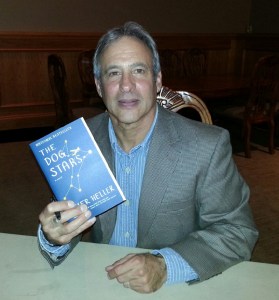
A few weeks ago I reviewed Peter Heller’s The Painter. That was shortly after Station Eleven. While I enjoyed both books, I thought I’d wait before starting another work by Heller, and I certainly had no intention of being drawn into another novel about a post-apocalyptic world. Then I heard Heller talk. He shared his experiences as a freelance writer and told how he came to write fiction. He read some from The Painter and The Dog Stars. I really had no good excuse not to read the latter.

It takes a little time adjusting to Heller’s stream of consciousness style with no quotation marks and single word sentences. It’s a terse yet fitting approach for Hig, a pilot who’s survived a flu pandemic, to tell his story. He lives with his dog, Jasper, and Bangley, a weapons-hoarder-ask-questions-later neighbor on an abandoned airfield northeast of Denver.
They must constantly be on alert from human predators. Hig is the least vigilant of the trio. What’s left of the world is not a friendly place. Yet, despite his best efforts, given the losses he’s faced, Hig is an optimist. A chance static-riddled radio transmission three years earlier from western Colorado has made him restless. Against Bangley’s better judgment, Hig needs to know what and, more importantly, who may still be out there.
His discovery is beautiful and gut-wrenching. Like Hig, the reader comes to appreciate Bangley. Although it hardly seems possible, as the story progresses Hig’s sensitivity and humanity gain greater significance.
The Dog Stars
Four Bookmarks
Alfred A. Knopf, 2012
320 pages
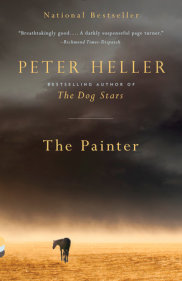
The Painter by Peter Heller is a story of redemption. It’s also part thriller. The who-dunnit isn’t in question, but the underlying reasons and the chase(s) help make it a page turner.
Jim Stegner is a painter with a temper, a broken heart and a soft spot for children and animals. His passions are his art and fishing, both of which usually bring him a sense of peace. Set in southwestern Colorado and northern New Mexico, Heller’s writing renders vivid landscapes with careful, albeit, broad strokes. The images accurately evoke the beauty of the Rocky Mountains.
An encounter with a poacher leads Jim from one bad decision to another. At times it’s easy to think the best solution is for Jim’s mistakes to catch up with him. They come close, very close. The problem is there several other characters with whom the reader becomes invested, including – perhaps especially – Sophia, the young model with whom Jim befriends. Irmina, his long-time friend/occasional lover, is also likeable.
There’s more to Jim than his canvases and waders. His past is slowly revealed providing possible explanations for his rash behaviors. The pain he carries regarding his daughter is palpable. So is the disdain he has for law enforcement, art collectors and others. And, he’s a man capable of murder. Ironically, though his actions are crimes and can’t be condoned, they’re almost justified.
Despite Jim’s frustrating behavior, the moments of joy and a fair amount of intrigue make Heller’s novel an enjoyable read.
The Painter
Four Bookmarks
Vintage Contemporaries, 2014
363 pages


 The Blue Page Special