Archive for the ‘news’ Tag
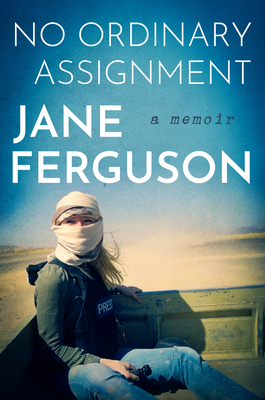
No Ordinary Assignment is Jane Ferguson’s memoir about her career as a war correspondent, primarily in the Middle East.
Ferguson grew up in Northern Ireland where conflict was a constant, so it’s little surprise that later she often put herself on the front lines that led, for example, to Arab Spring, the fall of Kabul and much more. This was initially as a freelance journalist and eventually on staff of Al Jazeera English and PBS.
The work meant leaving her home base, which through the years included Sana, Yemen; Dubai; Kabul; New York City; and others on a moment’s notice. The result tested relationships but allowed Ferguson to prove her abilities at getting the story.
Her experiences were fraught with danger; she was often the first reporter on the scene and usually the only female. She frequently embedded with military forces and was smuggled into several war zones.
Ferguson shares her love of Kabul and the heartbreak of its downfall, not just for herself but the Afghans who were forced to leave – she was among the last Western journalists to evacuate Afghanistan.
At times self-deprecating, Ferguson’s account of becoming an award-winning journalist is compelling, if, albeit, at times repetitive. Not to denigrate her exploits, but it’s difficult to keep track of so many close calls in the face of peril.
It’s evident she sacrificed a lot to pursue her goals. Certainly, she warrants admiration for her tenacity and desire to inform the public about world events that have impactful consequences.
No Ordinary Assignment
Three-and-a-half bookmarks
Mariner Books, 2023
320 pages

Broadcast journalist Soledad O’Brien’s voice is honest, moving and completely engaging in her memoir, The Next Big Story. I’d expected nothing less than an accurate and fair narrative. It’s also a celebration of opportunities, not just for her as the daughter of a mixed-race marriage, but everyone willing to work hard for the prize. O’Brien acknowledges that for many the ability to make that reach is often riddled with obstacles.
Thanks to the values instilled by her family, O’Brien admits she wasn’t always aware of any impediments. Yes, she is bi-racial, and yes, she grew up in a predominantly white community, but she was never beaten down. This was largely due to her drive to keep up with family expectations.
Much of O’Brien’s story focuses on her journey to become a respected reporter. It wasn’t something she anticipated, but once she discovered journalism she was hooked. She shares her early days of trying, often unsuccessfully, to get meaningful stories on the air. Through hard work, strong friendships and tenacity, she worked her way to anchor weekend news programs locally then nationally. Along the way she married, had children, but continued her quest to share other people’s stories. CNN’s Black in America and Latino in America documentaries are hers, both award-winning works, although she never mentions the accolades.
Most riveting are O’Brien’s accounts of covering such catastrophic events as the tsunami in Indonesia, Hurricane Katrina and the earthquake in Haiti. These are all familiar, but O’Brien’s insider retrospective evokes emotion and suspense.
The Next Big Story
Four Bookmarks
Celebra Books, 2010
321 pages
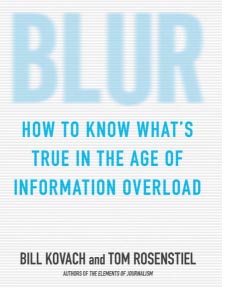
A journalism background isn’t necessary to appreciate the points made by Bill Kovach and Tom Rosenstiel in their book entitled Blur: How to Know What’s True in the Age of Information Overload. Anyone who reads or listens to the news should find this interesting. The authors examine the speed at which information, specifically news, reaches consumers/viewers/readers. Demand for attention from various media is overwhelming in its volume and content.
Plus, since news is disseminated via multiple outlets including Twitter, blogs, newspapers, television, and Facebook — among others — it’s often difficult to know who or what to believe. Consequently, the authors say a healthy dose of skepticism is not a bad trait to possess. The pair outlines a six-step process to help sift through the excessive information to discern fair and accurate reports about the world around us. They suggest asking: “What kind of content am I encountering; Is the information complete, and if not, what is missing; Who or what are the sources, and why should I believe them; What evidence is presented, and how was it tested or vetted; What might be an alternative explanation or understanding; Am I learning what I need to?”
Media literacy is nothing original among journalism scholars, but taking it to the public is. It’s something that benefits the general population. A camera and access to the Internet are all the tools necessary to record and distribute news stories. However, just because everyone can play the game, doesn’t mean everyone plays it well, accurately or fairly.
Blur: How to Know What’s True in the Age of Information Overload
Bloomsbury, 2010
203 pages, plus notes and appendix

 The Blue Page Special