Archive for the ‘literature’ Tag

I’ve always loved to read, but there are times I just can’t bring myself to pick
up a book. Suffering overwhelming grief, experiencing mind-numbing fatigue,
and finishing an exceptionally well-written book have all, at one time or anoth-
er, contributed to a reading lull. I’ve had a bit of trouble picking up a book since
finishing The Dovekeepers. This made me think about other books that have
stopped me in my reading tracks*: Cutting for Stone, The Night Circus, A Prayer
for Owen Meany, among others, I’m sure.
Occasionally there are times I stop reading a particularly good passage just to
relish the image or writing. This happens frequently when I read Barbara King-
solver. But that’s pleasurable. I truly do savor good books. I get lost in them. I
think about them. I want characters to move into my home. Some stories I just
don’t want to end. When the especially good ones do, I sulk. I want more of the
same, not something new.
Perhaps I’ve been over-reading, a concept I’ve never really considered until now.
Is it possible to read too much? I hope not, but I am satiated from my last read,
and I’ve been reluctant to start anything new. Fortunately, this usually doesn’t
last long.
When I can’t read, no matter what the reason, I feel unmoored. The great thing
about books, though, is that I know there are others certain to stop me yet again.
I can’t wait.
*This is obviously taking that end-of-a-good-book feeling to the extreme.

Depending on perspective, the good or bad thing about historical fiction is knowing
how something will end – at least generally. Alice Hoffman’s The Dovekeepers
may have Masada in ancient Israel as its setting, but her novel about four strong,
captivating women is all new. It’s no spoiler to acknowledge that, yes, nearly every-
one dies; nonetheless, Hoffman’s characters are so vibrant and remarkable that
they make their home in our minds and hearts.
Hoffman typically combines the supernatural with the ordinary, but this is the first
time she blends these with history and religion. In her hands, the concepts are not
as incongruous as might be expected. Along with what could be perceived as a little
magic, other attributes shared by the women include survival, desire, love and relig-
ious conviction; these qualities move the fast-paced story toward its inevitable con-
clusion.
Hoffman clearly did her research. Rich with descriptive language of the harsh land,
the brutality of men, and Judaic traditions, Hoffman details the lives of the women
before and after their arrival in Masada. The four, Yael, Revka, Aziza and Shirah,
fill the pages with joy and heartache. They are of various ages, backgrounds, and
experiences; all are intelligent, sensual, even daring characters. Although each wo-
man shares her narrative, the voices are not that distinctly different.
In some ways reminiscent of The Red Tent for its portrayal of women in a Biblical
context, The Dovekeepers is a gripping representation not just about the existence
of faith but of its necessity.
The Dovekeepers
Four-and-a-half Bookmarks
Scribner, 2011
501 pages

Anne Tyler is a gifted story teller. Her characters are ordinary, and if you live in
Baltimore — her setting of choice — they could easily be your next door neighbors.
She makes the potentially banal into something sublime. Such is the case with
The Beginner’s Goodbye, a finely-threaded novel about a man, Aaron, left to
scrutinize his marriage following the death of his wife in a freak household accident.
The story’s beauty deepens as Aaron is ultimately forced to confront his relation-
ship with not only his deceased wife, Dorothy, but also with his sister, co-workers,
and others he’d rather ignore.
The beginner in the title comes from the succession of books published at Aaron’s
small, family-run publishing house. Humorously based on the Dummies’ series, the
Beginner’s books address everything from kitchen remodeling to dog training, from
wine tasting to bird watching. In a way, Tyler’s novel is about how to avoid dealing
with grief. Aaron is pathetic, and, if not for glimmers of humor, would be a completely
disagreeable protagonist due to his efforts to deflect expressions and gestures of sym-
pathy as well as support. By the way, Aaron stutters and his right side is crippled. He
has a history of impeding assistance, which he mistakes for pity. He has always kept
everyone at bay. From Aaron’s perspective, so did Dorothy. Ironically, Dorothy’s re-
appearance as an apparition helps him acknowledge this and other truths.
This is no ghost story or smoke and mirrors tale. Instead, it’s about love, loss and un-
derstanding.
Four Bookmarks
The Beginner’s Goodbye
Alfred A. Knopf, 2012
197 pages

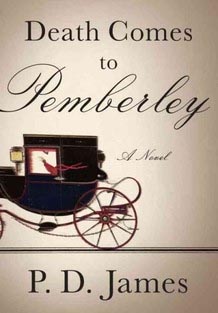
I imagine it’s entirely possible to enjoy Death Comes to Pemberley even if, heaven for-
bid, you’ve never read Pride and Prejudice; but I especially appreciate P.D. James’s latest
mystery because I do know about the Bennet and Darcy families. The novel begins six years
after Jane Austen’s Elizabeth and Darcy are married.
A few new minor characters are introduced, but James, for the most part, extends the lives
of those created by Austen in a completely believable manner: the Darcys have two young
boys; Jane and Bingley are regular visitors to Pemberley, the Darcy estate; and Wickham,
the troublemaker in the original work has a similar role, with his wife Lydia not far behind
in her ability to exasperate.
The story begins on the eve of the annual ball overseen by Elizabeth as she continues a
tradition started by Darcy’s mother. The preparations are interrupted when an uninvited,
hysterical Lydia appears believing Wickham has been shot nearby. The characters’ react-
ion to this news, subsequent discoveries, and a trial in London’s Old Bailey are sheer en-
tertainment. In James’s hands, the story is plausible. The characters react just as one
would expect of proper, early 19th century British gentry. Family obligations and public
perceptions dictate their behavior.
The numerous and recent spinoffs, including combining zombies with Pride and Prejudice,
even if only meant to introduce or reacquaint readers to Jane Austin, have never appealed
to me. However, James has created something completely original from classic literature
without diminishing appreciation for Austen’s writing.
“Death Comes to Pemberley”
Four Bookmarks
Alfred A. Knopf, 2011
291 Pages

I’m a writing tutor at a community college. It’s at once rewarding, challenging,
and, sometimes, frustrating. In a break from rhetorical analyses and summaries,
a student, with the aid of an ASL interpreter, asked for reading help. Initially
I recommended a reading tutor, but soon realized she was more interested in
books than the process.
“I don’t know how I should feel at the end of the book,” she explained.
Her face revealed she was being neither ironic nor sarcastic; she was earnest.
I was silent. What should you feel at the end: joy, relief, disappointment?
“It’s pretty subjective,” I finally answered. “So much depends on the book and
where you are in your life. Some books I don’t want to end; the good ones I think
about long after setting it down for the last time. Others make want me to read
something better where I can know the characters, revel in the language, be awed
by the images, or just enjoy the story. Sometimes after finishing an exceptional
book, I don’t even want to read anything new for a while.”
Her rapid hand movements interrupted me, “But have you read any famous books?”
The inquiry seemed sincere. “I read a lot,” I said, “including books that could be
considered famous.”
For a moment she was still before she scrunched her face, moving her lips and
her hands at the same time. “Like Harry Potter?”
“Sure, like Harry Potter,” I said. “I read those to my kids, at the end we couldn’t
wait for the next one.”
Was that it? Did she really just want to know how she should feel at the end of
Harry Potter?
We all shrugged our shoulders.
It left me wanting to read a good book, one I can’t put down. How should you feel
when you finish a book?




 The Blue Page Special